Skip to content

Prehistory & Stone Age

Overview
What is prehistoric India's key sequence?

Prehistoric India (from ~5,00,000 BCE) is reconstructed via stone tools, fossils, and rock art — no written records. Sequence: nomadic Palaeolithic hunters → transitional Mesolithic → settled Neolithic farmers → Chalcolithic copper-users → Bronze Age Harappans → Iron Age megalith-builders.

Classification of Sources
Distinguish pre-history, proto-history, and history.
  • Pre-history: Pre-script; only archaeological sources
  • Proto-history: Undeciphered script (Harappan) OR oral traditions (Vedic); Neolithic/Chalcolithic
  • History: Literate societies; written + archaeological sources
  • Sequence: Palaeolithic → Mesolithic → Neolithic → Chalcolithic → Bronze Age → Iron Age
Geological eras of prehistoric cultures?
  • Pleistocene (~2 mya–10,000 BCE): Palaeolithic cultures; Ice Age; ice covered earth
  • Holocene (10,000 BCE–present): Mesolithic + Neolithic cultures; warmer climate post Ice Age
Palaeolithic Age (~5,00,000–10,000 BCE) — Overview
Key facts about Palaeolithic Age?
  • Term coined: John Lubbock (1865) — 'Palaeo' = old, 'lithic' = stone
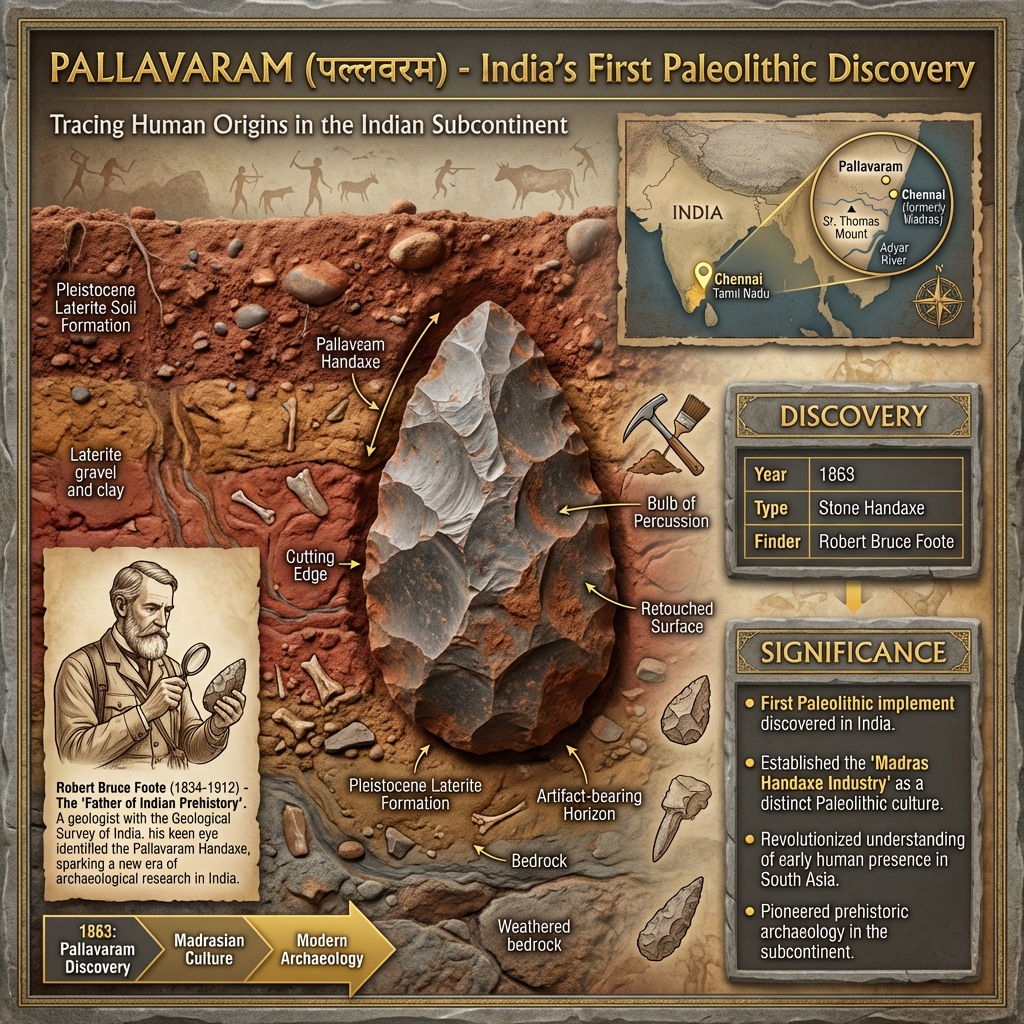
  • First Indian discovery: Robert Bruce Foote at Pallavaram (1863)
  • Era: Pleistocene period (~2 mya) — Great Ice Age
  • Economy: Hunting & food-gathering; Quartzite Man (main raw material = quartzite)
Three sub-phases of Palaeolithic?
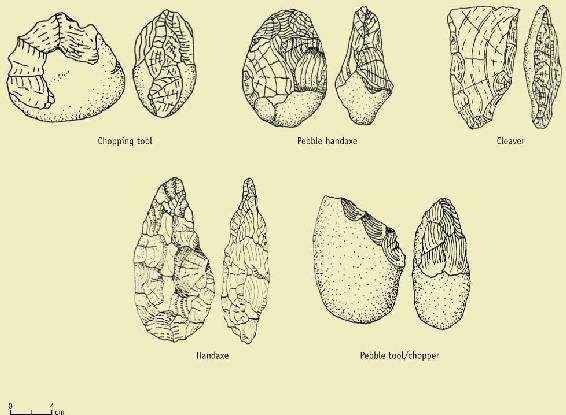
  • Lower Palaeolithic: 5,00,000–1,00,000 BCE — handaxes, cleavers, choppers (core tools)
  • Middle Palaeolithic: 1,00,000–40,000 BCE — flake tools dominant; smaller & lighter
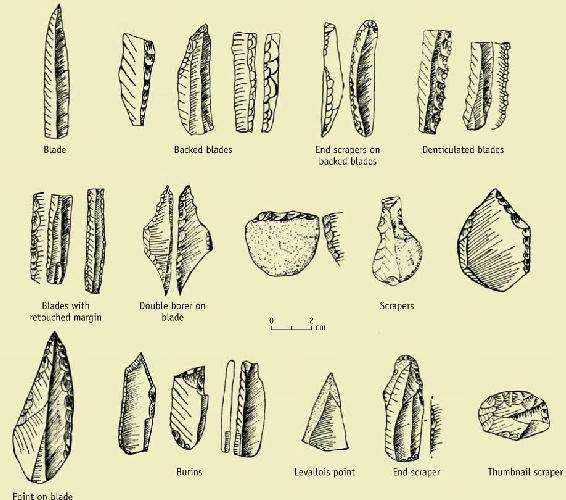
  • Upper Palaeolithic: 40,000–10,000 BCE — burins, scrapers, bone tools; Homo sapiens
Two main Palaeolithic cultures in India?
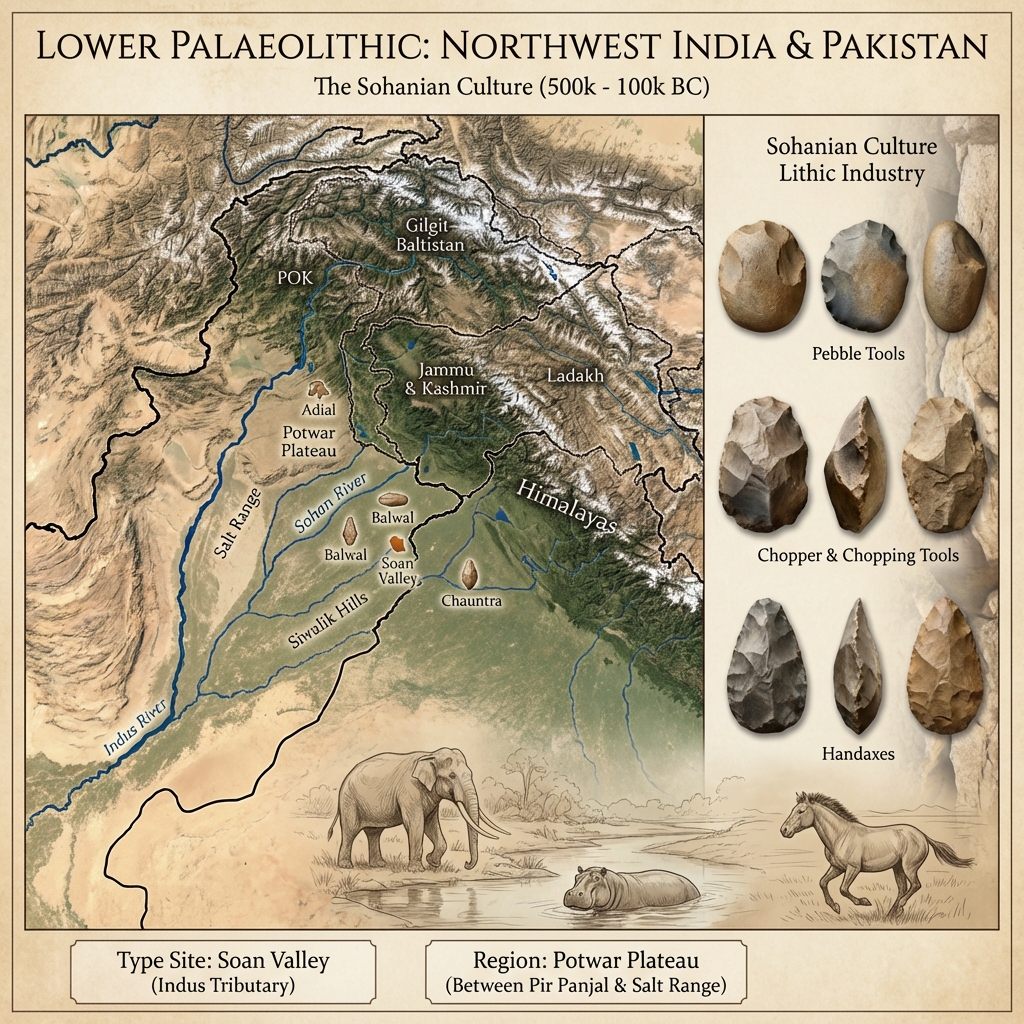
  • Sohanian Culture: Named after Sohan river (Indus tributary); NW India & Pakistan (Siwalik Hills, Soan Valley); tools = pebble choppers/chopping tools, blades
  • Acheulian / Madrasi Culture: Named after St. Acheul (France); dominant across India (absent in Western Ghats, coasts, NE India); bifacial quartzite handaxes & cleavers; first effective colonisation of subcontinent
Palaeolithic human evolution stages?
  • Homo habilis: Early tool-maker
  • Homo erectus: Mastered fire, advanced tools
  • Homo sapiens sapiens: Art, cave paintings (Upper Palaeolithic)
→ Palaeolithic Tool Types (Must Know)
What is a Handaxe?
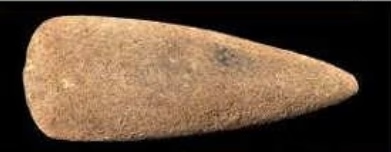
  • Handaxe: Core tool; biface (worked both sides); triangular — broad butt, pointed working end; used for cutting & digging
What is a Cleaver?
  • Cleaver: Flattish flake tool; broad straight cutting edge (biface); used for clearing & splitting tree trunks
What is a Chopper vs Chopping Tool?
  • Chopper: Unifacial (one side) — massive core tool for chopping
  • Chopping Tool: Bifacially flaked pebble/core → wavy cutting edge; sharper than chopper
What are Flake, Side Scraper, Burin?
  • Flake: Crude shape produced by applying force on stone
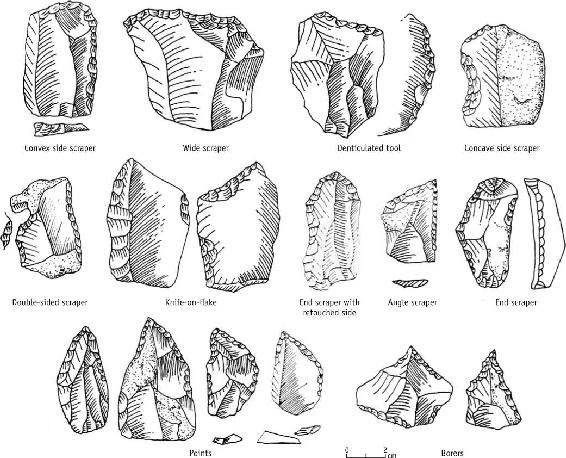
  • Side Scraper: Flake/blade with retouched border; scraped bark & animal skins
  • Burin: Small blade tool; sharp thickset edge (like screwdriver); engraved soft stones, bones, rock walls
Lower vs Middle vs Upper tool signatures?
  • Lower: Handaxes, cleavers, choppers (large core tools of quartzite)
  • Middle: Flakes & blades; fine-grained siliceous rocks (chert, jasper); Nevasan industry (peninsular India)
  • Upper: Burins, scrapers, parallel-sided blades, bone tools (only at Kurnool & Muchchatla Chintamanu Gavi, AP)
→ Lower Palaeolithic (5,00,000–1,00,000 BCE)
Key features of Lower Palaeolithic?
  • Raw material: Quartzite (mainly); limestone (Hunsgi, KA); pink granite (Lalitpur, UP); basalt (MH & Central India)
  • Bori (MH): Considered earliest Lower Palaeolithic site
  • Five paved stone floors identified at Bhimbetka (Lower Palaeolithic)
  • Factory sites: Near raw material sources; tools made in various stages of preparation
Key Lower Palaeolithic sites?
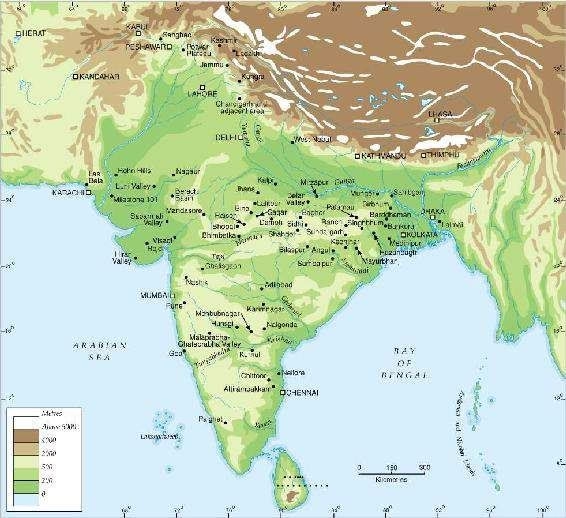
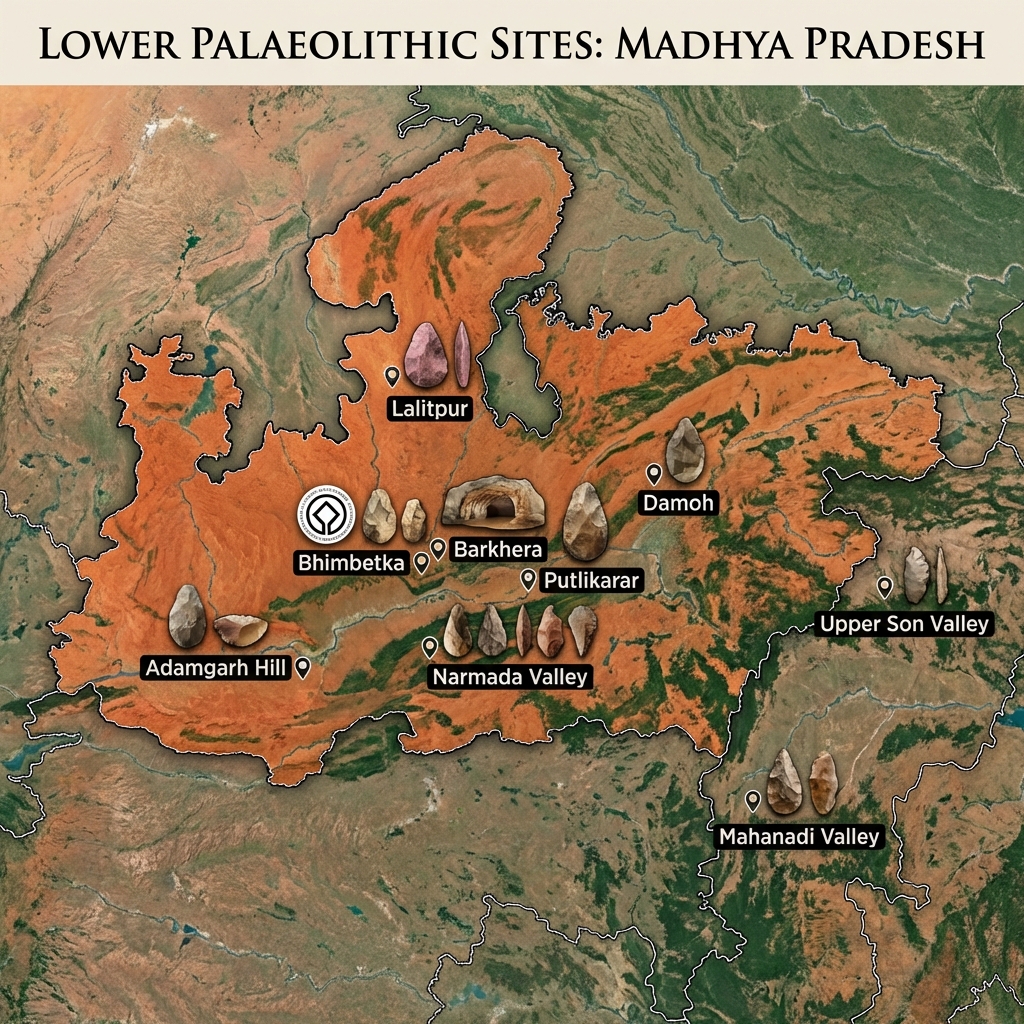
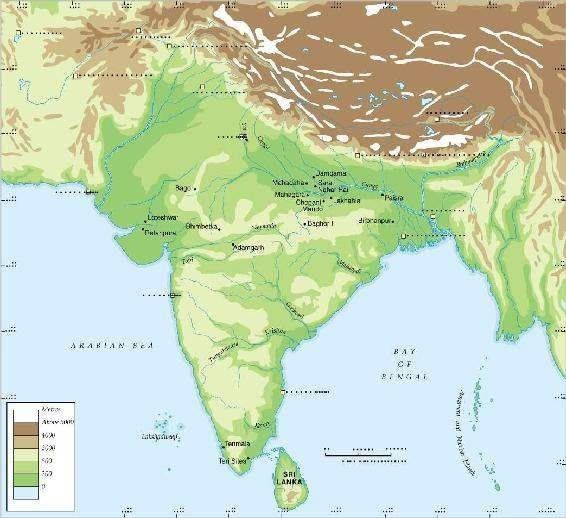
  • Bhimbetka (Raisen, MP): Hundreds of rock shelters; longest sequence Lower Pal → Historic
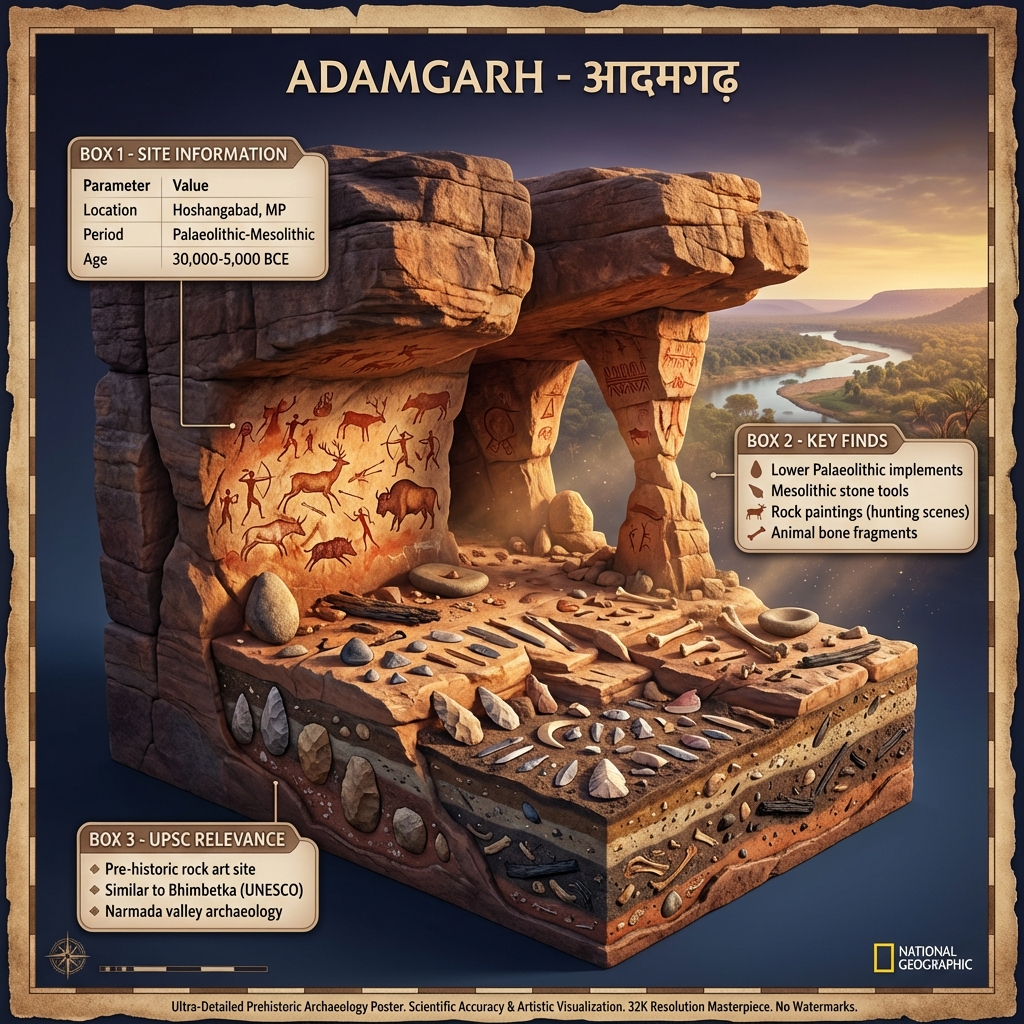
  • Adamgarh (MP): Lower & middle palaeolithic; near Hoshangabad
  • Hunsgi-Baichbal & Krishna Valley (Gulbarga, KA): Dense lower pal sites; tools in limestone, sandstone, dolerite
  • Attirampakkam (Kortallayar basin, TN): Richest Tamil Nadu site; animal footprints + Acheulian tools; horse/buffalo/nilgai fossils
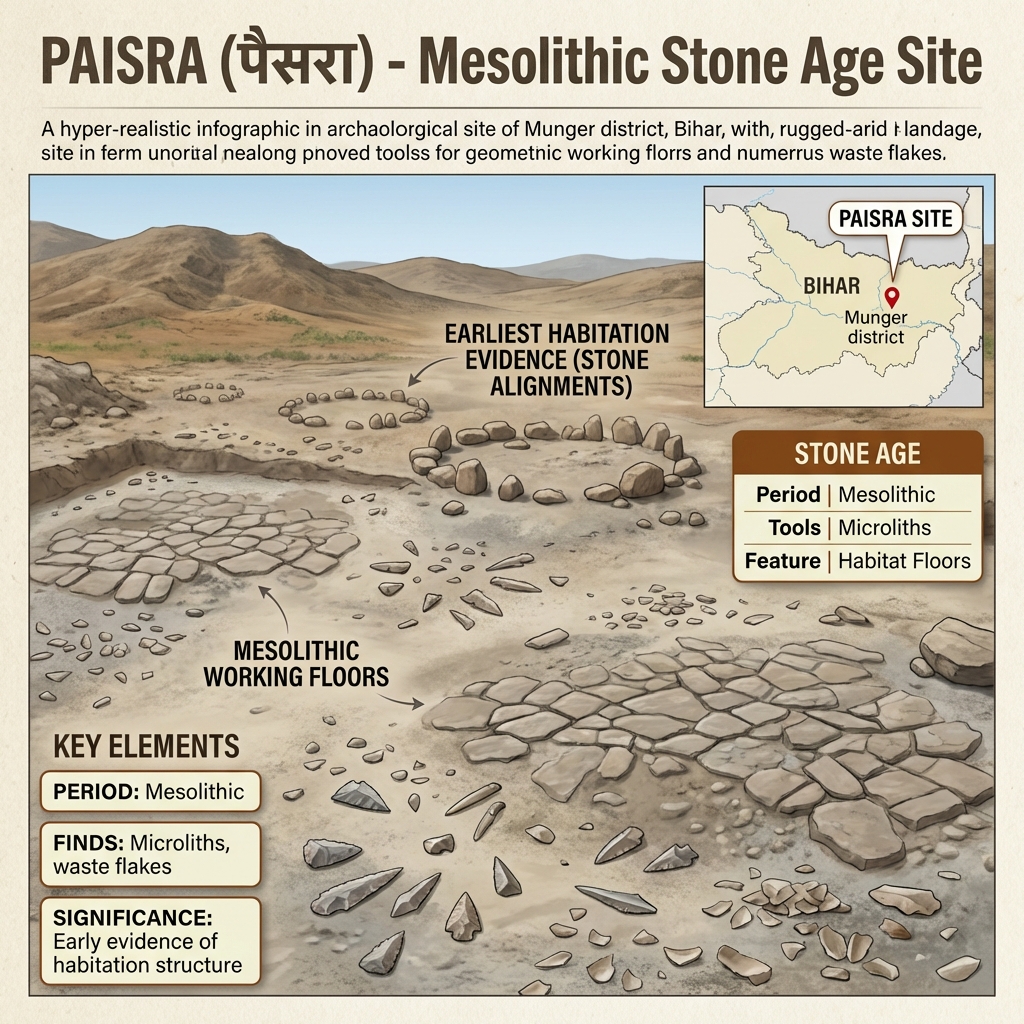
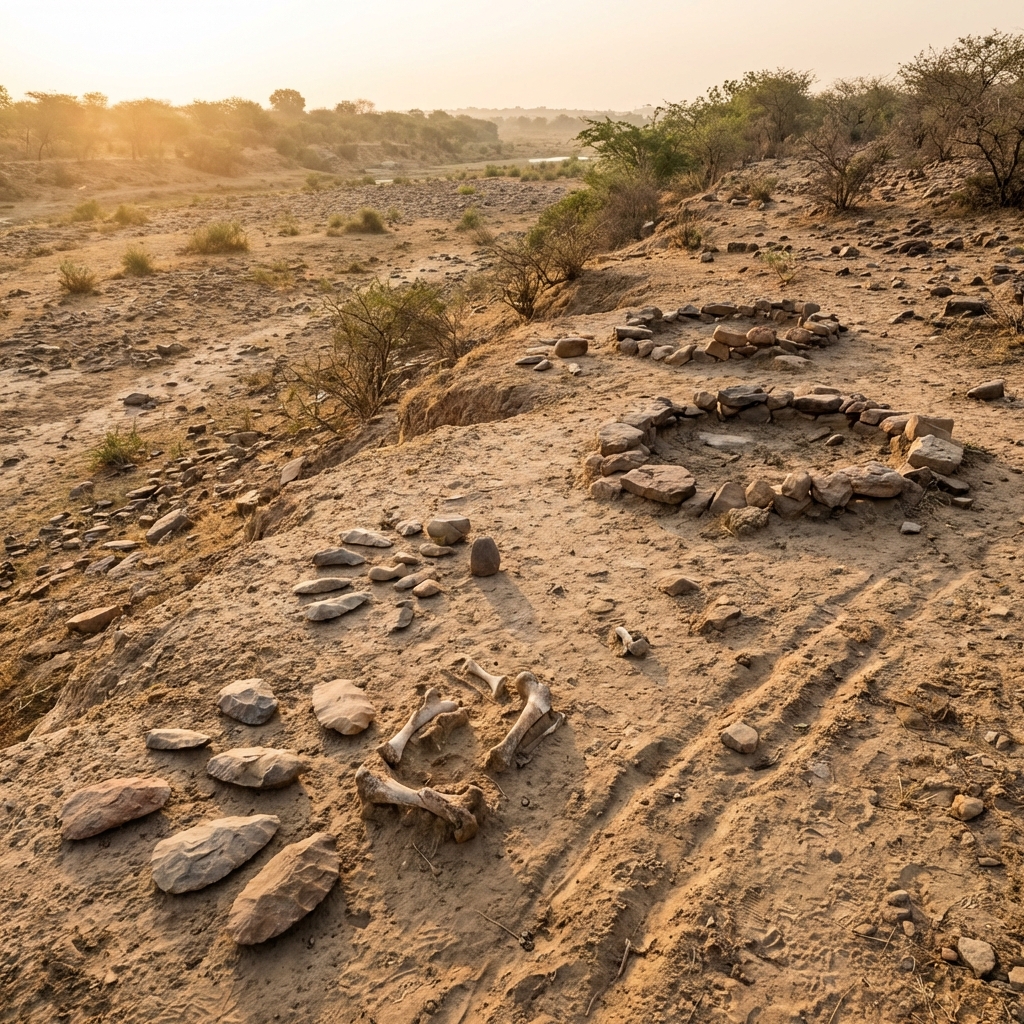
  • Paisra (Munger, BR): Living/working floor; 8 post-holes (thatched huts)
  • Singi Talav (RJ), Lalitpur (UP), Chirki-Nevasa (MH), Gudiyam Cave (near Chennai)
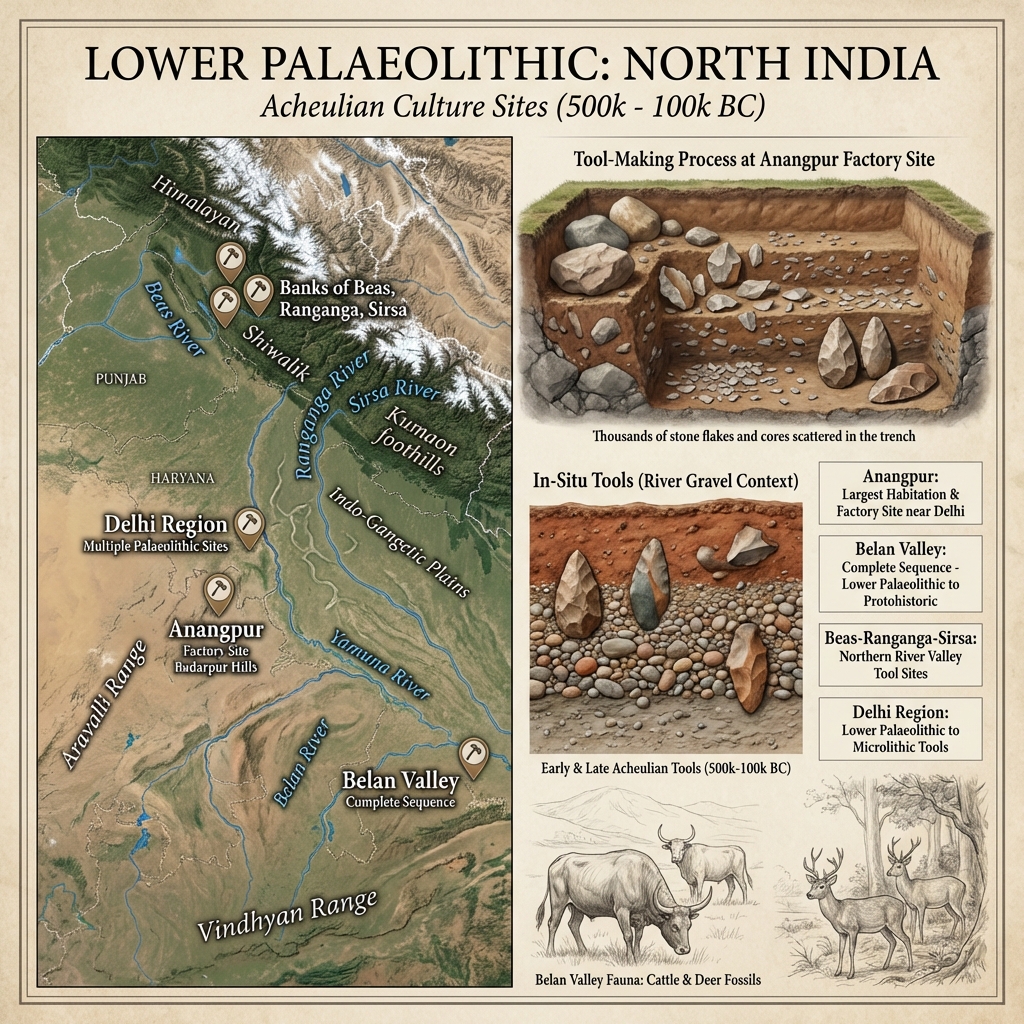
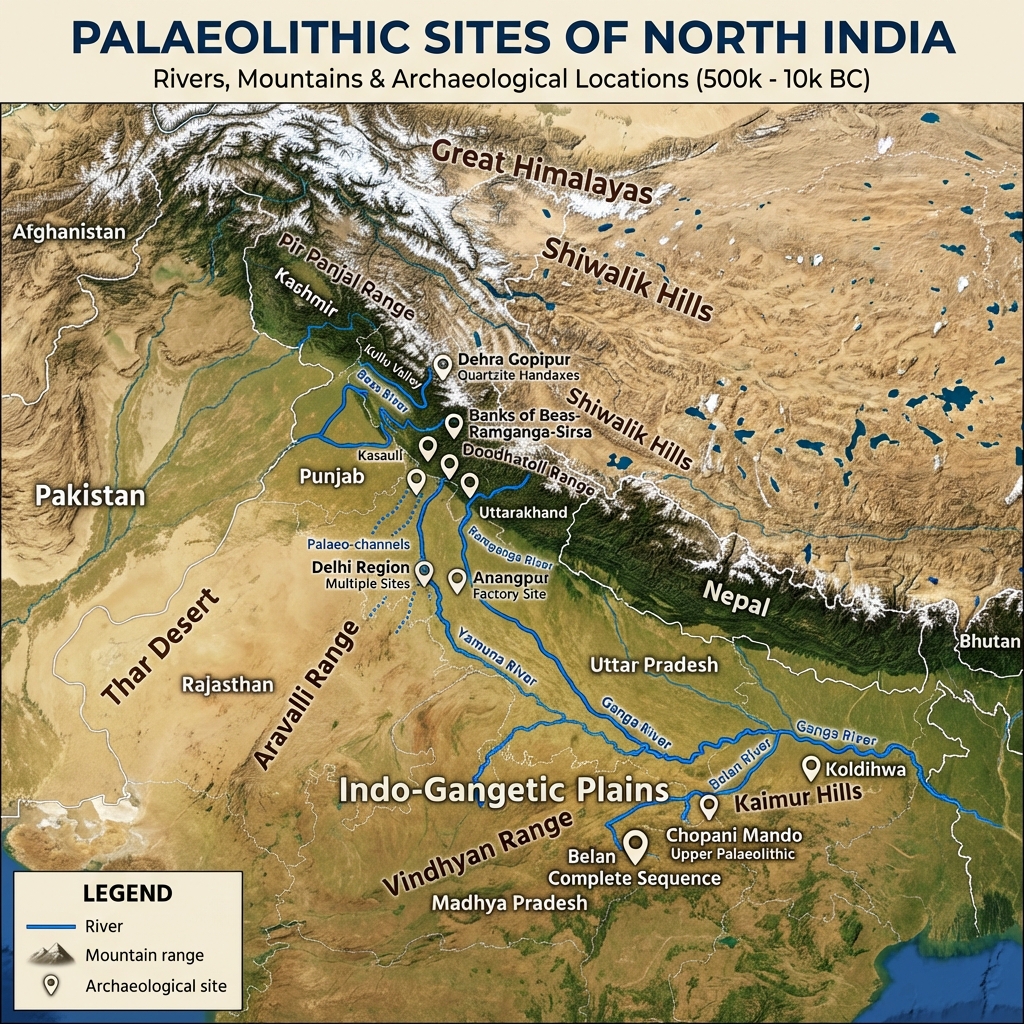
  • Anangpur (Delhi, Badarpur hills): Large lower pal habitation & factory site
→ Middle Palaeolithic (1,00,000–40,000 BCE)
Key features of Middle Palaeolithic?
  • Transition from Acheulian → Middle Pal by dropping some tool types & adding new forms
  • Tools: smaller, thinner, lighter flake tools; fine-grained siliceous rocks (chert, jasper, agate, chalcedony)
  • Developed during Upper Pleistocene — intense cold & glaciation → aridity → sparse distribution of sites
  • Nevasan industry: Middle Pal of central & peninsular India; named after Nevasa (MH)
  • Luni industry: Middle Pal assemblages west of Aravallis; more variety in stone tool types
Key Middle Palaeolithic sites?
  • Sanghao Cave (NW Frontier, Pakistan): Middle & upper pal tools, hearths, animal bones, possible burials; tools of quartz
  • Didwana & Budha Pushkar (RJ): Rich in middle pal; Budha Pushkar lake = water + stone advantage
  • Potwar Plateau (between Indus & Jhelum): Rich in middle pal
  • Belan Valley (UP/Vindhyas foothills): Lower & middle pal + animal fossils (cattle, deer)
  • Kalpi (Jalaun, UP): Earliest human occupation in Ganga plain; elephant tusk/molars found
  • Chirki-Nevasa (MH): Middle pal living & factory site
  • Patne (Tapi valley): Middle + upper pal + mesolithic sequence
→ Upper Palaeolithic (40,000–10,000 BCE)
Key features of Upper Palaeolithic?
  • Marks: Homo sapiens appearance; parallel-sided blades; increase in burins
  • New: bone tools (needles, fishing tools, harpoons); figurines/art/ritual objects; bored stones & grinding slabs
  • Climate: cold & arid in N & W India; ostrich (adapted to arid climate) bones at 40+ sites (RJ, MP, MH)
  • Trend: Towards smaller tools due to environmental adaptation
Key Upper Palaeolithic sites?
  • Chopani Mando (Belan Valley, UP): Habitation site; cultural sequence Upper Pal → Neolithic
  • Baghor I (Son Valley, MP): Upper Palaeolithic shrine — circular sandstone rubble platform; triangular concentric stone (female goddess symbol); worshipped by Kol & Baiga tribes today
  • Kurnool & Muchchatla Chintamanu Gavi (AP): Only sites with bone tools in Upper Pal context
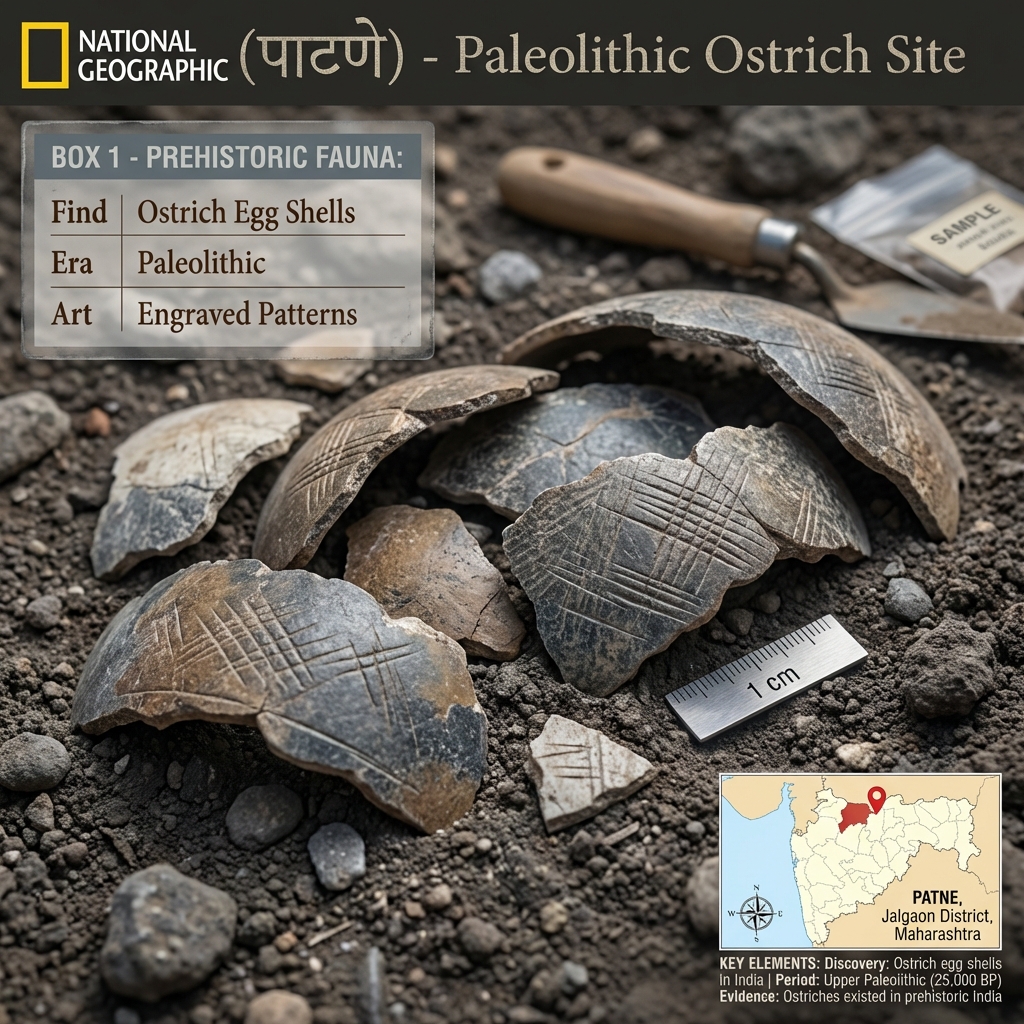
  • Patne (MH): Ostrich eggshell engraved with criss-cross designs; 4 perforated beads from eggshell
  • Lohanda Nala (Belan Valley, UP): Carved bone — Mother Goddess figurine/harpoon
  • Paisra (Munger, BR), Rohiri Hills (Sindh), Belan & Son Valleys (UP)
Palaeolithic Art & Society
What is known about Palaeolithic art?
  • Earliest form: Ostrich eggshell engraved with cross-hatched designs (Upper Pal)
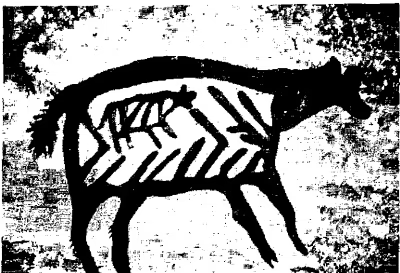
  • Bhimbetka: Earliest paintings = Upper Palaeolithic; green (dancers) & dark red (hunters); huge animals (bisons, elephants, tigers, rhinos, boars); stick-like humans
  • Petroglyphs: Rock surface removed by engraving/bruising/hammering
  • Portable art: figurines; permanent: cave paintings
Palaeolithic social structure?
  • Band society: <100 people; nomadic; kinship-based; no formal government
  • Division of labour: men hunted, women gathered (women likely contributed MORE — plant food dominant)
  • No formal leaders; behaviour regulated by customs & social norms
  • Animal remains: ox, bison, nilgai, chinkara, sambar, spotted deer, wild boar, birds, tortoise, fish
  • Foreign-origin animals: camel & horse (N. America); hippo & elephant (Central Africa via NW route)
Mesolithic (10,000–6000 BCE)
Key features of Mesolithic Age?
  • Term: Middle Stone Age; 8000–4000 BC (conventional); transitional Pal → Neolithic
  • Trigger: Pleistocene → Holocene transition; warmer, drier climate; ice caps melted → rivers formed
  • Shift: big game → small game, fishing, fowling; microliths replace large tools
  • First major human colonisation of Ganga plains; 200+ sites in Allahabad, Pratapgarh, Jaunpur, Mirzapur, Varanasi districts
  • Epi-palaeolithic: Transitional tools — smaller than Upper Pal but larger than microliths
What are Microliths?
  • Very small (1–8 cm); geometric forms; made of flint or chert
  • Types: Blade (fluting technique), Core (cylindrical), Point (broken blade = arrowhead/spearhead), Triangle (cutting/arrowhead), Lunate (segment of circle), Trapeze (arrowhead)
  • Used as components: spearheads, arrowheads, knives, sickles, harpoons, daggers
  • Bored stones: Weights in digging sticks & net sinkers (appear Upper Pal, common Meso onwards)
Mesolithic lifestyle changes?
  • From nomadism → seasonally sedentary settlements
  • First intentional burials: Bagor (RJ), Langhnaj (GJ), Bhimbetka (MP)
  • 4 burial types: Extended, Flexed (folded), Fractional (secondary), Double burials (indicate family units)
  • Rock art: Bhimbetka, Adamgarh (MP), Pratapgarh & Mirzapur (UP/RJ)
  • Colours: Red (iron oxide minerals) & White (limestone)
  • Art subjects: hunting scenes, animals, sexual union, child birth, burial ceremony, dancing
  • Bhimbetka Boar: body of boar + rhino snout + elephant underlip + buffalo horn
  • No snake paintings in any Mesolithic site
Mesolithic economy & subsistence?
  • Hunting, fishing, gathering (dominant); some animal domestication begins
  • Earliest animal domestication evidence: Adamgarh (MP) & Bagor (RJ)
  • Domesticated: dog, cattle, sheep, goat
  • Plant foods: roots, tubers, fruits, honey, wild rice (late Mesolithic at Damdama & Chopani Mando)
  • Pottery: mostly absent; present at Langhnaj, Kaimur (Mirzapur); hand-made, coarse-grained
  • Houses: circular/oval wattle-and-daub; stone-paved floors (Bagor, Bhimbetka)
→ Key Mesolithic Sites
Bagor (Rajasthan)?
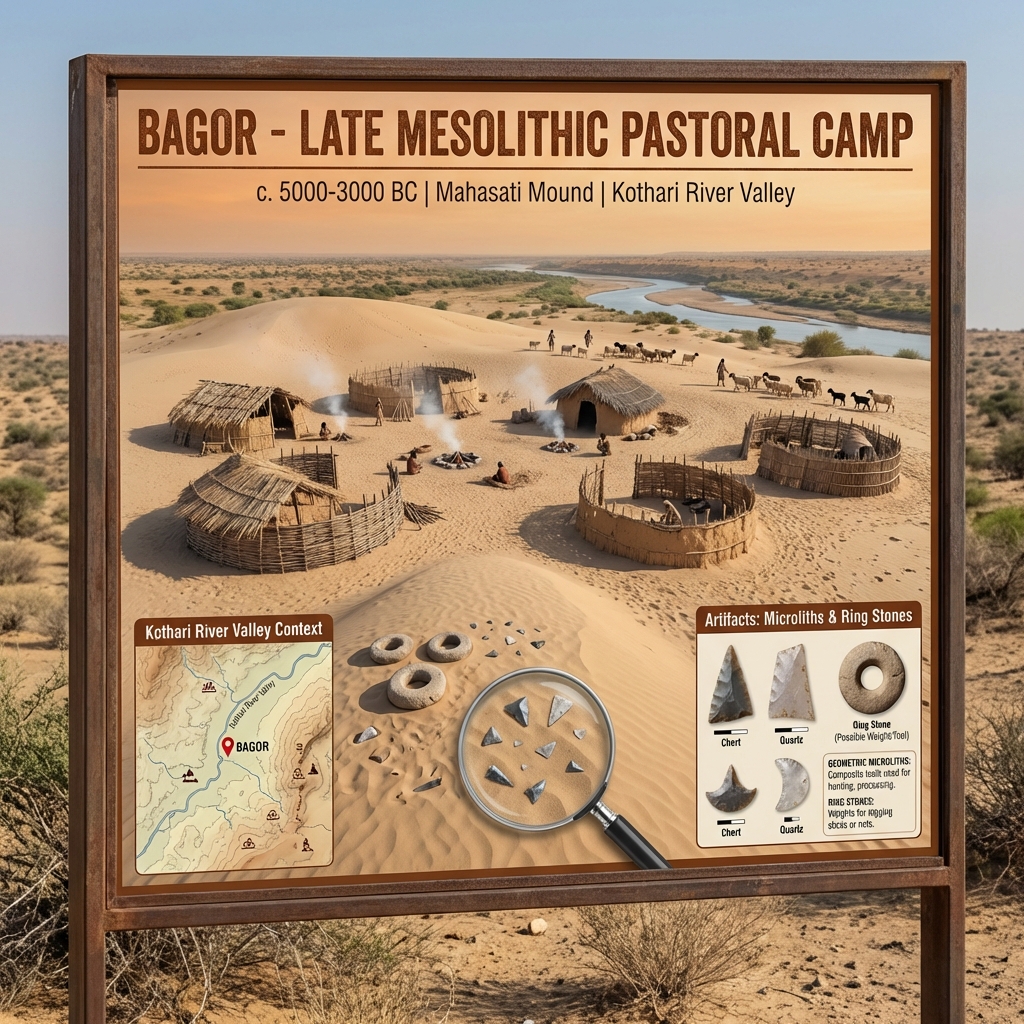
  • Bagor: Bhilwara district; on Kothari river; Largest Mesolithic site in India
  • 3 periods: Period I (Mesolithic), II (Chalcolithic), III (iron evidence)
  • Tools: chert & quartz microliths; triangles & trapezes; ring stones, querns, rubbing stones
  • Animals: wild cattle, deer, pigs, jackals, fish; domesticated sheep/goat & cattle
  • Only one burial found; house floors paved with stone slabs
Sarai Nahar Rai (UP)?
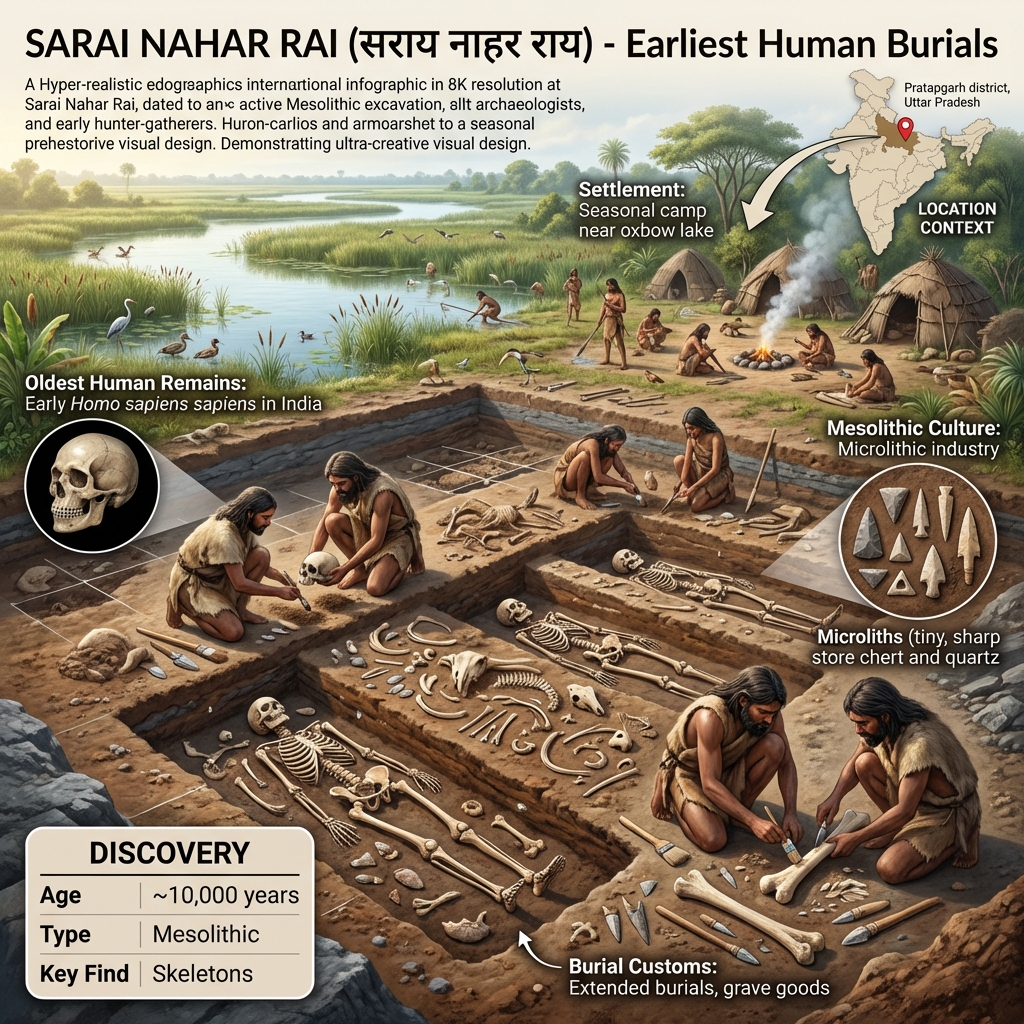
  • Pratapgarh district; oxbow lake of Ganga
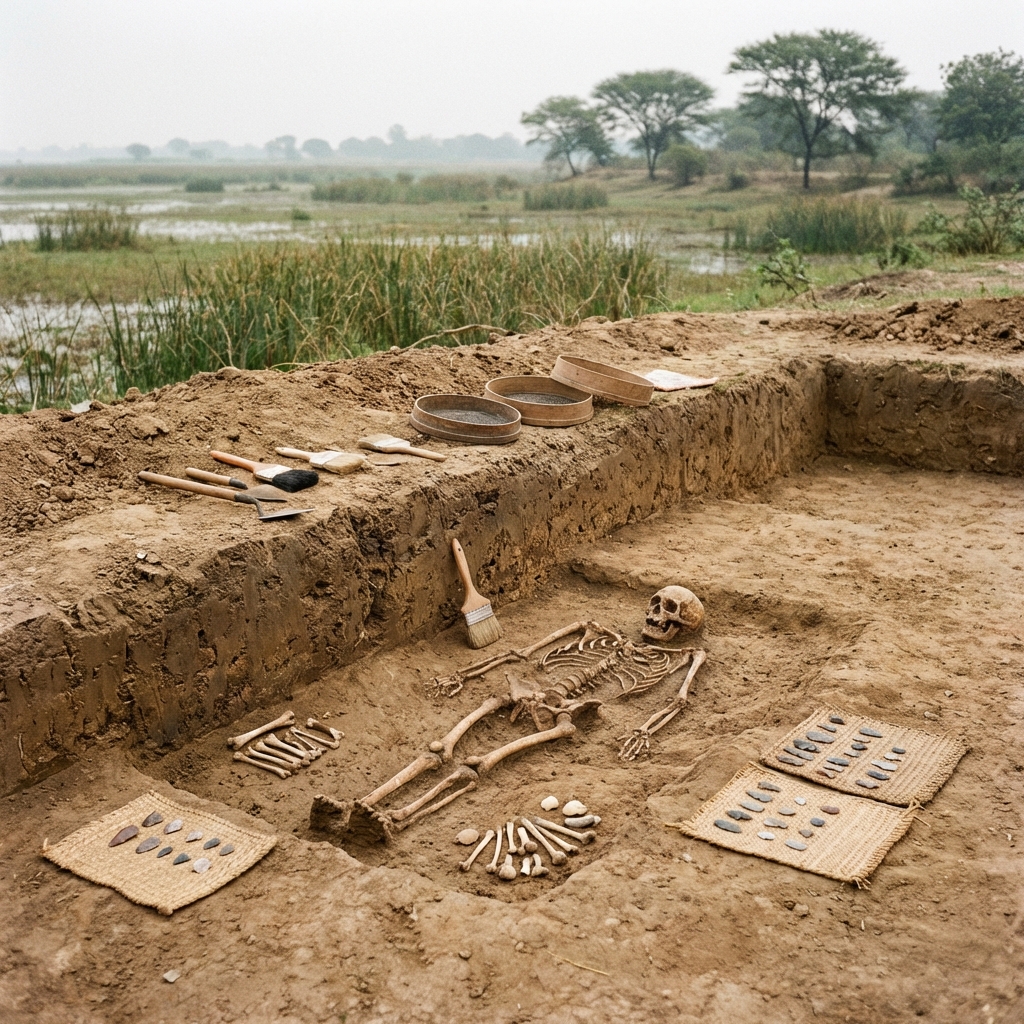
  • 11 burials (9 men, 4 women, 1 child); one skeleton had arrow in ribs; multiple burial of 4 persons
  • Grave goods: microliths, animal bones, shells; good dental health but osteo-arthritis
Mahadaha (UP)?
  • Oxbow lake; distinct habitation & butchering areas
  • 28 burials of 30 individuals; 2 instances of man & woman buried together
  • Grave goods: microliths, shells, bone arrowheads & rings, ochre; people were tall
  • Animals: wild cattle, hippo, deer, pigs, turtles
Damdama (UP)?
  • 41 burials including 4 multiple burials; ivory pendant as grave good
  • Domesticated rice reported from Mesolithic levels
Chopani Mando (Belan Valley, UP)?
  • 3 occupational periods: I (epi-palaeolithic), IIA (non-geometric microliths), IIB (geometric microliths), III (handmade pottery + querns)
  • Wattle-and-daub round huts; wild rice at late Mesolithic levels
  • Animals: wild cattle & sheep/goats
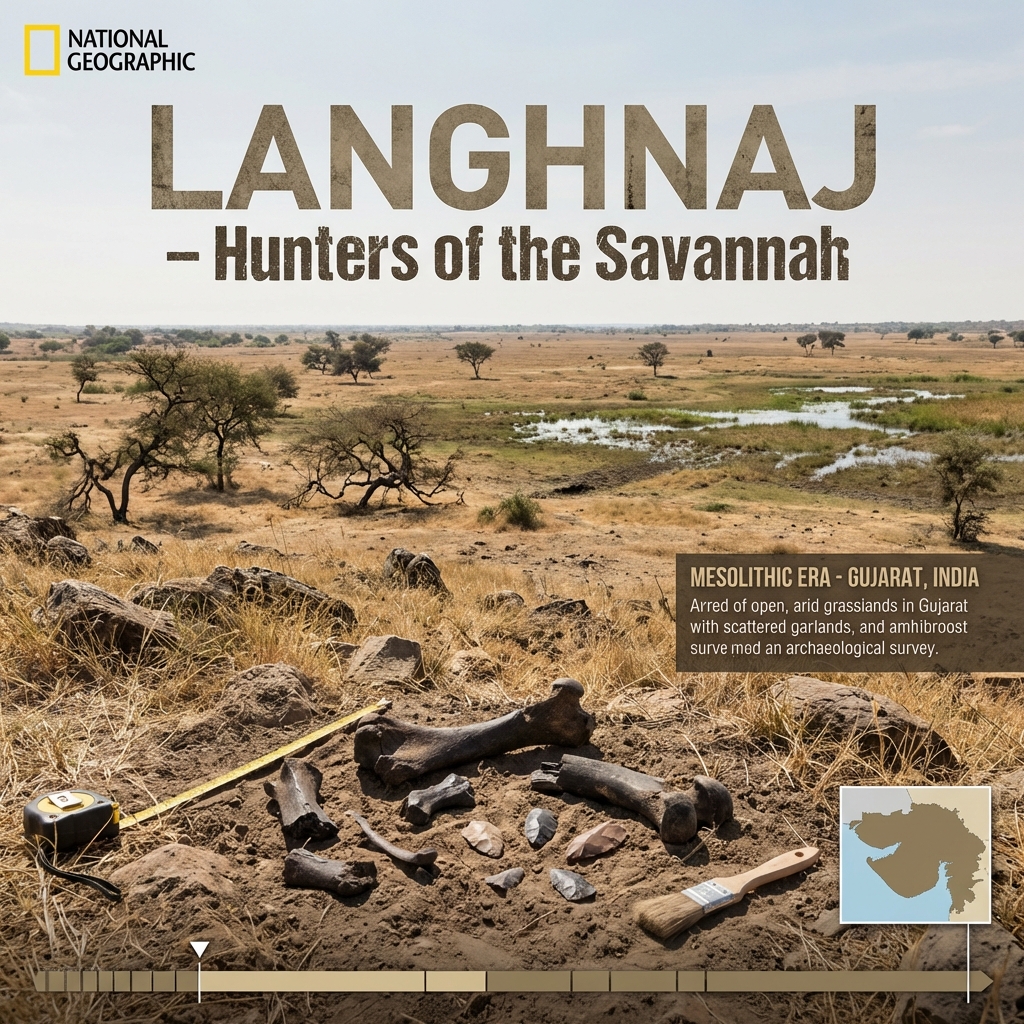
Langhnaj (Gujarat)?
  • 3 cultural phases; microliths, human burials, animal bones, potsherds
  • Microlith types: blades, triangles, cressenis, scrapers, burins
Bhimbetka (MP) — Mesolithic?
  • Mesolithic tools: blades & geometric microliths (triangles, trapezes, crescents)
  • Shift from quartz (Palaeolithic) → chalcedony (Mesolithic)
  • Richest Mesolithic paintings; Period II = most abundant naturalistic paintings; hunting scenes, community life, hand/fist prints
Birbhanpur (West Bengal)?
  • River Damodar, Burdwan district; quartz, chert, chalcedony tools
  • Habitation + factory site; drier climate than preceding phase
Neolithic (~6000–1000 BCE)
Key features & definition?
  • Term coined: Sir John Lubbock (polished, varied stone tools)
  • V. Gordon Childe: Coined Neolithic Revolution; defined Neolithic-Chalcolithic as self-sufficient food-producing economy
  • Miles Burkitt's 4 traits: Agriculture + Animal domestication + Polished stone tools + Pottery
  • Key features: polished stone axes, sedentary villages, pottery (hand-made → wheel-made), surplus production, pit & urn burials
  • Now viewed as transformation/evolution not revolution (gradual process)
Origins of agriculture in India — theories?
  • Earlier view: borrowed from Mesopotamia/Iran → Discredited
  • Now: independent indigenous development
  • Wheat & barley: Mehrgarh (Pakistan) — contemporaneous with Fertile Crescent → rules out diffusion
  • Rice: Koldihwa (UP) — indigenous origin
  • Millet: South India — not from Africa
Theories on origin of agriculture?
  • V. Gordon Childe: Pleistocene climate change → desiccation → concentration near water → domestication
  • Braidwood: Nuclear zones with wild plant/animal potential → natural experimentation
  • Binford: Population stress (external demographic — sea level rise → coastal migration inland) triggered food production
  • Kent Flannery: Positive feedback — human interference increases productivity → more domestication
  • Recent: Holocene milder/wetter climate expanded natural habitat of wild cereals
How to identify domestication archaeologically?
  • Animals: Smaller size, reduced teeth/horns, muscle ridge changes; animals outside natural habitat; male-female ratio shift (males killed young)
  • Plants: Morphological change in grain size; grain impressions on pottery; grinding stones & sickles
Social changes in Neolithic?
  • Sedentary life → higher birth rates (less stress in pregnancy, shorter birth intervals)
  • More vulnerability to infectious disease & epidemics (vs nomadic)
  • High-carbohydrate diet (cereals) vs high-protein hunter-gatherer diet
  • Women key: plant domestication (gatherers), pottery making (food storage/cooking)
  • Craft production; social differentiation (house sizes, grave goods); political control in larger settlements
  • Terracotta female figurines = Mother Goddess / fertility cult; humped bull figurines = possible cult objects
→ Key Neolithic Sites — Region-wise
NW India / Balochistan?
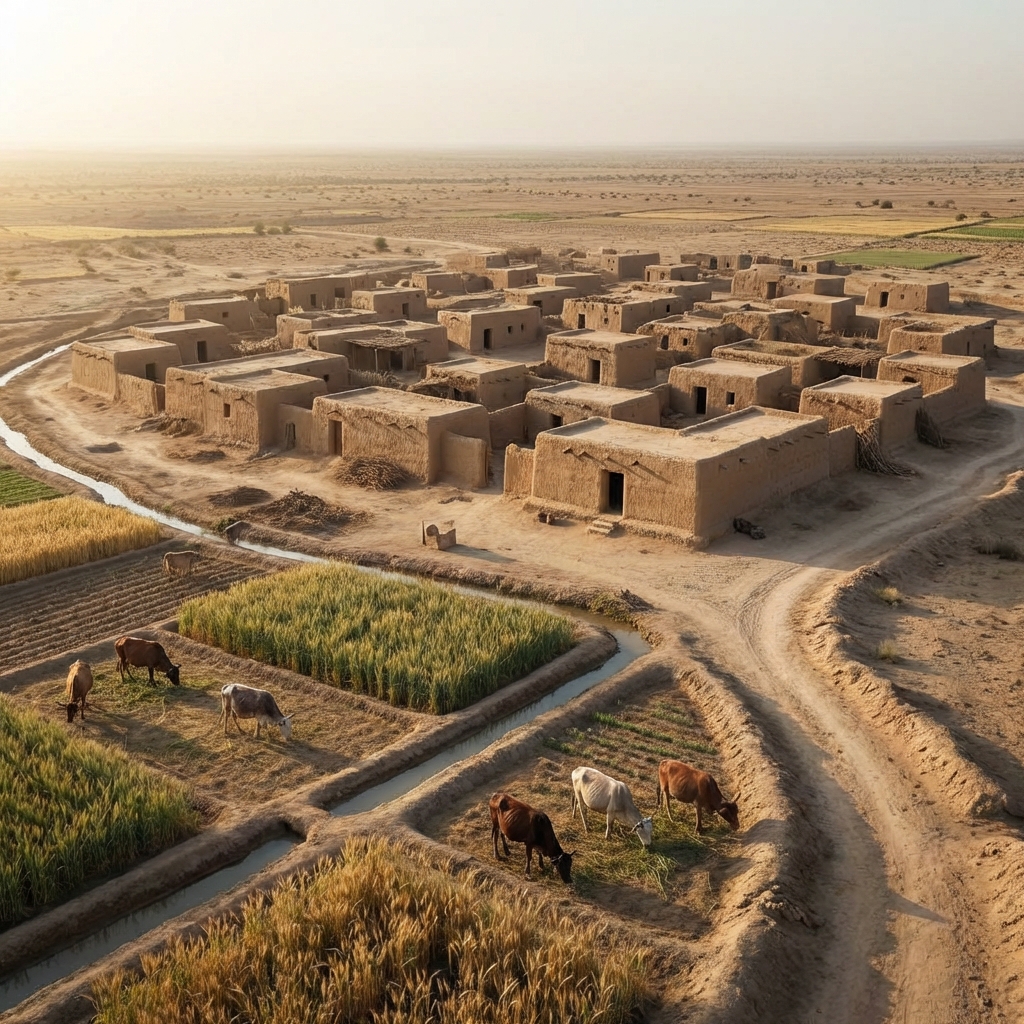
  • Mehrgarh (Balochistan, Pakistan): Earliest Neolithic site in South Asia; wheat, barley cultivation; human tooth drilling; no pottery initially; mud-brick houses; evidence of bead-making & trade
Kashmir?
  • Burzahom (J&K): Pit dwellings; dog buried with master; hunting economy (not agriculture-based); bone tools; grey handmade pottery — PYQ trap: pit dwellings NOT rock-cut shrines
  • Gufkral (J&K): Advanced Neolithic features; bone tools, polished stone celts
Vindhyas / UP?
  • Koldihwa (UP): Earliest evidence of rice cultivation in the world
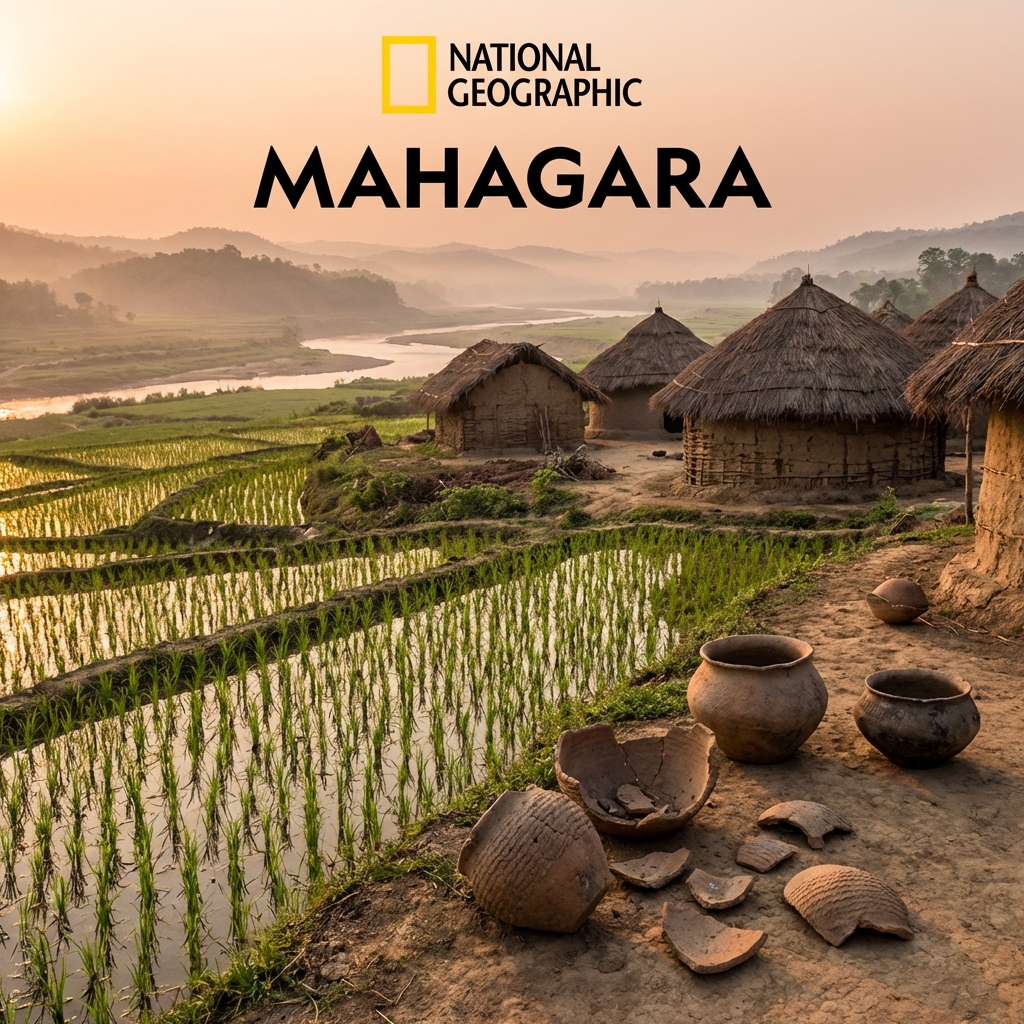
  • Mahagara (UP): Circular huts; rice cultivation; cattle hoof-prints
  • Chopani Mando (Belan Valley): Neolithic phase after Mesolithic
Mid-Ganga Valley (UP & Bihar)?
  • Chirand (Saran, BR): At Sarayu-Ganga confluence; bone & antler objects (like Burzahom); bangles of tortoise bone & ivory; crops = rice, wheat, barley, moong, lentil; circular wattle-and-daub huts
  • Senuwar (Rohtas, BR): On Kudra river; millets, rice, barley, field pea, lentil; remarkable bone tools; wheel-made pottery
  • Taradih (Bodh Gaya): Rice, wheat, barley; wattle-and-daub houses
  • Lahuradeva (Sant Kabir Nagar, UP): Rice cultivation; cord-impressed red ware & black-and-red ware
  • Narhan (banks of Saryu), Chirand, Imlidih, Sohagaura (Rapti-Ami confluence)
Eastern India (Orissa, WB, Jharkhand)?
  • Kuchai (Mayurbhanj, OR): Polished celts, axes, faceted hoes; reddish-brown pottery
  • Golbai Sasan (on Mandakini, OR): Handmade dull red & grey pottery with cord impressions
  • Pandu Rajar Dhibi (Ajay Valley, WB): First to demonstrate Neolithic base of Chalcolithic; grey ware with rice husk impressions; coexistence of microliths + polished stone tools
  • Barudih (Singhbhum, JH): Earliest village level in Chhotanagpur; microliths + celts + iron slag; black-and-red ware; dated 1401–837 BC
North-East India?
  • Daojali Hading (N. Kachhar hills, AS): Polished stone & fossil-wood axes, adzes, hoes, cord-marked pottery; no domesticated cereals but querns/mullers confirm agriculture; >2700 yrs
  • Other sites: Sarutaru, Marakdola (AS); Napchik (Manipur); Pynthorlangtein (Meghalaya)
  • Characteristic: shouldered celts + cord-impressed pottery (affinity with China/SE Asia, but not settled)
South India (Karnataka, AP, TN)?
  • Dated 2600–1000 BC; Raichur doab (Krishna-Tungabhadra) & Shorapur Doab (Bhima-Krishna) as core areas
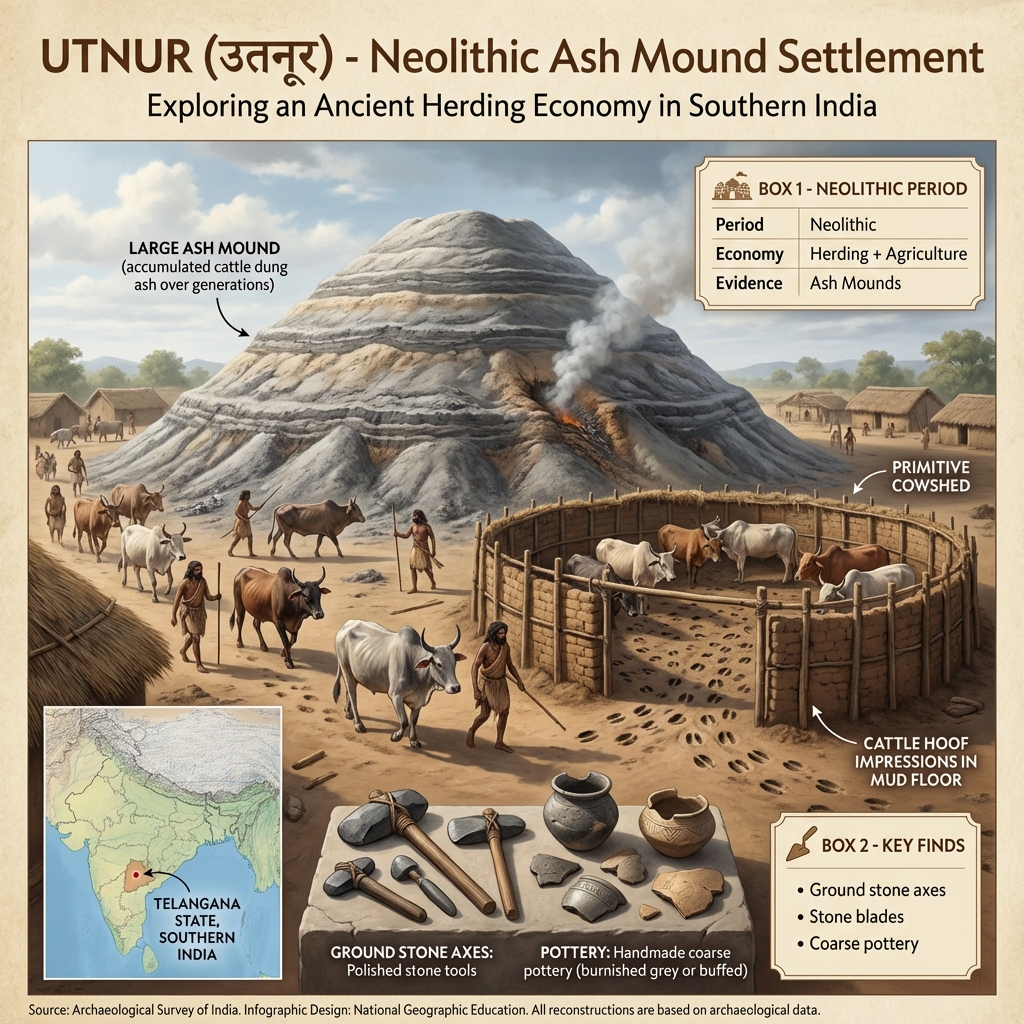
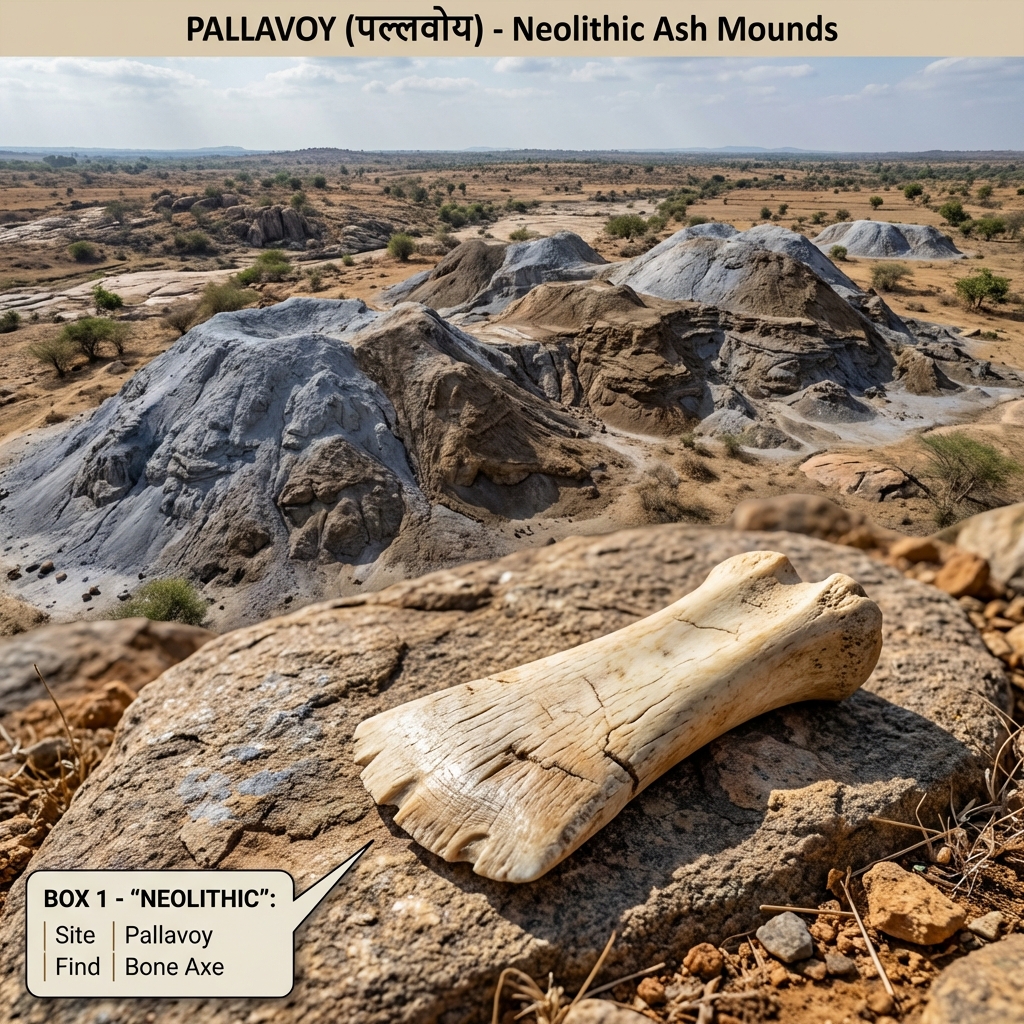
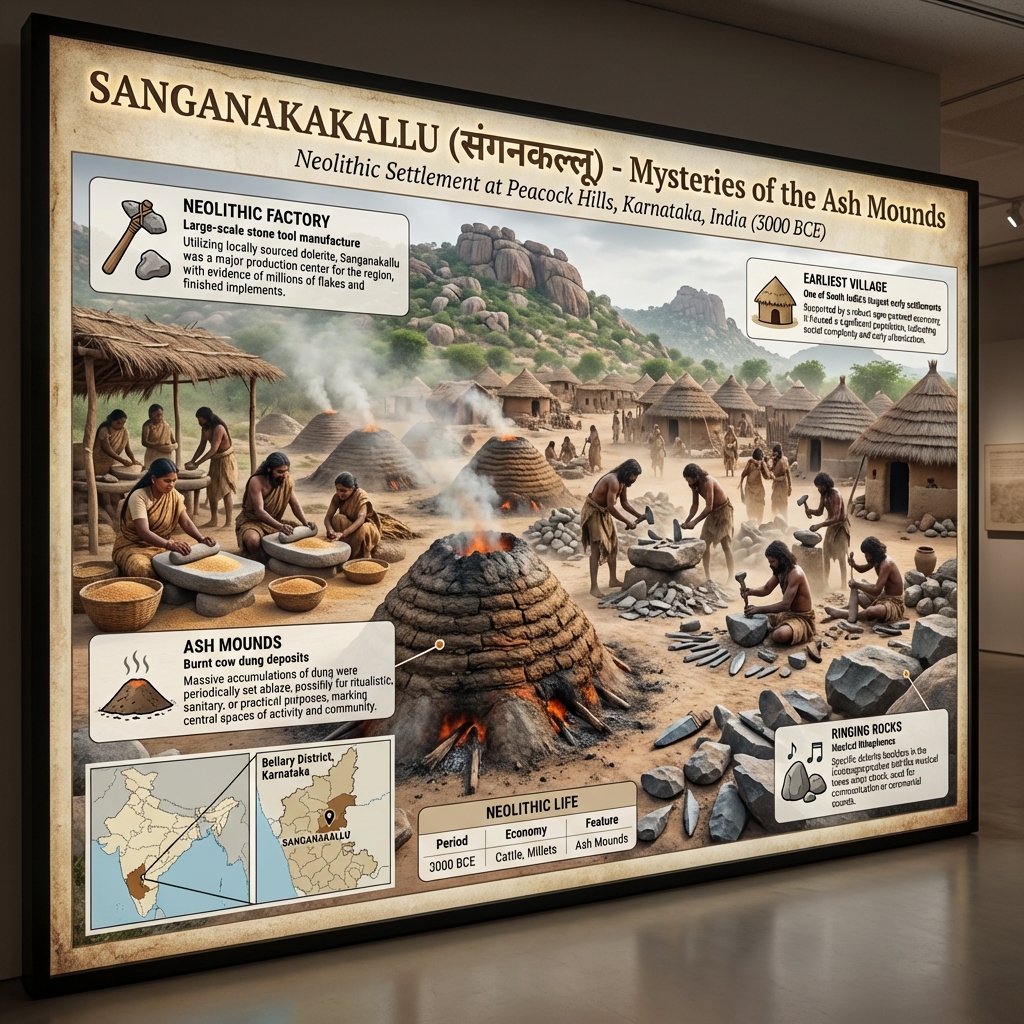
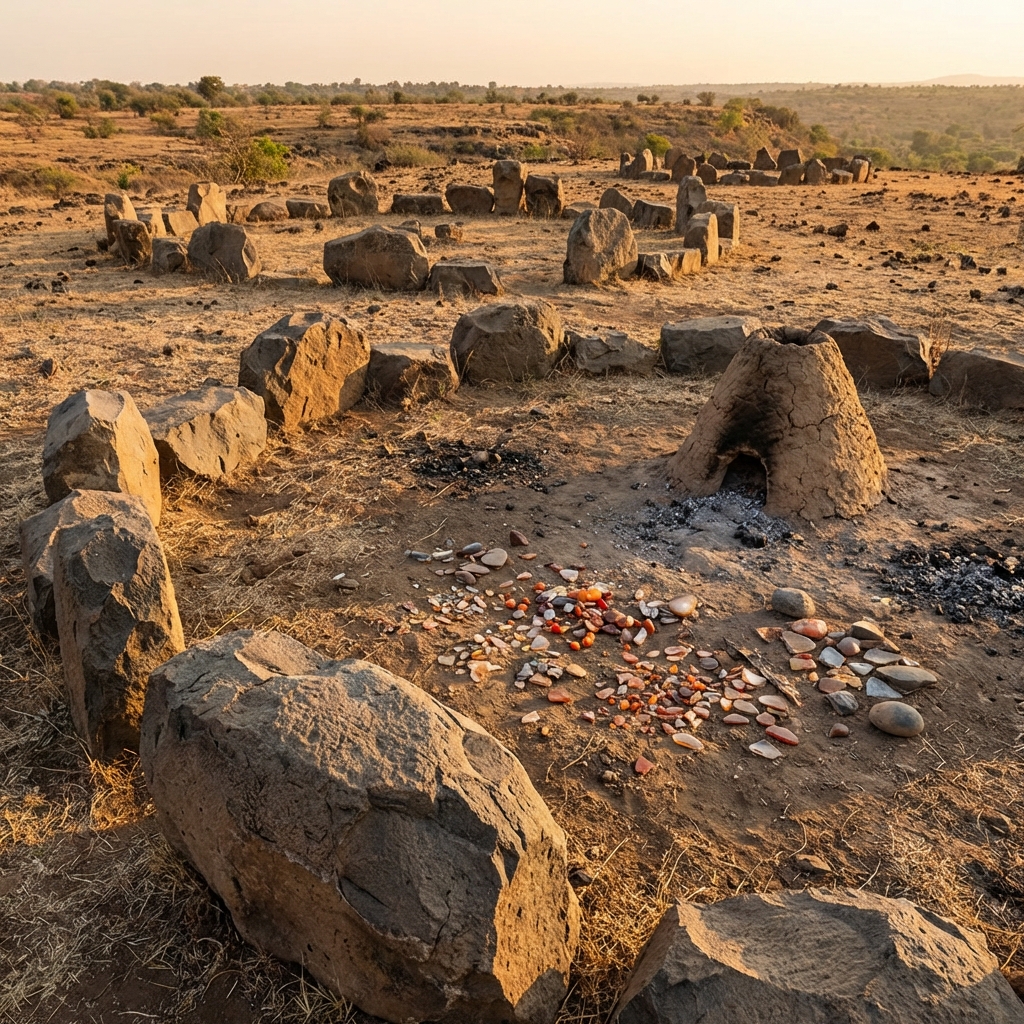
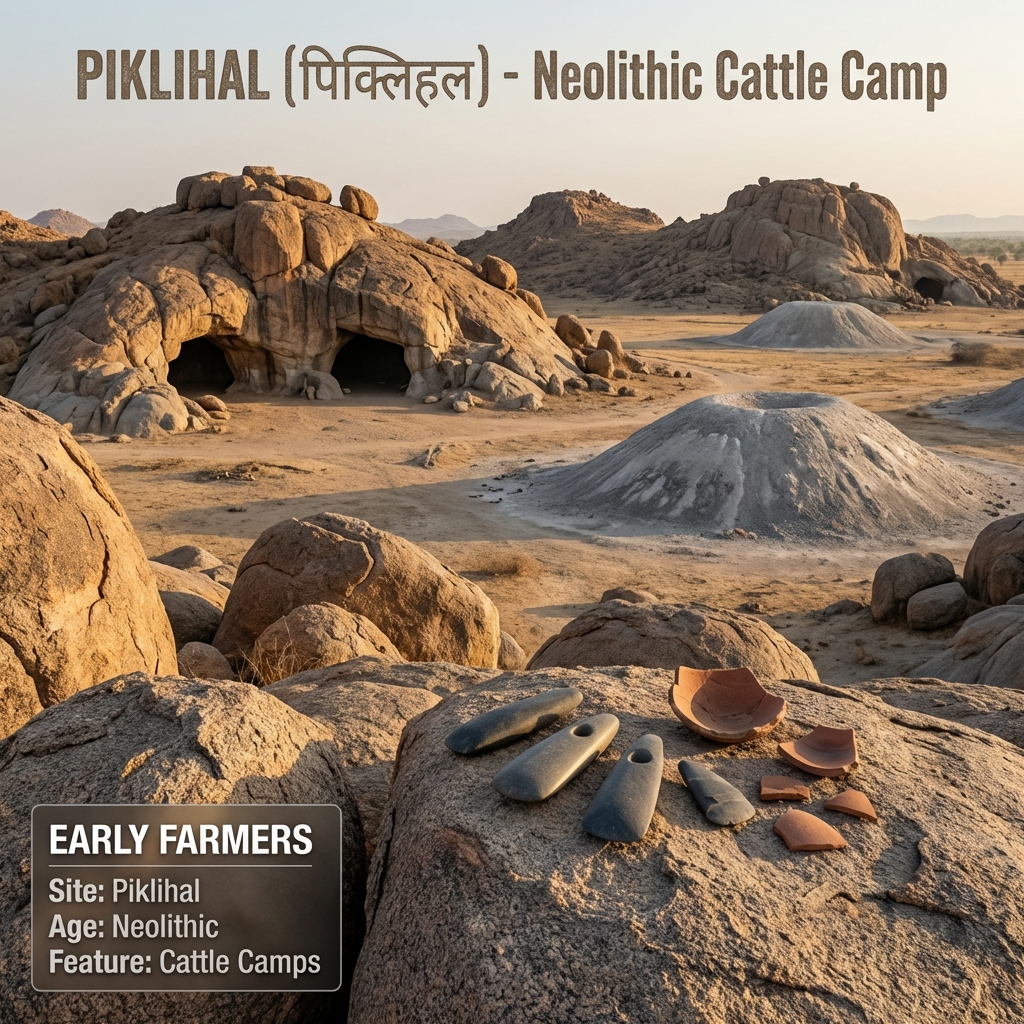
  • Ash mounds: Burnt cattle dung; periodically set on fire; at Utnur, Kupgal, Kodekal, Pallavoy, Piklihal — seasonal cattle pens / cattle fairs
  • 3 phases: I (2500 BC — Sangankallu, Nagarjunakonda; no domestication?), II (red ware; lapidary art; quartz microliths), III (1500 BC — grey ware; agriculture dominant)
  • Piklihal (Raichur, KA): Ashmound; mobile cattle herders; seasonal camps with cowpens set on fire when moving
  • Sangankallu (KA): Long occupation Pal → Neolithic; storage pits with charred grains
  • Utnur (Mahbubnagar, AP): Ashmound; cattle hoof-prints in ash; stone axes, blades
  • Budihal (Gulbarga, KA): 2200–1600 BCE; child burials; chert blade-working area; cattle rearing dominant
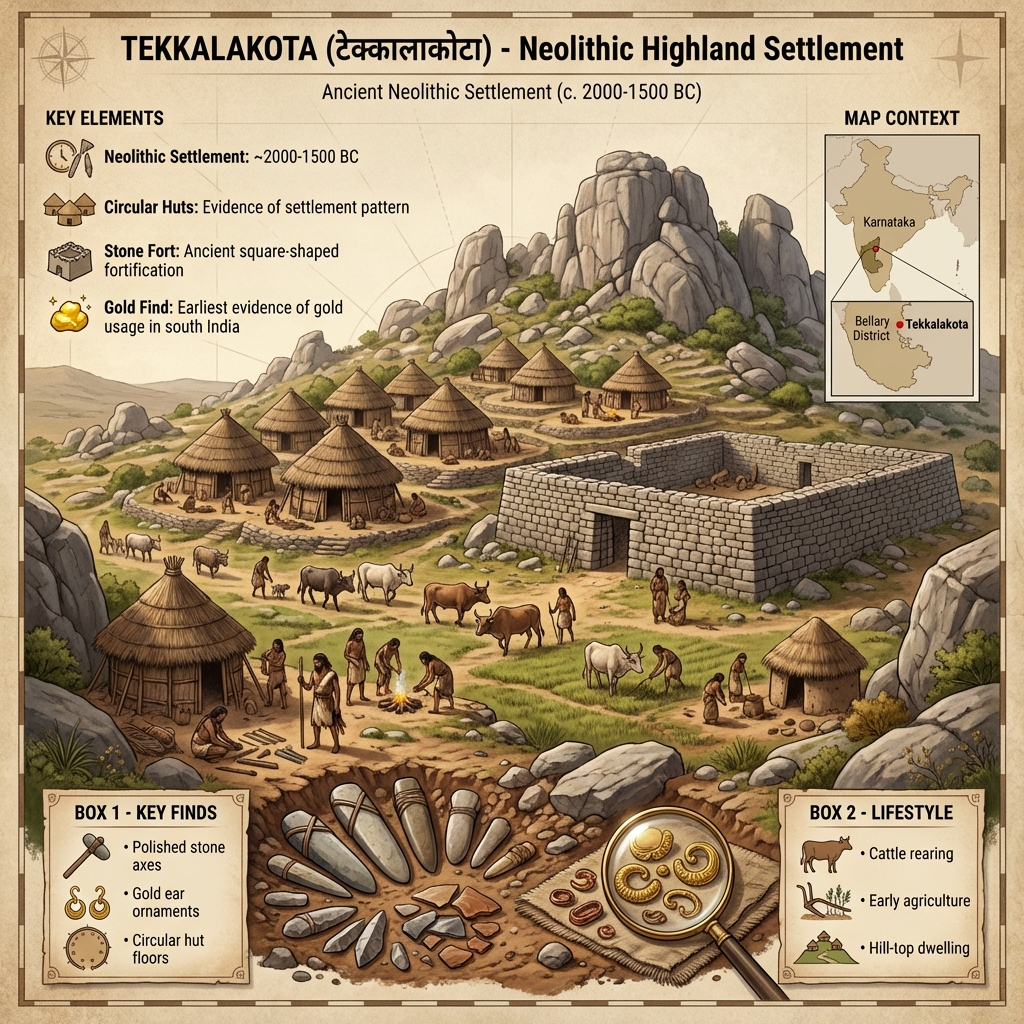
  • Tekkalakota (KA): Gold earrings found — implies trade with Harappans (Kolar gold field source)
  • Hallur (KA): Transition to Chalcolithic; Paiyampalli (TN)
  • Main crop: millets (Ragi) — now considered indigenous (not African); also horsegram, wheat, moong, date palm
Chalcolithic Age (~2000–700 BCE)
Key features of Chalcolithic?
  • First use of copper (first metal); stone tools continued alongside
  • Rural villages; stone/mud-brick houses; agriculture + pastoralism
  • Pottery: Black-and-Red Ware, Ochre Coloured Pottery
  • Social differentiation in burials; artisan quarters separate (Inamgaon)
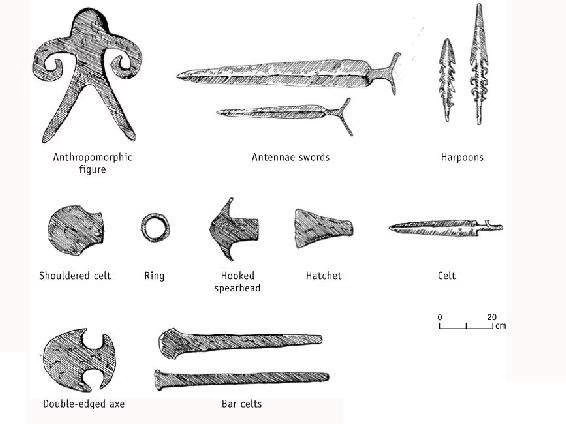
  • Copper objects: flat axes (celts), arrowheads, spearheads, chisels, fish hooks, bangles, rings, mid-ribbed swords
  • Ornaments: carnelian, jasper, chalcedony, agate, shell beads; 40,000 microbeads steatite necklace at Kayatha
Named Chalcolithic cultures?
  • Kayatha (2000–1800 BC): Near Ujjain on Kalisindh; 3 wares — sturdy red-slipped (dark brown designs), buff ware, combed ware; copper bangles (28 in one pot)
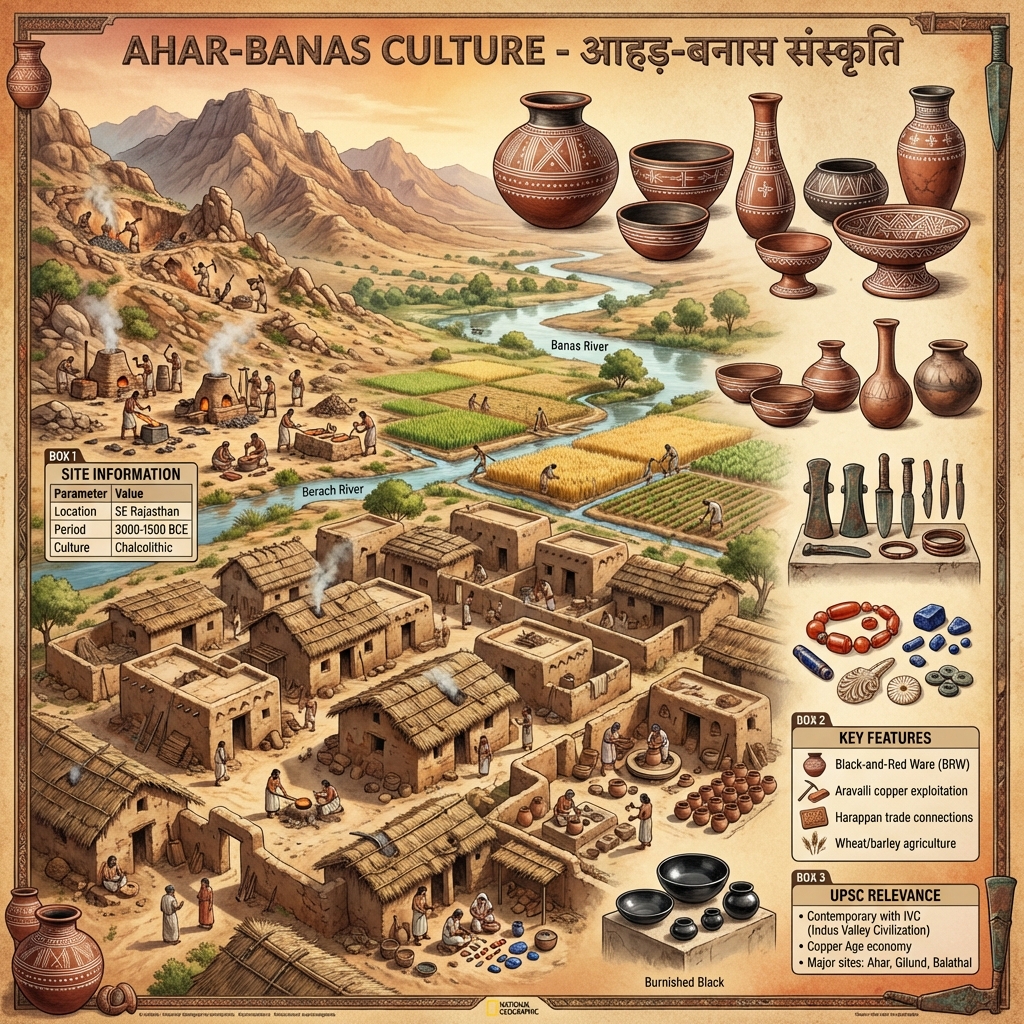
  • Ahar-Banas (2000–1400 BC): Udaipur; black-and-red ware with white paint; no stone axes; Balathal, Gilund, Ojiyana, Pachamta; houses on schist plinths
  • Savalda (2000–1800 BC): Tapi valley; black-on-red with naturalistic designs (birds, animals, fish)
  • Malwa (1700–1200 BC): Maheshwar & Navdatoli (Narmada); coarse buff-slipped pottery; black/dark brown patterns; expanded to MH ~1600 BC
  • Prabhas (1800–1500 BC): Prabhas Patan (GJ); derived from Harappan black-on-red
  • Rangpur (1400–700 BC): Rangpur (GJ)
  • Jorwe (1400–700 BC): Jorwe (Ahmednagar, MH); painted black-on-red matt surface; carinated bowls, spouted jars; three regional centres: Prakash (Tapi), Daimabad (Godavari), Inamgaon (Bhima)
  • Ganeshwar-Jodhpur (RJ): Abundant copper tools/weapons
Inamgaon — important facts?
  • Fortified mud wall + ditch; embankment to divert flood water through canal (irrigation evidence)
  • Artisans (potter, goldsmith, lapidary, ivory-carver) on western periphery; well-to-do farmers in centre
  • Early Jorwe (1400–1000 BC): large rectangular mud-wall houses in E-W rows
  • Late Jorwe (1000–700 BC): small round huts in clusters of 3–4; pit silos replaced by 4-legged storage jars → decline due to aridity/rainfall drop
  • Burial: 4-legged unbaked clay urn with male skeleton in sitting posture; spouted pot with boat design (cross river to heaven = Hindu belief)
  • Gold & ivory beads; spiral gold ear ring; copper anklets found
Daimabad Hoard?
  • Daimabad (Ahmednagar, MH): Largest Jorwe settlement (30 ha)
  • Bronze hoard: 2-wheeled chariot with rider, water buffalo, elephant, rhinoceros
Chalcolithic economy?
  • Main crops: barley, wheat, rice, bajra, jowar, lentil, horsegram, hyacinth bean, grass pea, black gram, green gram
  • Barley = principal cereal
  • Evidence of crop rotation at Inamgaon; prototype ploughshare at Walki (shoulder bone of cattle)
  • Domesticated animals: cattle, sheep, goat, dog, pig, horse (horse at Kayatha — debated)
  • Wild animals: blackbuck, four-horned antelope, nilgai, barasingha, sambar, rhino
  • Marine fish bones at Inamgaon (source: Kalyan/Mahad creek ports → trade)
Chalcolithic religion & burials?
  • Mother Goddess: Female clay figurines (headless = Goddess Sakambhari, vegetative fertility)
  • Male figurines rare; painted jar (Malwa) — human figure in twig-garment surrounded by stag, deer, peacock
  • Burials: N-S orientation (head north, legs south); adults = extended; children = urn burials
  • Bodies buried inside house floor; Jorwe: feet below ankle chopped off (prevent ghost)
  • Grave goods: 2 pots, personal ornaments; child with 12 copper & red jasper bead necklace
Administrative organisation in Chalcolithic?
  • 2-tier settlement hierarchy: regional centres + village settlements
  • Public structures: fortifications, ramparts, moats, granaries, canals (Inamgaon)
  • Post-Harappan influence visible but strong regional elements
  • Decline ~first millennium BC (Late Jorwe to 700 BC); cause = aridity → semi-nomadism
Bronze & Iron Ages
Bronze Age (~2600–1900 BCE)?
  • Copper + tin = bronze; urbanisation phase (IVC)
  • Planned urban centres, standard bricks/weights/drainage, surplus agriculture, trade (Lothal)
  • Sites: Sinauli (UP), Daimabad (MH), Bhagwanpura (HR), Gandhara Grave Culture (NW)
Iron Age (~1200–600 BCE)?
  • Widespread iron tools/weapons; forest clearance, large-scale agriculture
  • Excavations at Sivagalai (TN) suggest iron usage by 3345 BCE
  • Pottery: Painted Grey Ware (PGW) → Northern Black Polished Ware (NBPW)
  • Burials: Urn/megalithic with iron implements (South India)
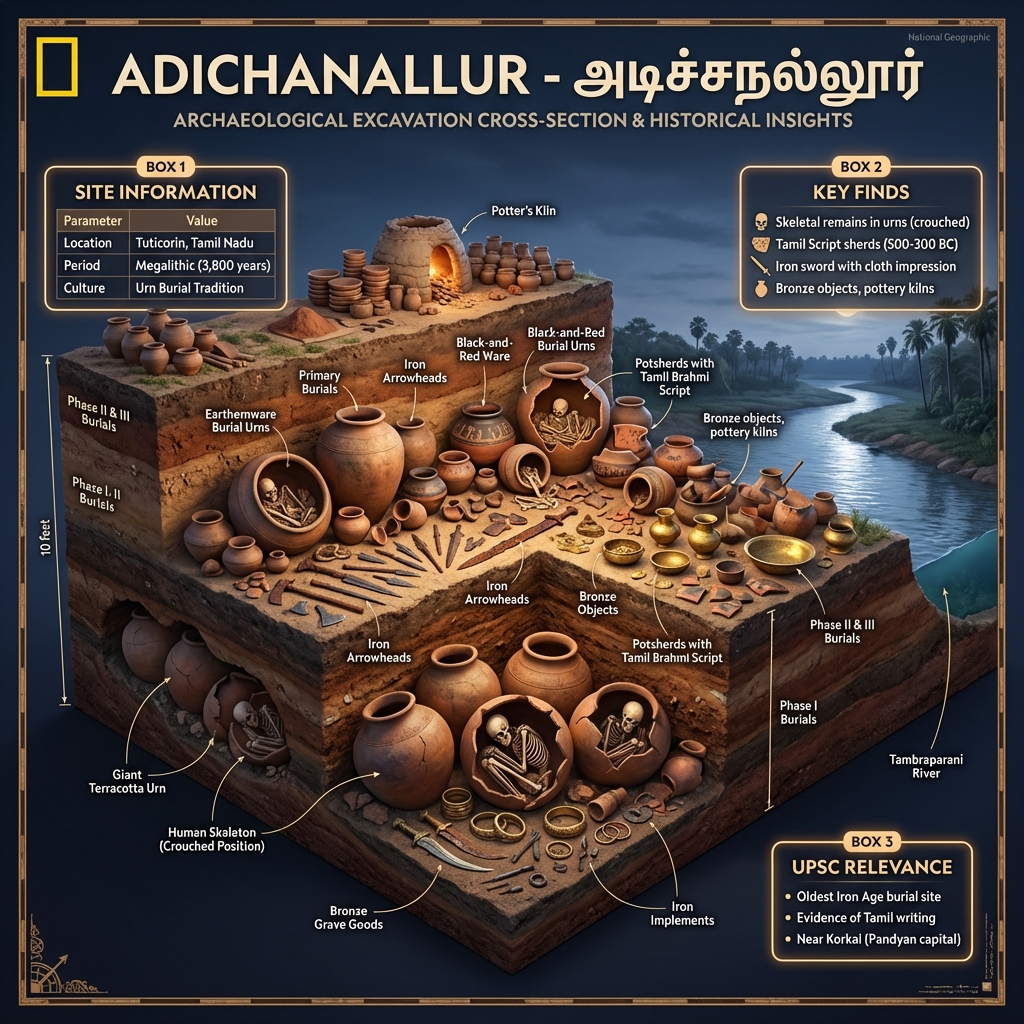
  • Sites: Hastinapur, Mathura, Ahichchhatra, Malhar (UP); Panipat, Rupnagar, Bhagwanpura (HR/PB); Paiyampalli, Sivagalai, Adichanallur (TN)
Megalithic Culture (~1000 BCE–300 CE)
Key features of Megalithic Culture?
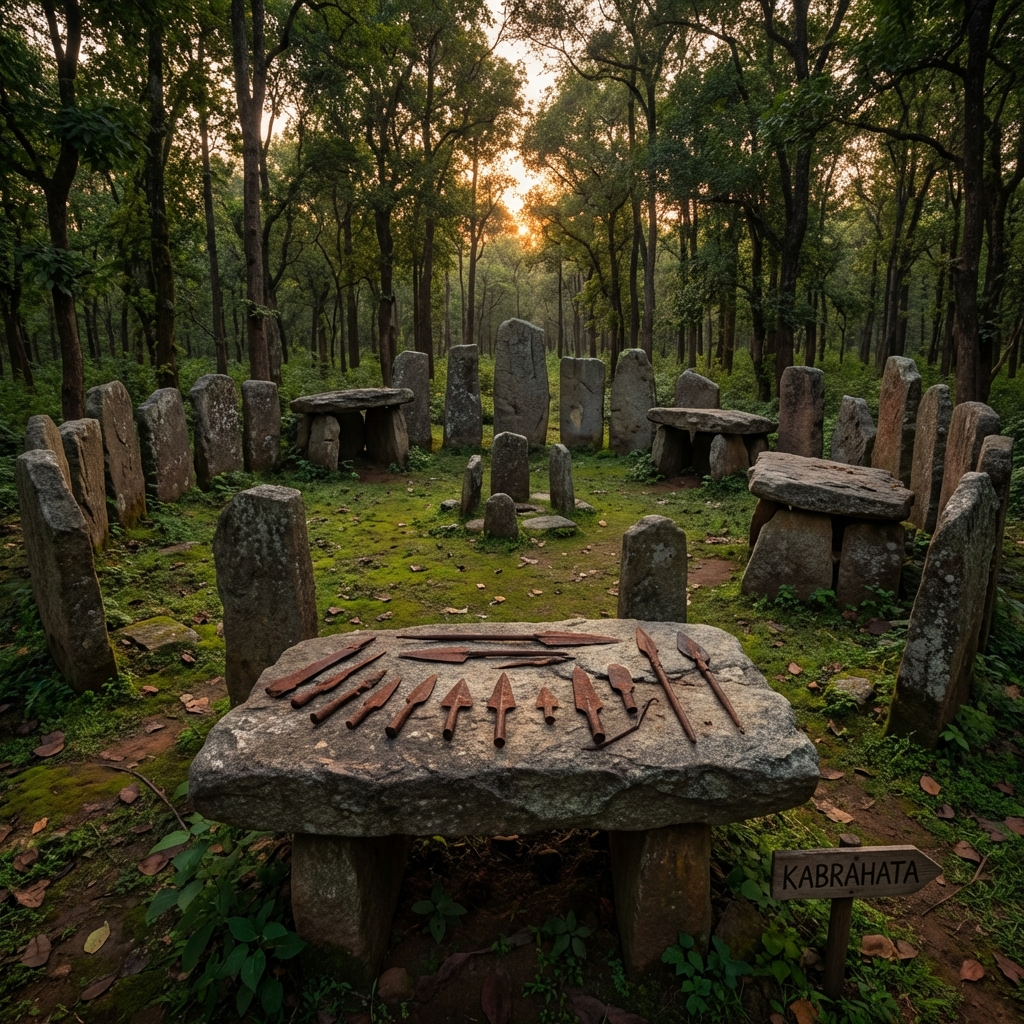
  • Stone-built burial markers; Iron Age context; grave goods = iron tools, gold ornaments, Black-and-Red Ware
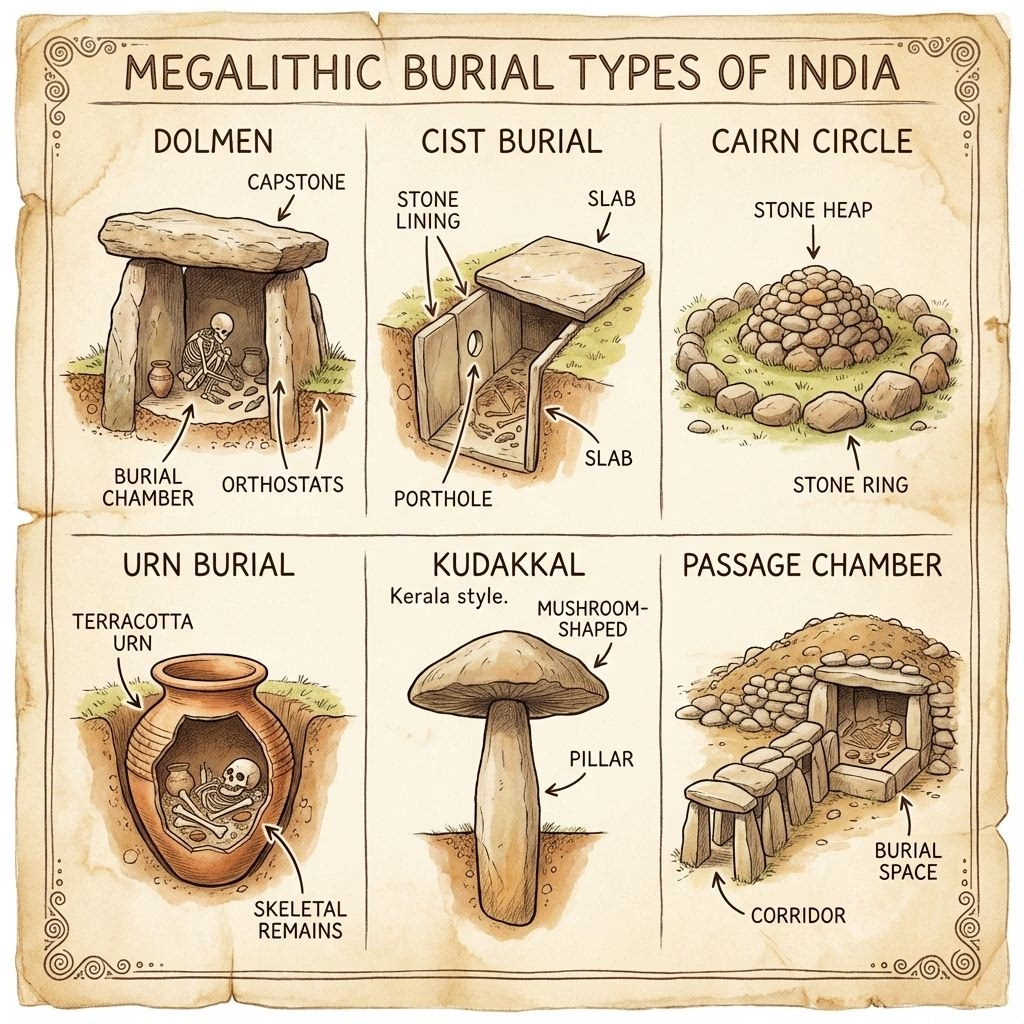
  • Burial types: Urn, pit, cist, sarcophagus
Types of Megaliths?
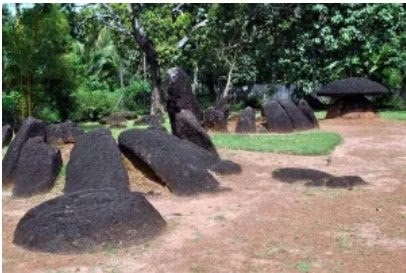
  • Menhir: Single upright tapering stone (Ellarigudem, TS)
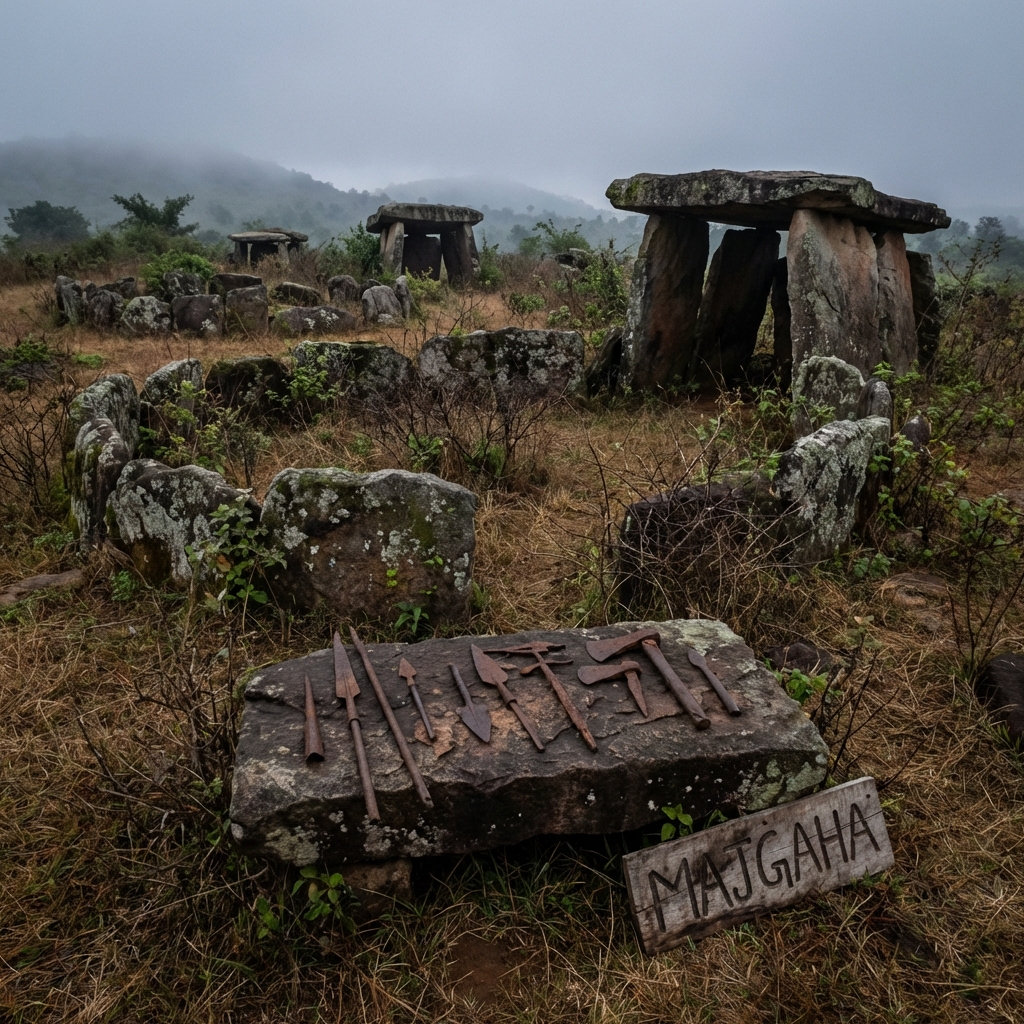
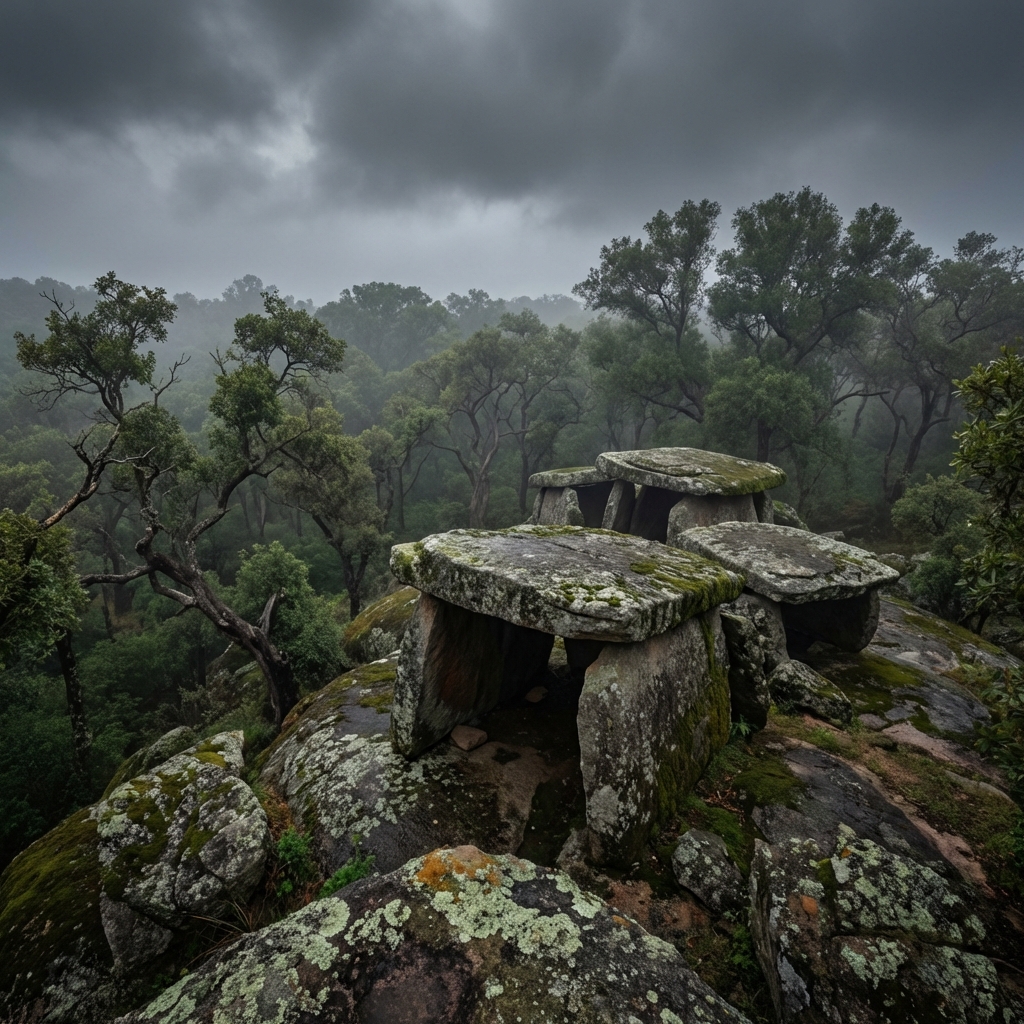
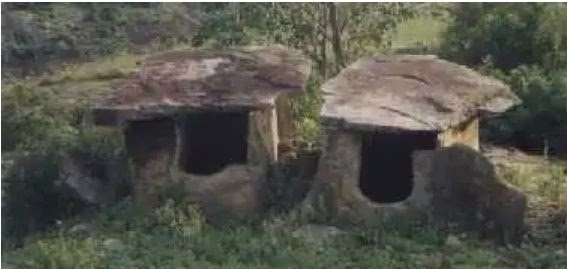
  • Dolmen: 3+ upright stones + flat capstone (Hire Benkal, KA; Marayur, KL)
  • Cairn: Man-made conical stone pile (Ottiyambakkam)
  • Cromlech: Prehistoric stone arrangement in circle/arc
  • Cist: Stone-lined burial chamber (Brahmagiri, KA)
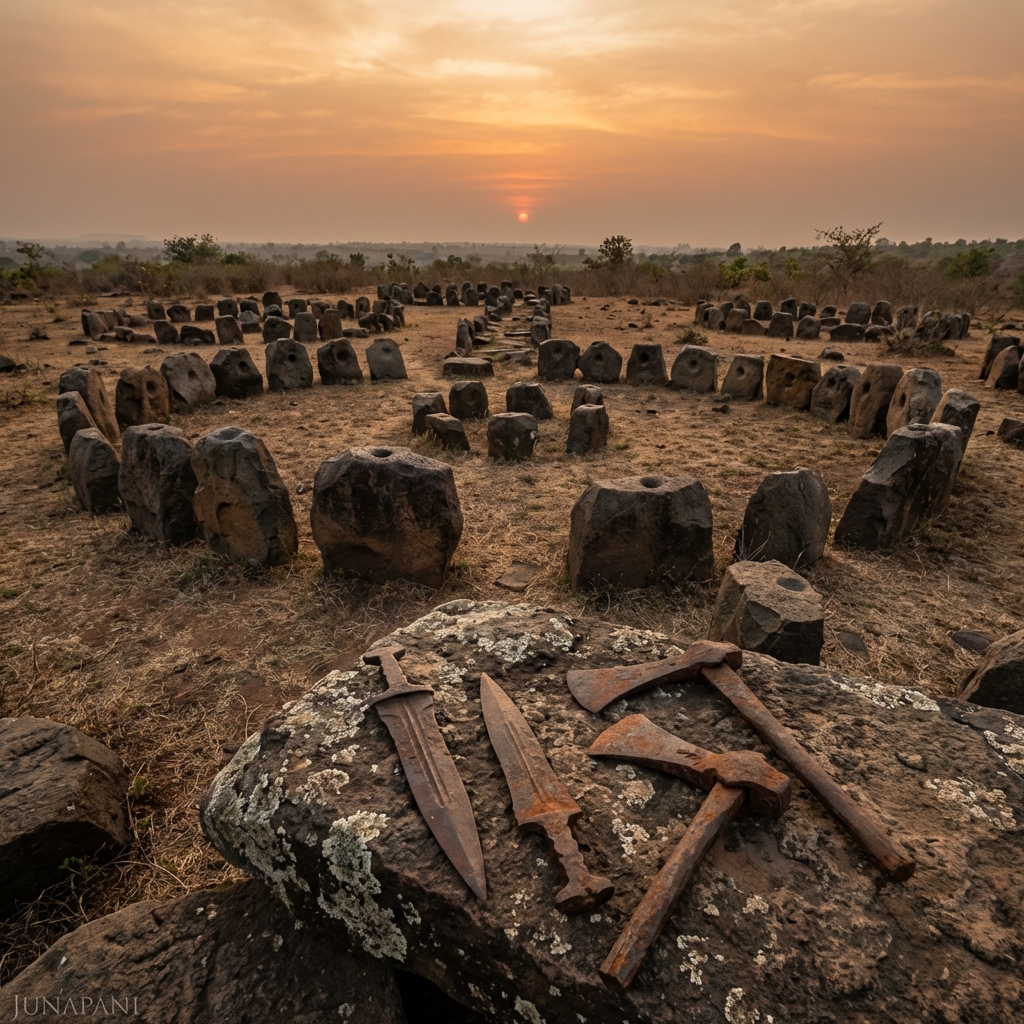
  • Stone Circle: Standing stones in circular/arc shape (Junapani, MP)
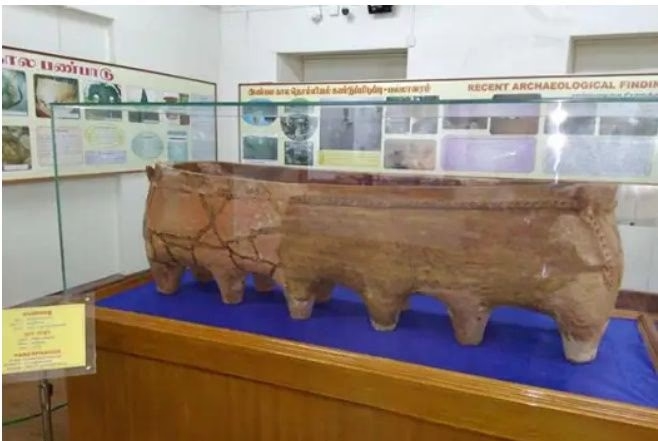
  • Sarcophagus: Stone coffin-style burial (common in Kerala)
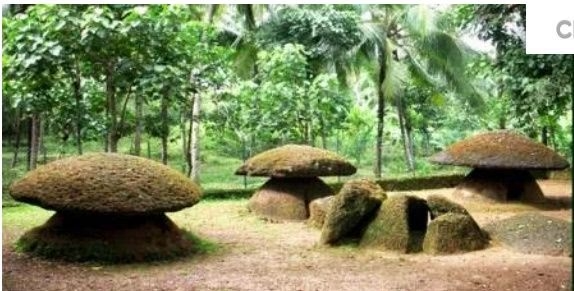
  • Toppikkal (Hat-stone), Pathikal (Flat stone grave), Kodakkal: Kerala-specific types
Key Megalithic sites?
  • Adichanallur (TN): Excavated by Alexander Rea; iron-age urns & bronze
  • Hire Benkal (KA): Dolmens
  • Nagarjunakonda (AP): Buddhist + Megalithic
  • Mangadu (KL): Megalithic — PYQ 2024
  • Also: Maski, Hallur, Piklihal (KA); Junapani (MP); Deodhoora, Koldihwa
Bhimbetka Rock Paintings
Key facts about Bhimbetka?
  • Discovery: V.S. Wakankar (1957); >500 paintings across 800 caves; Raisen district, MP; Vindhyan range
  • UNESCO World Heritage Site; sandstone & quartzite hillside
  • Up to 20 layers of overlapping paintings
Bhimbetka painting phases?
  • Upper Palaeolithic (Period I): Green (dancers) & dark red (hunters); huge animals (bison, elephant, tiger, rhino, boar); stick-like humans
  • Mesolithic (Period II): Most abundant; naturalistic colors; hunting scenes, community life, hand/fist prints; small humans, many animals
  • Chalcolithic: Varied themes
  • Subjects: elephant, bison, tiger, boar, deer, antelope, leopard, rhino, fish, birds
Indologists & Key Scholars
List key scholars & contributions?
  • John Lubbock: Coined terms Palaeolithic & Neolithic (1865)
  • Robert Bruce Foote: First Palaeolithic tool find at Pallavaram, India (1863)
  • V.S. Wakankar: Discovered Bhimbetka (1957); excavated Kayatha
  • V. Gordon Childe: Coined 'Neolithic Revolution'; self-sufficient food-producing economy
  • William Jones: Founded Asiatic Society of Bengal (1784); translated Shakuntalam
  • Alexander Cunningham: Father of Indian Archaeology; first DG of ASI; identified Harappa
  • James Prinsep: Deciphered Brahmi & Kharoshthi (1837) — PYQ 2016
  • John Marshall: Identified IVC as Bronze Age urban culture
  • Mortimer Wheeler: Introduced scientific excavation & stratigraphy
  • Daya Ram Sahni: First to excavate Harappa (1921)
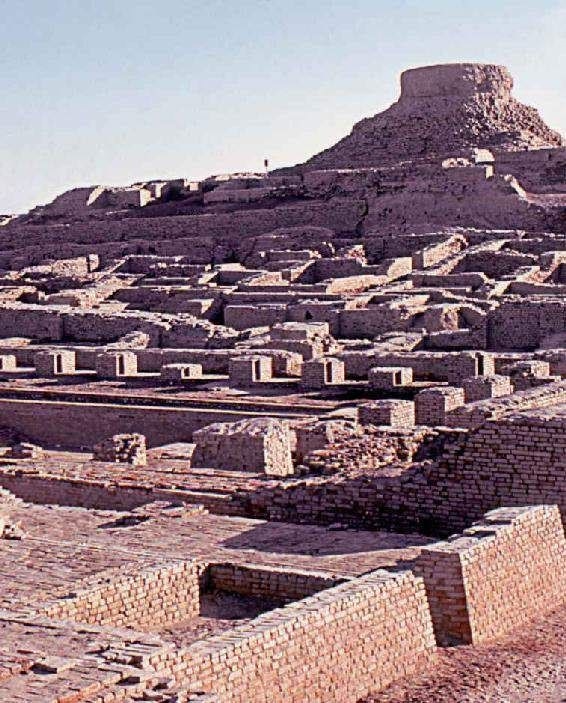
  • R.D. Banerji: Identified Mohenjo-daro (1922)
  • Alexander Rea: Excavated Adichanallur (Iron Age urns/bronze)
  • Georg Bühler: Pioneer in Indian epigraphy; studied Ashokan inscriptions/Brahmi
  • D.C. Sircar: Authority on epigraphy; authored Indian Epigraphy
  • Max Müller: Editor of Sacred Books of the East; popularised Aryan theory
PYQ Targets
Robert Bruce Foote / Pallavaram?
  • First Palaeolithic tool: Robert Bruce Foote at Pallavaram (1863) — PYQ 2024
Burzahom trap?
  • Burzahom: Pit dwellings, NOT rock-cut shrines; dog burials — PYQ 2021
Chandraketugarh?
  • Chandraketugarh: West Bengal (trading port + terracotta art), NOT Odisha — PYQ 2024, 2021
Inamgaon & Mangadu?
  • Inamgaon: Maharashtra (Chalcolithic site); Mangadu: Kerala (Megalithic site)
Ganeshwar?
  • Ganeshwar: Known for copper artefacts — PYQ 2021
James Prinsep?
  • James Prinsep: Deciphered Ashokan Brahmi & Kharoshthi (1837) — PYQ 2016
Koldihwa / Mehrgarh?
  • Koldihwa (UP): Earliest rice cultivation; Mehrgarh (Balochistan): Earliest Neolithic site in South Asia
Baghor I?
  • Baghor I (MP): Earliest known shrine (Upper Palaeolithic); triangular concentric stone = female goddess
Daimabad Hoard?
  • Daimabad Hoard: 4 bronze objects — 2-wheeled chariot with rider, buffalo, elephant, rhinoceros
Bone tools site?
  • Only sites with Upper Palaeolithic bone tools: Kurnool & Muchchatla Chintamanu Gavi (AP)
Ash mounds?
  • Ash mounds: Burnt cattle dung; South Indian Neolithic; Utnur, Kupgal, Kodekal, Pallavoy, Piklihal
Largest Mesolithic site?
  • Bagor (RJ, Kothari river) = Largest Mesolithic site in India
Sivagalai?
  • Sivagalai (TN): Iron usage by 3345 BCE — pushes back Iron Age
UPSC Relevance
Key angles UPSC targets?
  • First Tools: Pallavaram by Robert Bruce Foote (1863).
  • Agricultural Origins: Mehrgarh (earliest Neolithic), Koldihwa (earliest rice).
  • Habitations: Pit dwellings & dog burials at Burzahom; ash mounds at South Indian Neolithic sites.
  • Artistic Heritage: Bhimbetka (UNESCO WHS) discovered by V.S. Wakankar.
  • Metallurgy: Copper = first metal (Chalcolithic); iron emergence ~1200 BCE; Sivagalai dates to 3345 BCE.
  • Southern India: Megalithic sites as Iron Age markers; Ash mounds as Neolithic cattle pen markers.
  • Scholars: Prinsep (script decipherment), Marshall (IVC), Cunningham (Father of Archaeology).
  • Inamgaon: Best studied Chalcolithic site; evidence of irrigation, social stratification, artisan quarters, climate-driven decline.
  • Theories: Childe, Binford, Flannery on origin of agriculture — UPSC Mains angle.
→ Palaeolithic Sites — State-wise Distribution
Kashmir & NW India (Sohanian)?
  • Kashmir: Palaeolithic rare (cold glacial); handaxe found near Pahalgam on River Lidder; Pir Panjal range & Beas, Rangange, Sirsa river banks
  • Potwar Plateau (between Pir Panjal & Salt Range): key sites Adial, Balwal, Chauntra — Sohanian tools
  • Soan Valley: Lower + Middle Pal; Sohanian choppers/chopping tools
  • Sohanian fauna: horse, buffalo, straight-tusked elephant, hippopotamus (foreign-origin animals via NW route)
Rajasthan?
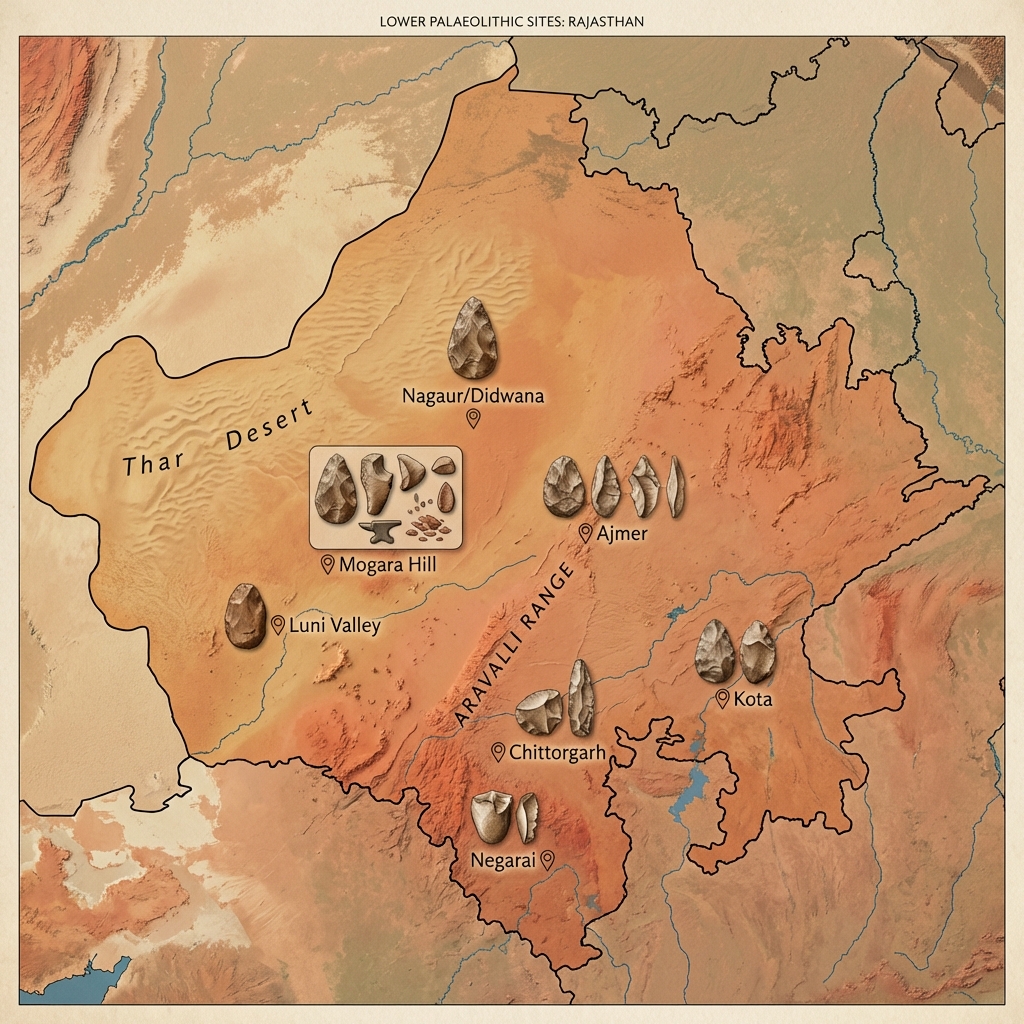
  • Singi Talav (near Didwana): Lower Pal; early hominid cranium found
  • Mogara hill near Jodhpur: Factory site — Lower, Middle, Upper Pal + Mesolithic sequence
  • Didwana & Budha Pushkar: Rich in Middle Pal; Pushkar lake advantage (water + stone)
  • Luni river valley tools (Lower Pal)
Gujarat?
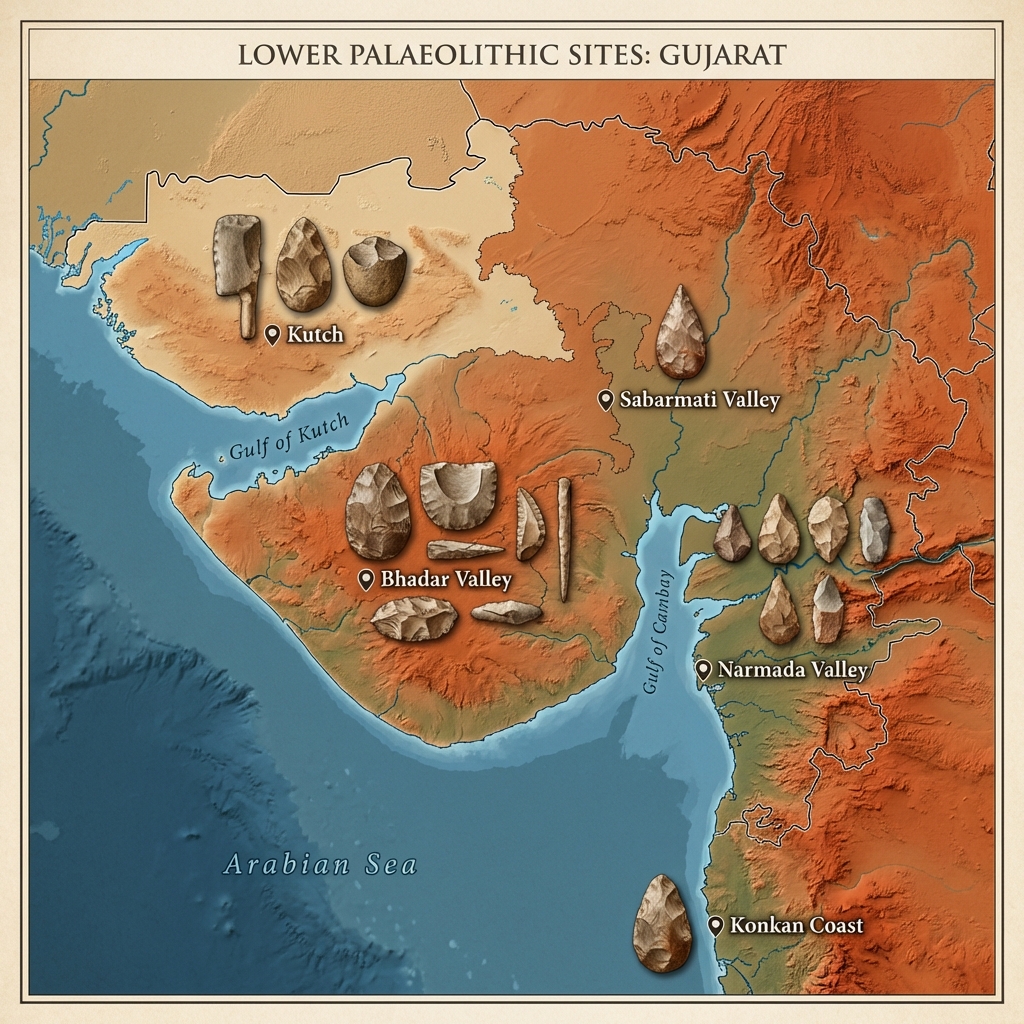
  • Sabarmati, Mahi, Tapti, Narbada tributaries; Bhadar valley (Saurashtra); Kutch desert
  • Konkan coast (Lower Pal); Narbada valley leading to Gulf of Cambay
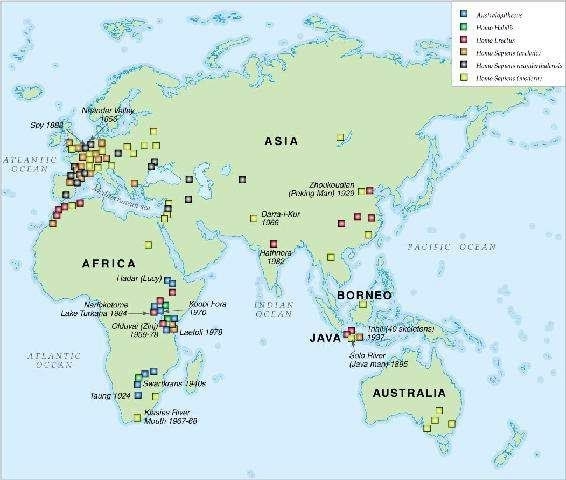
  • Narbada Man: Homo erectus cranial fragment (Hathnora, MP) = only palaeo-human fossil from Indian subcontinent
Maharashtra?
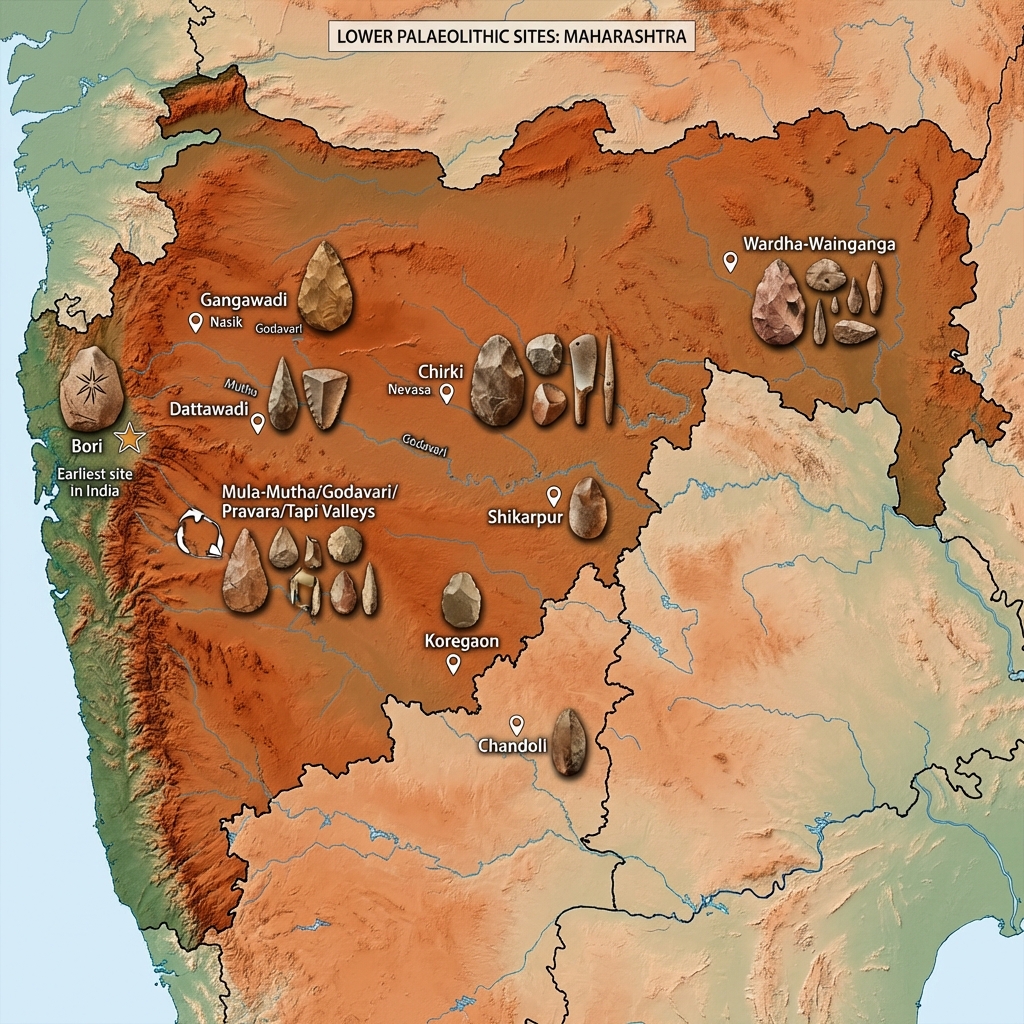
  • Rivers: Mula-Mutha (Pune), Godavari, Pravara, Tapi — all yield Lower Pal tools
  • Sites: Dattawadi (Mutha river, Pune), Gangawadi (Godavari, Nasik), Koregaon, Chandoli, Shikarpur
  • Chirki-Nevasa (Pravara, Ahmednagar): rich Lower & Middle Pal; living & factory site
  • Bori (near Pune, MH): Earliest Lower Pal site in India (volcanic ash layer dated ~1.4 mya)
  • Patne (Tapi valley): Middle + Upper Pal + Mesolithic sequence; ostrich eggshell engravings (Upper Pal)
Central India (MP)?
  • Bhimbetka (Raisen): Longest sequence — Lower Pal → Historic; 5 paved stone floors (Lower Pal)
  • Adamgarh (Hoshangabad): Lower & Middle Pal
  • Narmada, upper Son, Mahanadi valleys; Damoh, Raisen districts
  • Baghor I (Son Valley): Upper Pal shrine
  • Belan Valley (UP): Lower & Middle Pal; animal fossils (cattle, deer)
  • Kalpi (Jalaun, UP): Elephant tusk & molars; earliest human occupation of Ganga plain
South India (KA, AP, TN, KL)?
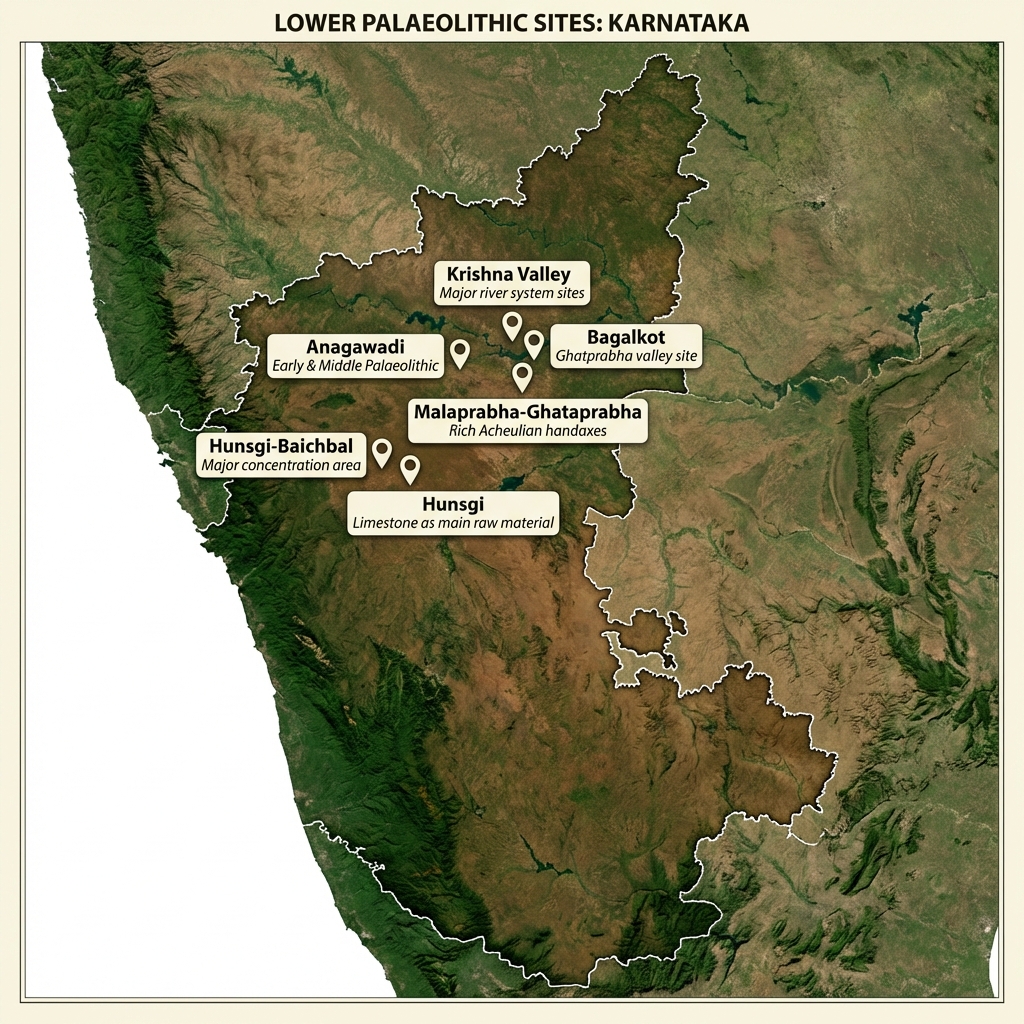
  • Hunsgi-Baichbal & Krishna Valley (Gulbarga, KA): Dense Lower Pal sites; limestone, sandstone, dolerite, chert, quartzite
  • Anagawadi, Bagalkot (Ghatprabha valley, KA): Lower Pal
  • Malaprabha & Ghatprabha valleys, Raichur doab — Lower Pal
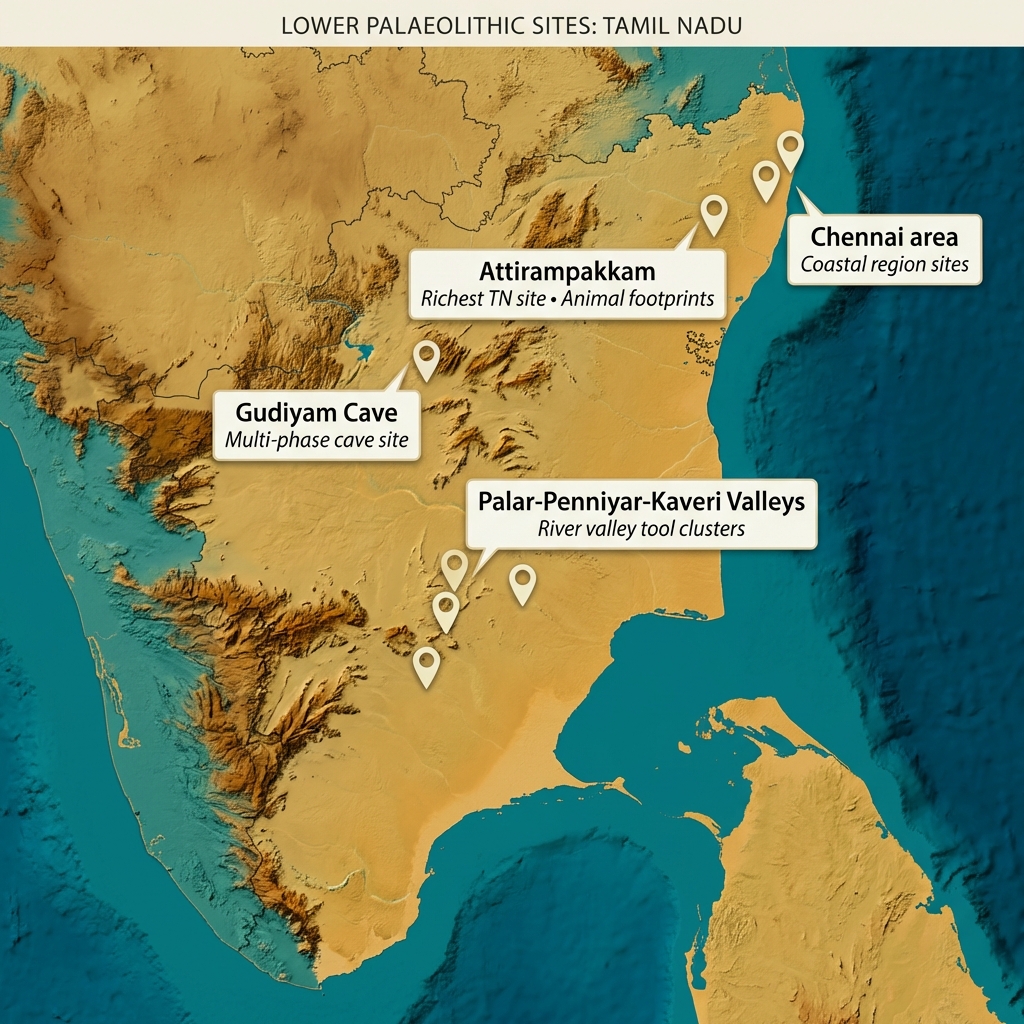
  • Attirampakkam (Kortallayar basin, TN): Richest TN site; Acheulian tools; horse/buffalo/nilgai fossils; animal footprints
  • Gudiyam Cave (near Chennai, TN): Lower Pal; animal bones (hippopotamus, horse, Sivatherium)
  • Palar, Penniyar, Kaveri river valleys (TN): Many Lower Pal sites
  • Nagarjunakonda (AP): Palaeo-climatic evidence of 3 alternating wet/dry cycles; Upper Pal levels
  • Visakhapatnam coast; Kurnool area
  • Kerala: Choppers & scrapers of quartz in Palghat district
Eastern India?
  • Raro river (Singhbhum, Jharkhand): Palaeo tools; Damodar, Suvarnarekha valleys
  • Orissa: Dari-dungri (Sambalpur); Budhabalan-Brahmani; Baitarani-Brahmani; Mahanadi delta; Buharbalang Valley (Mayurbhanj)
  • Paisra (Munger, Bihar): Living & working floor; 8 post-holes = thatched huts; earliest evidence of shelter building
  • Anangpur (Badarpur hills, Delhi): Large Lower Pal habitation & factory site
→ Upper Palaeolithic Environmental Changes
Climate & environmental shifts in Upper Palaeolithic?
  • Cold & arid in N & W India; desiccation of rivers
  • Ice-free areas: Rain-shadow zones, low-altitude plains, coastal areas became refugia
  • Desert formation: Rajasthan desert (Thar) expanded
  • Westward shift of river channels; sea level decreased (glacial lock-up of water)
  • Ostrich (adapted to arid conditions): bones found at 40+ sites in RJ, MP, MH — climate marker
  • Ostrich eggshells at Patne (MH): 4 perforated shell beads; criss-cross engravings = earliest portable art in India
  • Holocene (~10,000 BCE): Warming → rivers reformed → Mesolithic expansion possible
Upper Palaeolithic society details?
  • No pottery, no fire in Lower/Middle Pal; fire mastered by Homo erectus in Middle Pal
  • Diet: ox, bison, nilgai, chinkara, gazelle, blackbuck antelope, sambar, spotted deer, wild boar, birds, tortoise, fish, honey, fruits, roots
  • Hunting: selective ungulates; seasonal migration followed herds; subsistence patterns tracked dry/wet cycles
  • Rock paintings: Period I (Upper Pal) = green (dancers) & dark red (hunters); animals 2–3 m tall (bisons, elephants, tigers, rhinos, boars); stick-like humans
  • Earliest shrine: Baghor I (Son Valley, MP) — triangular concentric stone, worshipped by Kol & Baiga tribes even today
→ More Mesolithic Sites (Missed Earlier)
Adamgarh hill (Hoshangabad, MP)?
  • South of Bhimbetka; upper layers = Mesolithic; then Neolithic–Chalcolithic level
  • Tools: microliths of chert, chalcedony, jasper, agate (from Narmada riverbed ~2 km); geometric microliths (triangles & trapezes); mace heads/ring stones; hammer stones
  • Wild animals: hare, lizard, various deer, horse, porcupine
  • Domesticated: cattle, sheep, goat, dog, pig — earliest domestication evidence (with Bagor)
  • Pottery at Mesolithic levels (rare; confirms transition)
Baghor II (Son Valley, MP)?
  • Lower Pal + Mesolithic sequence
  • Tools: chert & chalcedony; geometric microliths; grinding stone fragments, hammer stone, red ochre pieces
  • Very few finished tools → most material = stone-working waste → tools made here and taken elsewhere
  • 5–6 large shelters identifiable by post-hole series
Lekhakia (Mirzapur, UP)?
  • Rock shelters in Kaimur range (southern UP)
  • Blade tools & microliths; burials found; pottery also found
Baghai Khor (Kaimur range, UP)?
  • Same area as Lekhakia; another rock shelter site
  • Two phases: pre-ceramic and ceramic microlithic
  • Two extended burials: first = pre-ceramic phase; second = ceramic phase
Morhana Pahar (UP) & other Kaimur sites?
  • Kaimur range, near Mirzapur
  • Rich Mesolithic art: rock paintings of chariots waylaid by men armed with spears, bows & arrows
  • Also: Morhana Pahar group of rock shelters — abstract & fantastic scenes
Tilwara (Rajasthan)?
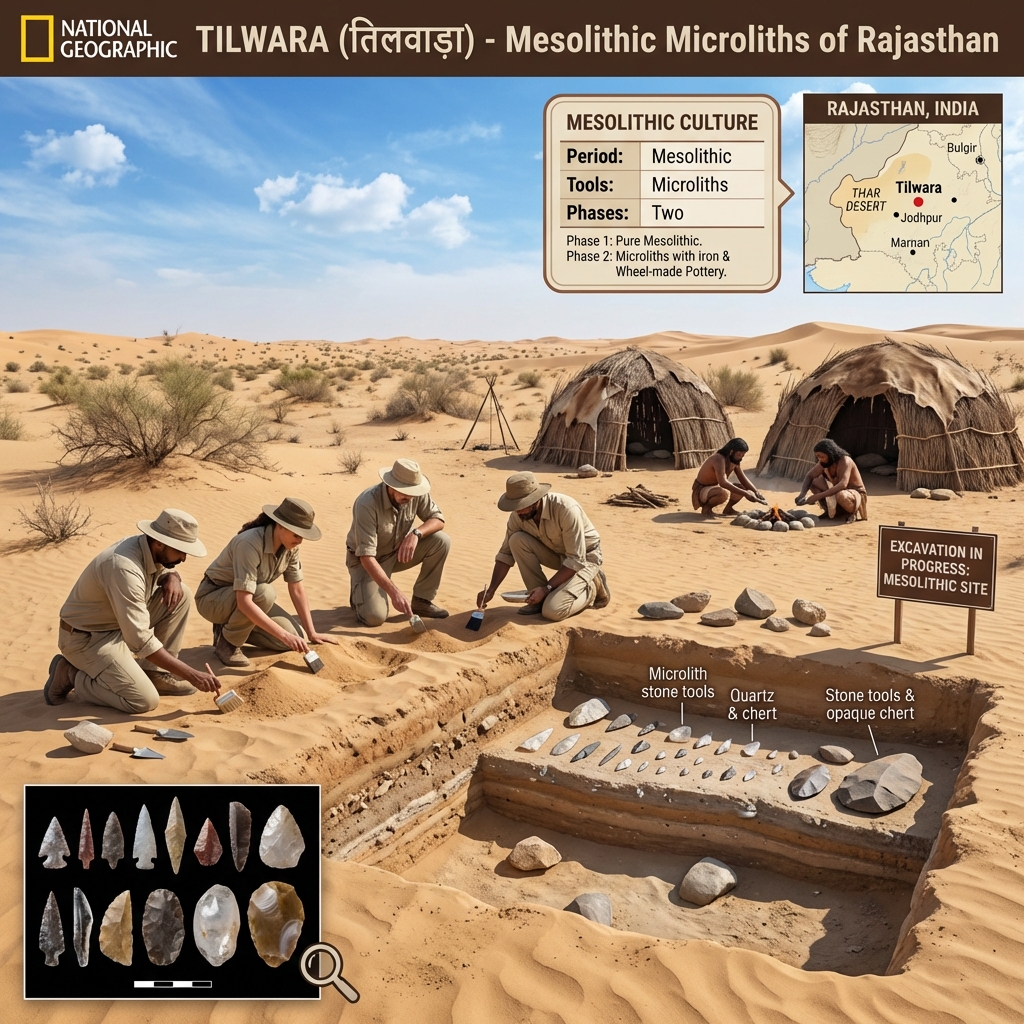
  • Pachpadra basin & Sojat area (RJ) rich in microliths
  • Tilwara: significant habitation site; Phase I = Mesolithic (microliths), Phase II = later
Paisra (Bihar) — Mesolithic phase?
  • Microliths at Mesolithic level; large & small fireplaces very close together
  • Thin deposit → short period of Mesolithic occupation
Sebalgiri (Meghalaya)?
  • Sebalgiri, Garo hills: Pre-Neolithic microliths
  • Mayurbhanj, Keonjhar, Sundergarh (Orissa): Microlithic assemblages
  • Chhota Nagpur plateau, Orissa coastal plains, Bengal delta, Brahmaputra valley, Shillong plateau: all yield microliths
→ Mesolithic Sites — South India & Deccan
Karnataka Mesolithic sites?
  • Jalahalli & Kibbanhalli (near Bangalore, KA): Microliths found
  • Sangankallu (western fringe of Karnataka plateau): Cores, flakes, points
  • South of KA plateau: microliths mostly of milky quartz
Tamil Nadu Mesolithic sites?
  • Teris: Old sand dunes south of Chennai; tiny stone tools (quartz & chert); mark coastal Mesolithic fishing camps
  • South of Chennai coast: many teri sites (coastal mesolithic fishing communities)
Andhra Pradesh Mesolithic sites?
  • Kurnool area: Many microliths
  • Nagarjunakonda (S AP): Microliths
  • Renigunta (Chittor district, AP): Microliths
  • Visakhapatnam coast: Stone tablets & ring stones at Chandrampalem, Paradesipalem, Rushikondalocal fishermen still use similar ring stones as net sinkers today
Maharashtra / Mumbai Mesolithic?
  • Microlithic sites near Mumbai = coastal mesolithic communities exploiting marine resources
  • Konkan (coastal) and inland plateau sites: Janyire, Babhalgo, Jalgarh
  • Deccan basaltic plateau: many Mesolithic sites; Dhulia & Poona districts
  • Godavari delta: rich in microliths; associated with Neolithic culture
Rivers & inter-regional movement?
  • Krishna & Bhima rivers: many microliths; evidence of inter-regional interaction
  • Fact that tools N & S of Ganga made from same stone = raw materials OR tools crossed the river
  • Sarai Nahar Rai, Damdama & Mahadaha people travelled >75 km to reach Vindhyas stone sources
  • Sambhar lake (Ajmer, RJ): Plant cultivation evidence ~7000–6000 yrs BP (not full agriculture)
→ Mesolithic Habitation Environments
6 types of Mesolithic habitation environments?
  • Sand-dune: Gujarat & Marwar; dunes enclose shallow lakes/ponds (aquatic food); thorny scrub with many animals → easy food collection
  • Rock-shelter: Vindhya, Satpura, Kaimur hills of Central India; thick deciduous forest; rainfall; some occupied since Acheulian times
  • Alluvial plain: River banks — water + game; Birbhanpur (Damodar's alluvial plain, WB); Gangetic plain UP sites
  • Rocky plain: Deccan plateau hilltops; seasonal or short-duration occupation (unless river nearby)
  • Lake-shore: Gangetic Valley (Allahabad & Pratapgarh); settlements on lake shores; food = lake resources + dense alluvial forest
  • Coastal: Large number of microlithic sites on coasts; e.g., Salsette Island; teri dunes in Tirunelveli district — marine resource-based diet
Mesolithic pottery details?
  • Pottery absent at most sites; present at: Langhnaj (GJ), Kaimur (Mirzapur, UP), Chopani Mando (Period III)
  • Pottery came after introduction of geometric tools (Late Mesolithic)
  • Sherds very small; hard to identify shapes; most popular: shallow & deep bowls with featureless rim
  • Wholly hand-made; coarse-grained; incised & impressed designs rare
Structural activity in Mesolithic?
  • Evidence: hutments, paved floors, wind screens
  • Houses: roughly circular or oval; post-holes around them; some stone-paved floors
  • Paved floors + wattle at Bagor
  • Bhimbetka folk made floors with flat stone slabs
  • Chopani Mando: reed impressions on burnt clay → wattle-and-daub round huts
→ Mesolithic Hunting Methods & Rock Art Details
Hunting methods from Bhimbetka paintings?
  • Weapons: Bow & arrow, barbed spears, sticks
  • Ring stones used as stone clubs
  • Animal head masks (rhinoceros, bull, deer, monkey) — disguises to deceive game
  • Animals driven down a cliff (depicted in paintings)
  • Men carrying dead animals suspended on wooden bar (depicted)
  • Bhimbetka Boar: body of boar + rhino snout + elephant underlip + buffalo horn
  • No snake paintings in any Mesolithic site (significant absence)
  • Jaora (MP): Abstract painting possibly representing air, earth & fire
  • Orissa rock art: co-existence of painting and engraving in same shelter (unique feature)
Mesolithic rock art locations?
  • Bhimbetka (MP): Richest; Period II = most abundant naturalistic paintings
  • Adamgarh (Hoshangabad, MP): Hunting scenes, human social life
  • Pratapgarh & Mirzapur (UP): Rich rock paintings
  • Paintings made in both inhabited and uninhabited shelters
  • Subject matter: wild animals & hunting; social/religious life (sexual activity, childbirth, rearing, burial, dancing, playing instruments)
  • Animals most frequent; also: animal-headed human figures; squares/oblongs (possible huts or enclosures)
Mesolithic clothing & ornaments?
  • Human figures in paintings: wearing loin cloth
  • Elaborate ornaments: headgear, feathers, waistbands
  • Shell, ivory and bone beads evident from sites
  • Musical instruments depicted: blowpipes and horns
Mesolithic social organisation?
  • Evidence of movement & interaction: factory sites (raw material sources) = meeting grounds
  • Late Mesolithic communities interacted with early agriculturists in neighbourhood
  • Burials mostly W–E orientation; grave goods → belief in afterlife OR bad luck from deceased's belongings
  • Jewellery on body before burial → high-rank individuals
→ Additional Neolithic Facts
Ramapuram (Kurnool, AP)?
  • Beginning of Chalcolithic phase at Singanapalli & Ramapuram (Kurnool, AP)
  • House floors plastered with lime
  • Wheel-made painted pottery: mostly black-on-red
  • Microliths; beads of semi-precious stones
Kunjhun & Ganeshwar specialisation?
  • Kunjhun & Ganeshwar: Fairly well-developed craft traditions; site specialisation (Neolithic)
  • Ganeshwar (RJ): Known for abundant copper artefacts — important PYQ fact
  • Many Neolithic sites show separate zones: cattle rearing area, craft production area, butchering area
Burzahom — additional facts?
  • Burzahom joint human-animal burials: humans buried with dogs → reflects close relationship between people and animals
  • Pit dwellings (not rock-cut shrines — common PYQ trap)
  • Hunting-fishing economy; not primarily agricultural
Mehrgarh burial ritual?
  • Covering bodies with red ochre prior to burial at Mehrgarh → fertility ritual
Humped bull figurines — cult?
  • Humped bull figurines (terracotta) found at: Rana Ghundai, Mehrgarh, Mundigak, Bala Kot, Gilund, Balathal, Chirand
  • May be cult objects; bulls = sacred animals OR just toys
  • Terracotta female figurines = Mother Goddess (fertility cult) — found from Neolithic levels onwards
Neolithic transition — key nuances?
  • In N. fringes of Vindhyas: food-producing Neolithic emerged out of Mesolithic phase (continuity)
  • In NW India (Mehrgarh): no Mesolithic phase — earliest settlements = Neolithic agriculturists
  • Rajasthan: little evidence of Neolithic; earliest sedentary communities appear in full-fledged Chalcolithic context
  • Many 'Neolithic' sites are actually Neolithic–Chalcolithic (overlap with copper use)
  • Agriculture occurrence in India: spread over few millennia — 8th millennium BCE to 1000 BC
Neolithic tools — specific features?
  • Heavy ground tools: pestles, mortars, grinders, pounders, axes, sickles
  • Sickles have characteristic sheen = result of harvesting wild/domesticated plants
  • Most Neolithic cultures start as aceramic (pre-pottery) Neolithic → then hand-made → wheel-thrown pottery
  • Wheel → spinning → weaving → carts (Bronze Age)
→ Chalcolithic — Pottery Diagnostic Features
Kayatha ware?
  • 3 fabrics:
    • Sturdy red-slipped ware with dark brown designs; ring base — most characteristic
    • Thin red-painted buff ware (fine fabric)
    • Combed ware: incised patterns, no slip
Ahar ware?
  • 7 kinds of wares; most characteristic = black-and-red ware painted in white
Savalda ware?
  • Black-on-red painted; naturalistic designs: birds, animals, fishes
Malwa ware?
  • Coarse fabric; thick buff slip; patterns in black or dark brown
Prabhas & Rangpur ware?
  • Derived from Harappan black-on-red painted ware (post-Harappan influence visible)
Jorwe ware?
  • Painted black-on-red; matt surface with red wash
  • Distinctive forms: carinated bowls, spouted jars with flaring mouths, high-necked globular vases
General Chalcolithic pottery facts?
  • All cultures have associated red or grey wares; mostly wheel-made but also hand-made
  • Shapes: bowls, basins, globular jars with concave necks, dishes, lotas
→ Chalcolithic — Additional Site & Economy Details
Navdatoli details?
  • West Nimar district, MP; on banks of Narmada
  • Largest settlement of Malwa culture; inhabited through 4 stages
  • Circular or rectangular shape; circular wattle-and-daub houses; post holes; floors plastered with lime
  • Chulhas and storage jars found in houses; 1–2 mouthed chulhas in kitchen
  • Grain stored in deep pit silos
  • Circular mud platforms inside houses
Ahar (Banas culture) site details?
  • Houses on plinths made of schist
  • Walls of mud or mud brick; decorated with quartz cobbles
  • Floors: burnt clay or clay mixed with river gravels
  • Bigger houses: partition walls, chulahs & quartzite saddle querns in kitchen
Chalcolithic fortified sites?
  • Eran & Nagda (Madhya Pradesh, Malwa culture): Fortification walls
  • Inamgaon: Fortified mud wall + ditch; embankment + channel for flood irrigation
Chalcolithic stone blade industry?
  • All cultures: blade/flake industry of siliceous stones (chalcedony, chert, jasper, agate)
  • Tool types: long parallel-sided blades, blunted back blades, serrated blades, penknives, lunates, triangles, trapezes
  • Some blades have shine on sharp edge = used for harvesting
  • Polished stone axes (Karnataka-Andhra type) also found at some of these sites
Chalcolithic copper objects (full list)?
  • Flat axes/celts (convex cutting edges), arrowheads, spearheads, chisels, fish hooks, mid-ribbed swords, blades, bangles, rings, beads
  • Kayatha: One pot contained 28 copper bangles
  • Inamgaon: Beads of gold & ivory; spiral ear ring of gold; anklets of copper
Chalcolithic wild & marine fauna?
  • Wild: blackbuck, four-horned antelope, nilgai, barasingha, sambar, chital, wild buffalo, one-horned rhinoceros
  • Also: fish, waterfowl, turtle, rodents bones at some sites
  • Inamgaon: Marine fish bones — source = Kalyan or Mahad (nearest creek ports) → evidence of coastal trade
  • Charred bones of both domestic & wild species = cooked in open fire
  • Most animals slaughtered when young
Chalcolithic Malwa economic decline?
  • At close of 2nd millennium BC: drastic climate change in W & Central India → increasing aridity → semi-nomadic existence
  • Late Jorwe (1000–700 BC) at Inamgaon: small round huts; pit silos → 4-legged storage jar; sheep/goat pastoralism replaced farming
  • Godavari, Tapi, Bhima valleys deserted; reoccupied after 5–6 century gap in 5th–4th centuries BC (heralded by urbanisation)
  • Post-Harappan influence on Chalcolithic cultures visible but with strong regional identity & inter-cultural trade links

🖼️ Supplemental Asset Directory


Supplemental Asset Directory
  • Sohanian Culture Infographic: Sohanian Culture Infographic
  • North India Prehistoric Infographic: North India Prehistoric Infographic
  • Adamgarh Rock Shelter: Adamgarh Rock Shelter
  • Paisra Mesolithic: Paisra Mesolithic
  • Lower Palaeolithic Tools: Lower Palaeolithic Tools
  • Major Palaeolithic Sites Map: Major Palaeolithic Sites Map
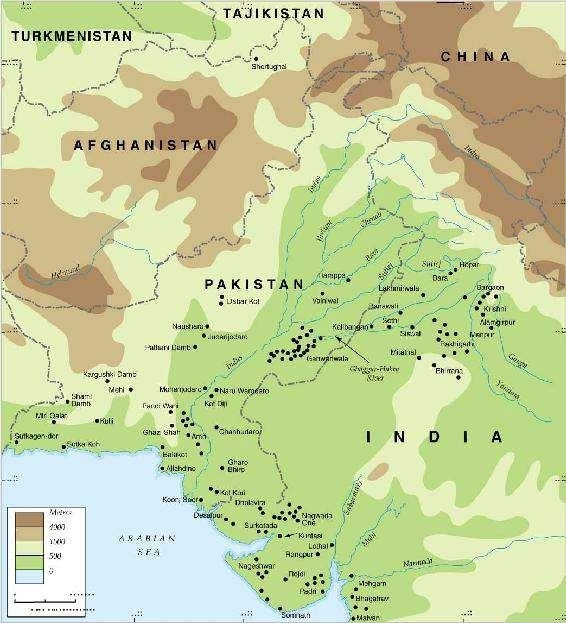
  • North India Prehistoric Map: North India Prehistoric Map
  • Madhya Pradesh Prehistoric Map: Madhya Pradesh Prehistoric Map
  • Rajasthan Prehistoric Map: Rajasthan Prehistoric Map
  • Maharashtra Prehistoric Map: Maharashtra Prehistoric Map
  • Karnataka Prehistoric Map: Karnataka Prehistoric Map
  • Tamil Nadu Prehistoric Map: Tamil Nadu Prehistoric Map
  • Middle Palaeolithic Tools: Middle Palaeolithic Tools
  • Gujarat Prehistoric Map: Gujarat Prehistoric Map
  • Patne Ostrich Egg Shells: Patne Ostrich Egg Shells
  • Upper Palaeolithic Tools: Upper Palaeolithic Tools
  • Stone Age Tools Comparison: Stone Age Tools Comparison
  • Hominid Remains Distribution Map: Hominid Remains Distribution Map
  • Bagor Mesolithic Camp: Bagor Mesolithic Camp
  • Bagor Mesolithic Site Plan: Bagor Mesolithic Site Plan
  • Tilwara Mesolithic Site: Tilwara Mesolithic Site
  • Langhnaj Mesolithic Savannah: Langhnaj Mesolithic Savannah
  • Sarai Nahar Rai Site: Sarai Nahar Rai Site
  • Mahadaha Mesolithic Burials: Mahadaha Mesolithic Burials
  • Mesolithic Sites Map: Mesolithic Sites Map
  • Mehrgarh Neolithic Farming: Mehrgarh Neolithic Farming
  • Mahagara Neolithic Rice: Mahagara Neolithic Rice
  • Utnur Neolithic Ashmounds: Utnur Neolithic Ashmounds
  • Pallavoy Neolithic Ashmounds: Pallavoy Neolithic Ashmounds
  • Sanganakallu Neolithic Ashmounds: Sanganakallu Neolithic Ashmounds
  • Tekkalakota Neolithic Fort: Tekkalakota Neolithic Fort
  • Neolithic Sites Map: Neolithic Sites Map
  • Neolithic Tools: Neolithic Tools
  • Ahar Banas Culture Artifacts: Ahar Banas Culture Artifacts
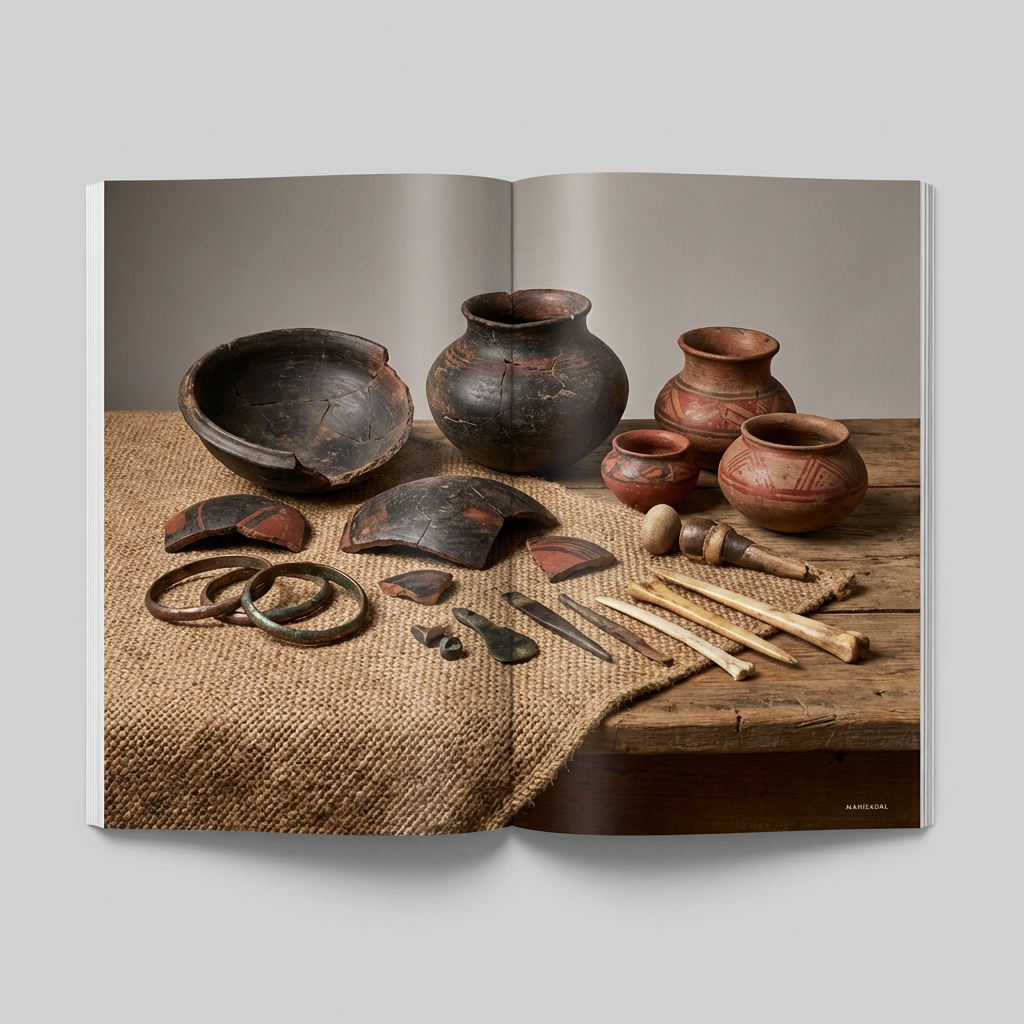
  • Mahisadal Black and Red Ware: Mahisadal Black and Red Ware
  • Copper Hoard Objects: Copper Hoard Objects
  • Kayatha Culture Ceramics: Kayatha Culture Ceramics
  • Copper Hoards Distribution Map: Copper Hoards Distribution Map
  • Junapani Megalithic Circles: Junapani Megalithic Circles
  • Majgaha Megalithic Site: Majgaha Megalithic Site
  • Mahurjhari Megalithic Steel: Mahurjhari Megalithic Steel
  • Kabrahata Megalithic Site: Kabrahata Megalithic Site
  • Adichanallur Urn Burial: Adichanallur Urn Burial
  • Piklihal Neolithic Settlement: Piklihal Neolithic Settlement
  • Marayur Dolmens: Marayur Dolmens
  • Pallavaram Sarcophagus: Pallavaram Sarcophagus
  • Megalithic Burial Types Labeled: Megalithic Burial Types Labeled
  • Menhir (Hazaribagh): Menhir (Hazaribagh)
  • Dolmens (Marayur): Dolmens (Marayur)
  • Sarcophagus (Pallavaram): Sarcophagus (Pallavaram)
  • Toppikkal Hat-stone (Kerala): Toppikkal Hat-stone (Kerala)
  • Hood-stone (Kudaikallu): Hood-stone (Kudaikallu)
  • Bhimbetka: Pregnant Cow (Raisen): Bhimbetka: Pregnant Cow (Raisen)