Skip to content

Gupta Empire (319–540 CE)

Overview
Cue WordsNotes
Gupta Empire Overview 'Classical Age' or 'Golden Age' of ancient India. Decentralised quasi-feudal administration supported by land grants. Flourishing Sanskrit literature, science, astronomy, and Nagara temple architecture. State religion: Vaishnavism.
1. Imperial Gupta Rulers & Navaratnas
Cue WordsNotes
Imperial Rulers Chandragupta I (319–335 CE): Maharajadhiraja, Gupta Era (319 CE), gold coins. Samudragupta (335–380 CE): "Napoleon of India", Prayag Prashasti (Harisena), Kaviraja. Chandragupta II 'Vikramaditya' (380–414 CE): Defeated Shakas, silver coins, Mehrauli Iron Pillar, Fa-Hien visit. Kumaragupta I: Founded Nalanda University. Skandagupta: Repelled Hunas (Bhitari pillar).
Navaratnas of Chandragupta II Kalidasa (Poet/playwright), Amarasimha (Amarakosha lexicon), Dhanvantari (Medicine, Navanitakam), Varahamihira (Astronomy, Brihat Samhita), Vararuchi (Grammar).
2. Administration & Economy
Cue WordsNotes
Decentralised Governance Provinces (Bhukti - Uparika), Districts (Vishaya - Vishayapati), Village (Grama - Gramika/Mahattara). Urban board (Adhishthana Adhikarana): Nagara Sresthin, Sarthavaha, Prathama-Kulika, Prathama-Kayastha. High officers: Kumaramatyas, Sandhivigrahika (War/Peace).
Land & Taxes Largest number of gold coins (Dinaras). Land: Kshetra (cultivable), Khila (waste), Vastu (habitable). Taxes: Bhaga (1/6th produce), Bhoga (perishables), Bali (tribute), Hiranya (cash), Vishti (forced unpaid labour).
3. Society, Literature & Science
Cue WordsNotes
Social Conditions & Sati Rise of sub-castes (Jatis); untouchability pronounced (Chandalas). Pre-puberty marriage; first dated epigraphic evidence of Sati at Eran Inscription (510 CE).
Literature & Science Kalidasa (Shakuntalam, Meghadutam); Sudraka (Mrichchhakatikam); Vishakhadatta (Mudrarakshasa); Vishnu Sharma (Panchatantra). Aryabhata (Pi, Earth rotation); Brahmagupta (Zero rules).
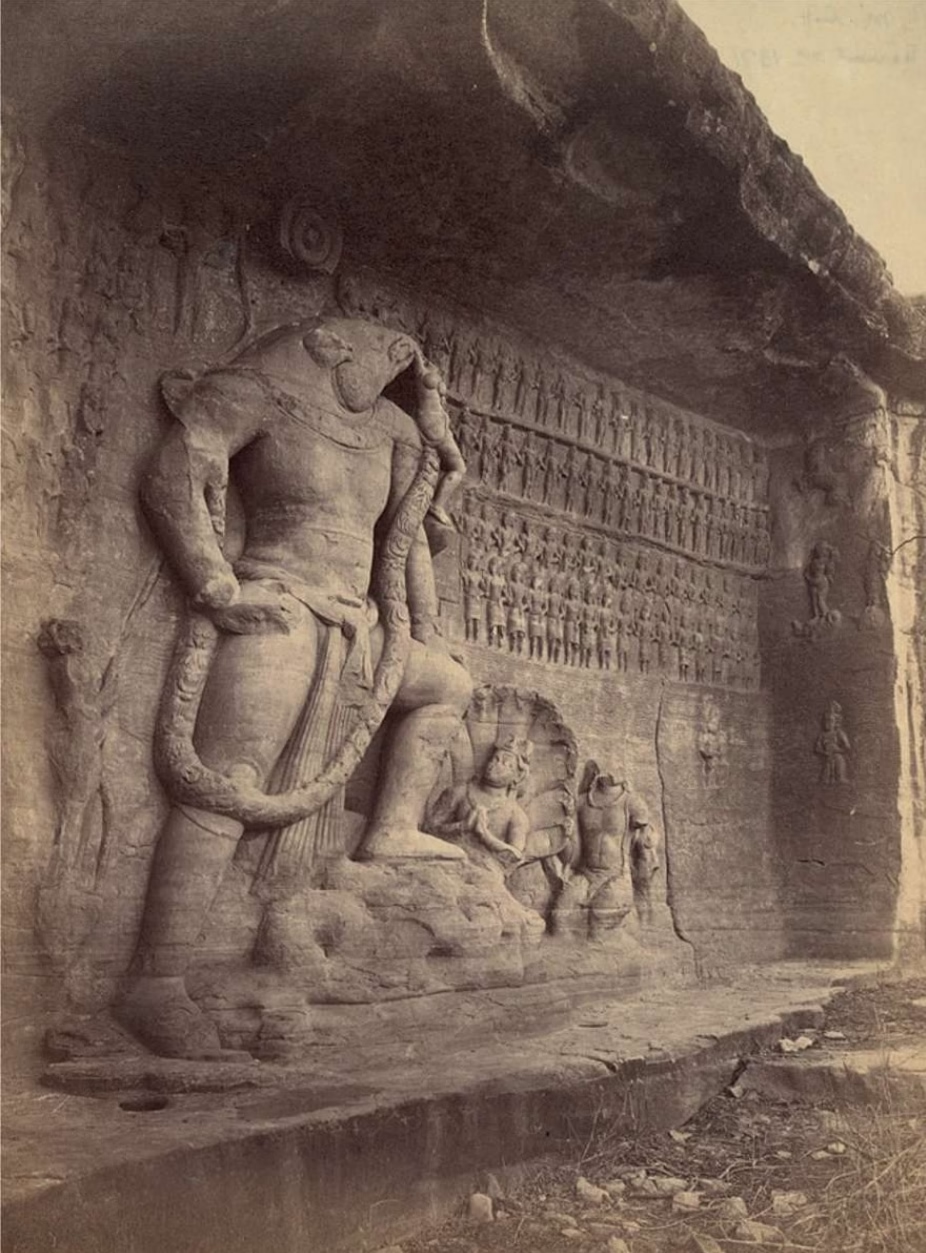
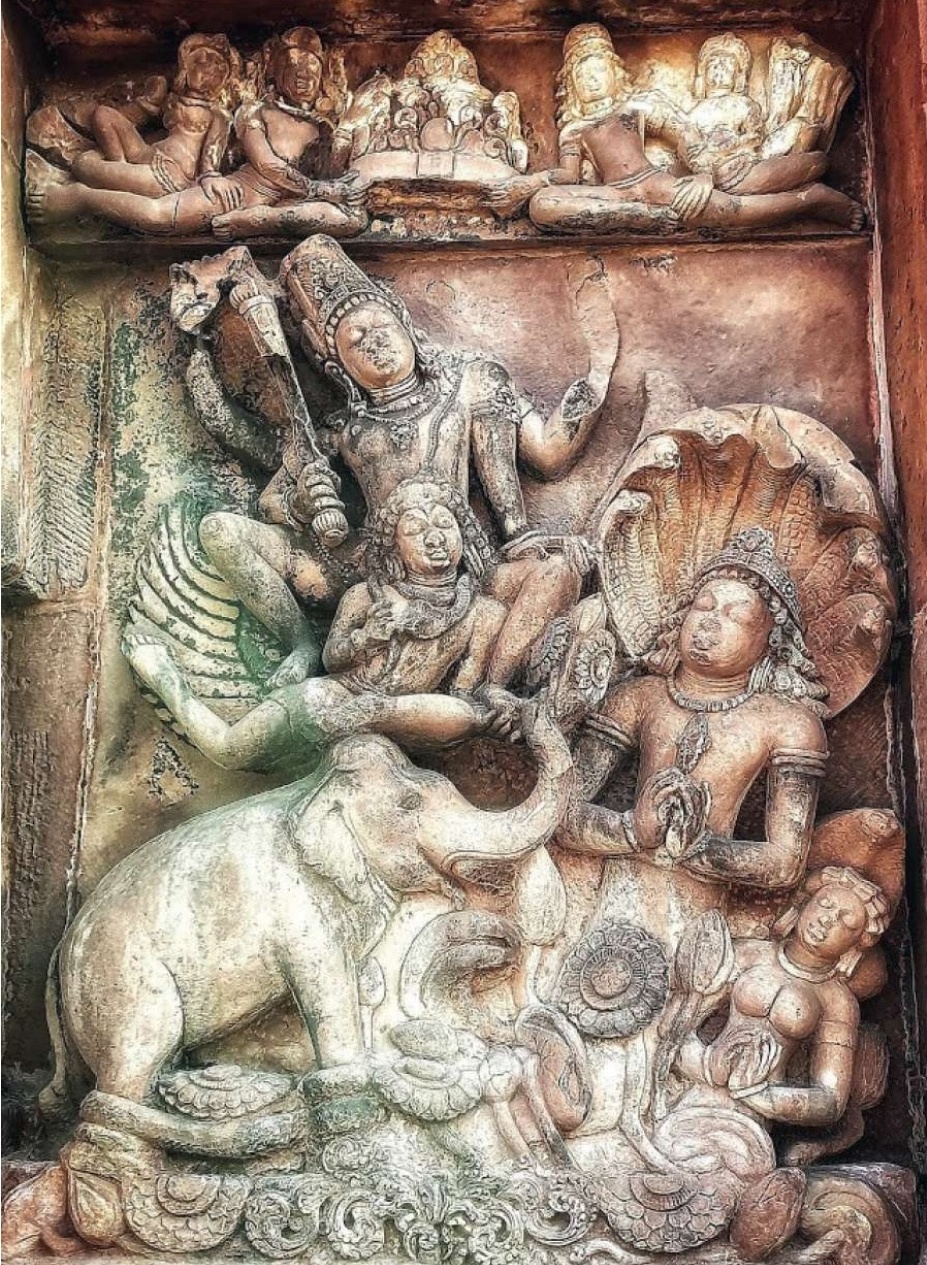
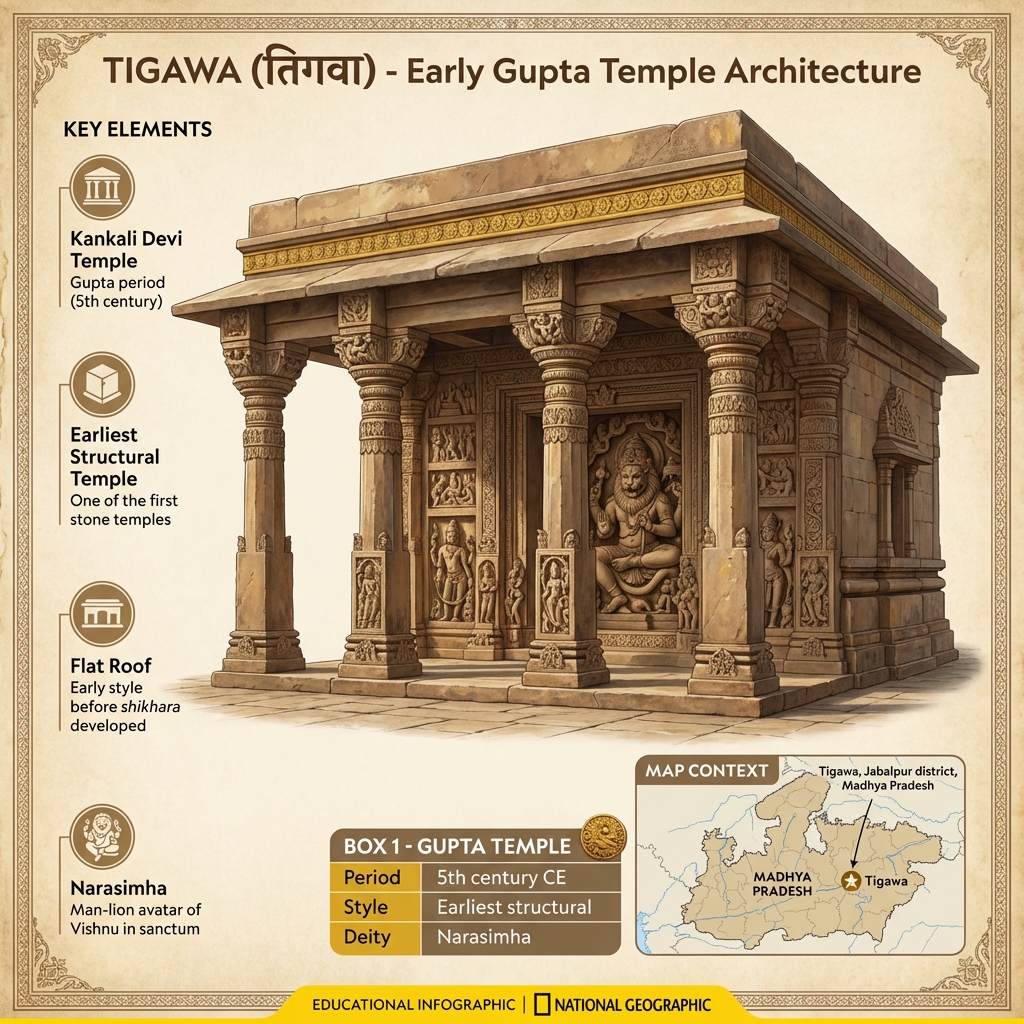
Architecture & Art Early Nagara structural temples: Deogarh Dasavatara Temple (stone), Bhitargaon Temple (brick), Tigawa. Sarnath Seated Buddha sculpture; Ajanta & Bagh cave frescoes.
UPSC High-Yield Recall & Exam Traps
Cue WordsNotes
Eran Inscription 510 CE First dated epigraphic evidence of Sati.
Bhitari Pillar Inscription Details Skandagupta's repelling of Huna invaders.
Nalanda University Founder Kumaragupta I (Mahendraditya) in 5th century CE.
First Silver Coins Chandragupta II (Vikramaditya) issued the first Gupta silver coins after defeating Shakas.
🏛️ Land Grants, Feudalism Debate & Nalanda's UNESCO Status
  • R.S. Sharma's "Indian Feudalism" thesis: Argues Gupta-era land grants (Agrahara/Brahmadeya grants to Brahmins, later officials) created a decentralised landed intermediary class, weakening central control and prefiguring medieval feudalism — a historiographical framework, not universally accepted (D.N. Jha broadly supports it; B.D. Chattopadhyaya and others contest the "feudalism" label for India).
  • Nalanda Mahavihara: Inscribed as a UNESCO World Heritage Site in 2016, recognising the archaeological remains of the monastic-university founded under Kumaragupta I and patronised by successive Gupta and Pala rulers.
Supplemental Asset Directory
  • Varaha Chandragupta II: Varaha Chandragupta II
  • Deogarh Vishnu Avatars: Deogarh Vishnu Avatars
  • Tigawa Gupta Temple: Tigawa Gupta Temple

I'll read the specified range of NOTES_FILE.md and convert every Gupta–Chola detail into zero-loss VitePress Cornell Notes markdown.I'll check existing Cornell Notes in the UPSC materials so the conversion matches the project's format exactly.I have the Cornell format and the full source block. Converting the listed Gupta–Chola sections into zero-loss VitePress Cornell Notes markdown only.

Gupta Empire — Administration, Coinage & Society | Post-Gupta Dynasties | Harshavardhana | Imperial Cholas


1. Gupta Empire — King and Central Administration


1. Gupta Empire — King and Central Administration
Cue WordsNotes
What titles did the Gupta king hold as the central figure of administration?Paramabhattaraka; Parama-daivata; Chakravarti; Paramesvara:
  • The King was the central figure of administration.
  • Titles: Paramabhattaraka, Parama-daivata, Chakravarti, Paramesvara.
How do the Allahabad Prasasti and Bhitari Pillar portray Gupta kings (Samudragupta, Skandagupta, Kumaragupta)?Equal to Gods; Merciful Conqueror; True Path of Religion:
  • Allahabad Prasasti of Samudragupta describes him as “equal to the gods: Dhanada (Kubera), Varuna (Sea-God), Indra and Antaka (Yama).”
  • In the spirit of Smriti literature and of Kalidasa, Skandagupta in his Bhitari Pillar inscription is eulogized as one who “subdued the earth and became merciful to the conquered people, but he became neither proud nor arrogant though his glory was increasing day by day.”
  • His father, Kumaragupta, “followed the true path of religion.”
List the council of ministers and other key officials under the Guptas.Hereditary Offices; Mahanandanayaka; Mahapratihara; Pratihara; Dutakas; No Capital Punishment:
  • Offices were perhaps hereditary.
  • Mahanandanayaka (Chief Justice): assisted the King.
  • Mahapratihara: Chief of palace guards.
  • Pratihara: regulated ceremonies and granted permits for admission to royal presence.
  • As per Fa-Hien: No capital punishment.
  • Dutakas: task of implementing gifts.
Describe the Gupta army structure and military officers.Paid in Cash; King Led Army; Sandhi-Vigrahika; Pilupati–Asvapati–Narapati; Ranabhandagarika:
  • Army was paid in cash; at the time of war the King led his army.
  • Sandhi-Vigrahika / Mahabaladhikrita: Minister in charge of peace and war.
  • Pilupati: head of elephants.
  • Asvapati: head of horses.
  • Narapati: head of foot soldiers.
  • Ranabhandagarika: Officer-in-charge for supply of offensive weapons.

2. Gupta Empire — Revenue Administration and Taxes


2. Gupta Empire — Revenue Administration and Taxes
Cue WordsNotes
What were the main sources of state income and who kept accounts?Land Revenue + Fines; Akshapataladhikrita; Pustapala:
  • Land revenue and fines were sources of the state’s income.
  • Gopasramin working as Akshapataladhikrita: accounts registers; recover royal dues.
  • Pustapala: record-keeper.
List Gupta land, irrigation, transit, commercial and labour dues.Udranga; Bhaga; Bedakhbog; Uparikara; Sulka; Visthi:
  • Land Revenue: Udranga and bhaga.
  • Irrigation Tax: Bedakhbog.
  • Uparikara: levied on cloth, oil, etc. when taken from one city to another.
  • Sulka: commercial tax paid by organization of traders; in case of non-payment → cancellation of right to trade and fine amounting to 8 times of the original Sulka.
  • Visthi: King had a right to forced labour; also mentioned in Arthashastra and Junagadh / Jaunpur Inscription of Rudradaman-I (source notes this parallel).
What share of produce was taken as revenue according to literary sources?Kamandaka Nitisara; Kalidasa; Narada-Smriti = 1/6 of Produce:
  • Kamandaka in Nitisara suggests that a King should take special care of his treasury.
  • Kalidasa and the author of the Narada-Smriti: revenue is 1/6 of produce.

3. Gupta Empire — Provinces, Districts and Villages


3. Gupta Empire — Provinces, Districts and Villages
Cue WordsNotes
How was the Gupta Empire divided into Bhuktis and Vishayas?Bhuktis → Uparikas; Vishayas → Ayuktaka/Vishayapati:
  • Empire was divided into Bhuktis (Provinces): governed by Uparikas, directly appointed by the King.
  • Vishayas (districts): headed by Ayuktaka / Vishayapati; generally appointment by governor, but not always.
What was the Adhikarana of a Vishayapati and what lay below the district?Council of Four; Vithi; Patta; Bhumi; Pathaka; Petha:
  • A Vishayapati administered the Vishaya with the help of the Adhikarana (council of 4 representatives):
    • Nagarasresthi (head of city merchants)
    • Sarthavaha (Caravan-leader)
    • Prathamakulika (head of artisan)
    • Prathama Kayastha (head of Kayastha)
  • Vithi was part of Vishaya.
  • Administrative units below district level included clusters of settlements known variously as vithi, patta, bhumi, pathaka, and petha.
How was village administration organised under the Guptas?Astakuladhikarana; Gramapati; Grama-vriddhas:
  • Astakuladhikarana: in north Bengal, headed by the Mahattara (village elder).
  • Village’s headman: Gramapati.
  • Grama-vriddhas: village disputes.

4. Gupta Empire — Society (Varna, Caste, Sati, Fa-Hien)


4. Gupta Empire — Society (Varna, Caste, Sati, Fa-Hien)
Cue WordsNotes
Did the ideal Varna system hold, and what new social categories emerged?Varna-Samkara; Jatis; Vratya Kshatriya; Apadharma; Brahmadeya/Agrahara; Antyajas:
  • Ideal Varna System was not practiced; many Jatis (Caste — a Portuguese word, derived in the 14th Century) emerged due to Varna-Samkara (inter-marriage between varnas).
  • Vratya Kshatriya (semi-Kshatriya): families of Greek and Scythian origin.
  • Dharmasastras also speak of apadharma — conduct to be followed during periods of distress (take to professions and duties not assigned to them).
  • Brahmadeyas, Agrahara: kings and officials gave land not only to individual and groups of Brahmanas to come and settle in remote areas.
  • Antyajas (Untouchables): considered impure → outcasted like Chandalas.
What is the first epigraphic evidence of Sati in the Gupta period?Eran Inscription of Bhanugupta:
  • 1st epigraphic evidence of Sati practice: Eran Inscription of Bhanugupta.
What did Fa-Hien observe about society in the Gupta Empire?Vegetarianism; Non-Violence; Caste; Slavery; Chandalas; Widow Remarriage Unfavourable; Devadasi; Multi-religious:
  • Fa-Hien’s observations about the Gupta Empire:
    1. Vegetarianism
    2. Non-Violence
    3. Prevalence of caste
    4. Existence of slavery
    5. Presence of untouchability — Chandalas
    6. Remarriage of widow was unfavourable
    7. Prevalence of Devadasi system
    8. Multi-religious: Buddhism, Hinduism, Jainism

5. Gupta Empire — Literature, Philosophy and Mathematics (Society & Culture)


5. Gupta Empire — Literature, Philosophy and Mathematics
Cue WordsNotes
List Kalidasa’s major works of the Gupta period.Abhijnanashakuntala; Vikramorvashi; Raghuvamsha; Malavikagnimitra; Kumarasambhava; Meghaduta:
  • Kalidasa: Classical Sanskrit writer; greatest poet and dramatist of the Gupta Period.
  • Works:
    1. Abhijnanashakuntala
    2. Vikramorvashi
    3. Raghuvamsha (Poems)
    4. Malavikagnimitra
    5. Kumarasambhava
    6. Meghaduta (Poems)
What did Vishakhadatta and Shudraka write?Mudrarakshasa; Devi Chandraguptam; Mrichchhakatika; Vinavasavadatta; Abhana; Padmaprabhritaka:
  • Vishakhadatta:
    1. Mudrarakshasa: focus on Chanakya and Chandragupta Maurya
    2. Devi Chandraguptam: story of Chandragupta II
  • Shudraka (king as well as poet):
    1. Mrichchhakatika [story of Charudatta (merchant) and Vasantasena (Courtesan)]
    2. Vinavasavadatta
    3. Abhana (short one-act monologue)
    4. Padmaprabhritaka
Name other major poets and their works of this cultural milieu.Bhasa; Bharavi; Bhatti; Magha; Dandin; Bhartrihari; Ishwar Krishna:
  • Bhasa: wrote 13 plays; famous one is Swapnavasavadattam.
  • Bharavi: Kiratarjuniya — Sanskrit Kavya about the conversation of Shiva and Arjuna.
  • Bhatti: Bhattikavya, also known as Ravanavadha.
  • Magha: Sisupala (7th century AD).
  • Dandin: (1) Kavyadarshana (2) Dasakumaracharita (Adventures of 10 princes).
  • Bhartrihari (King): (1) Nitishataka (philosophy) (2) Vakyapadiya (Sanskrit Grammar).
  • Ishwar Krishna: Sankhyakarika (observation on Samkhya Philosophy).
What philosophical and secular works did Vyasa and Vatsyayana produce?Vyasabhasya; Nyaya Sutra Bhashya; Kamasutra:
  • Vyasa: Vyasabhasya (work on Yoga philosophy).
  • Vatsyayana:
    1. Nyaya Sutra Bhashya (1st commentary on Gautama’s Nyaya Sutras)
    2. Kamasutra (a secular text dealing with Eroticism)
What mathematical advances and games are noted for the Gupta period?Aryabhatiya; Suryasiddhanta; Chaturanga (Chess):
  • Aryabhatta wrote Aryabhatiya — discusses Sine, Cosine, etc.; the same is discussed in Suryasiddhanta written by Latadeva (as per Alberuni of the 11th Century).
  • Note: Game of chess (Chaturanga) originated in India in this period.

6. Post-Gupta Dynasties — Maukharis of Kannauj


6. Post-Gupta Dynasties — Maukharis of Kannauj
Cue WordsNotes
Which three early Maukhari kings appear on Barabar and Nagarjuna Hills inscriptions?Yajnavarman; Sardula-varman; Anantavarman:
  • 3 kings mentioned in inscriptions of Barabar and Nagarjuna Hills (Bihar): Yajnavarman, his son Sardula-varman, and his son Anantavarman.
List the Maukhari rulers named on the Asirgarh Copper seal.Hari-varman → Aditya-varman → Isvara-varman → Isana-varman → Sarva-varman → Avanti-varman:
  • Asirgarh Copper seal gives the names of the following rulers:
    1. Maharaja Hari-varman
    2. Maharaja Aditya-varman
    3. Maharaja Isvara-varman
    4. Maharajadhiraja Isana-varman
    5. Sarva-varman
    6. Avanti-varman
What were Isanavarman’s achievements and how did the Maukhari kingdom end?1st Maharajadhiraja; Defeated Andhras–Gulikas–Gaudas; Grahavarman + Rajyasri; Killed by Devagupta:
  • Isanavarman: defeated Andhras, Gulikas, Gaudas; 1st to have the title Maharajadhiraja.
  • Grahavarman (last Maukhari king) → married to Rajyasri (Pushyabhuti) and killed by Malawa king Devagupta → Maukhari kingdom came to an end.

7. Post-Gupta Dynasties — Later Guptas of Magadha


7. Post-Gupta Dynasties — Later Guptas of Magadha (Mid-6th Century CE – 675 CE)
Cue WordsNotes
Were the Later Guptas part of the Imperial Gupta line, and what is their genealogy?Feudatories; Aphsad Inscription; Krishnagupta → Adityasena line:
  • Feudatories of the Imperial Guptas and not part of the main Gupta dynasty.
  • Aphsad Inscription, Gaya: genealogy of the kings of this dynasty —
    1. Krishnagupta
    2. Harshagupta
    3. Jivitagupta
    4. Kumaragupta
    5. Damodaragupta
    6. Mahasenagupta
    7. Madhavagupta
    8. Adityasena
Who was the most powerful Later Gupta and what happened after him?Adityasena (672 CE); Param Bhagavata; Devagupta–Vishnugupta–Jivita-gupta; Ambiguous End:
  • Powerful ruler: Adityasena (672 CE) got title of Param bhagavata and constructed a temple.
  • Names of three successors of Adityasena: Devagupta, Vishnu-gupta and Jivita-gupta.
  • No successor of Jivita-gupta is known; end of the Later Guptas is ambiguous.

8. Post-Gupta Dynasties — Aulikaras of Malwa


8. Post-Gupta Dynasties — Aulikaras of Malwa (350 AD – 550 AD)
Cue WordsNotes
Who is the most famous Aulikara, and which inscription records him?Yashodharman; Mandsaur / Dashapur (Sondani):
  • Founder not confirmed, but most famous one is Yashodharman.
  • Mandsaur inscription of Yashodharma / Dashapur (Sondani village).
What was the Battle of Sondani (528 AD) and its outcome for the Hunas?Yashodharman + Narasimhagupta vs Mihirakula; Huna Empire Ends:
  • Battle of Sondani (528 AD): Yashodharman along with Narasimhagupta defeated Mihirakula → Mihirakula took refuge in Kashmir → End of Huna Empire.
  • Vakpati, Court Poet — seems to be an exaggeration that Yasodharman conquered all the regions in south and north.

9. Post-Gupta Dynasties — Gaudas of Bengal


9. Post-Gupta Dynasties — Gaudas of Bengal (6th–7th Century AD)
Cue WordsNotes
Who was Shashanka and what was his capital and religious identity?Shashanka (590–637 AD); Karnasuvarna; Lord of Gauda / Gaureshwara; Shaiva:
  • SHASHANKA (590 AD – 637 AD): famous ruler; capital: KARNASUVARNA.
  • Shaiva Brahmin; referred to as the Lord of Gauda, Gaureshwara.
  • 1st Mention: 7th-century fort Rohtasgarh (Magadha) as Mahasamanta Shashankadeva.
What controversial act is attributed to Shashanka, and how did his kingdom end?Bodhi Tree Chopped; Manava; Split between Harsha and Bhaskaravarman:
  • Said to have chopped down the Bodhi tree at Bodh Gaya’s Mahabodhi Temple.
  • Replaced by his son, Manava, but kingdom was quickly split between Harsha and Bhaskaravarman of Kamarupa (also conquered Karnasuvarna).

10. Post-Gupta Dynasties — Varman (Kamarupa) and Salamba of Assam


10. Post-Gupta Dynasties — Varman (Kamarupa) and Salamba of Assam
Cue WordsNotes
What was the Kamarupa (Varman) dynasty’s identity, location and mythical descent?Bhauma; Assam–Pragjyotish; Asur Naraka; Bhagadatta:
  • Also known as Bhauma (Son of Bhumi).
  • Location: Modern Assam and Pragjyotish.
  • Claims descent from Asur Naraka, father of Bhagadatta (who took part in the Mahabharata).
  • Time span noted: 4th Century CE – 12th Century CE.
Outline early Varman kings from Pushyavarman to Supratisthitavarman.Pushyavarman Founder; Narayanavarman 1st Independent; Shitavarman vs Mahasenagupta; Sasanka vs Supratisthitavarman:
  • King Pushyavarman (350 AD): Founder; assumed title of Maharajadhiraja and Lord of Pragjyotish as per Nalanda seal under Samudragupta.
  • Narayanavarman (7th King): 1st Independent King; followed by Bhutivarman (8th King).
  • Chandramukhavarman (not so known) followed by Sthitavarman / Shitavarman (mentioned in Aphsad inscription of Adityasena Gupta, Later Gupta ruler).
  • Shitavarman defeated by Mahasenagupta on the banks of Lauhitya (Brahmaputra River).
  • Sasanka defeated son of Shitavarman, i.e. Supratisthitavarman.
Why is Bhaskaravarman famous, and what sources/records belong to him?Alliance with Harsha; Xuanzang; Hamsvega; Dubi & Nidhanpur; Narakasura Claim:
  • BHASKARAVARMAN: famous ruler.
  • Political alliances with Harshavardhana against Gauda and East Malwa.
  • Foreign contacts: Xuanzang and Li Yi-Piao; Envoy to Harsha: Hamsvega.
  • 1st king to claim descent from the mythical Narakasura, Bhagadatta, and Vajradatta.
  • Issued: Dubi and Nidhanpur copper plate grants + clay seal found in Nalanda.
  • Salasthambha established the Mlechchha dynasty.
How was the Salamba dynasty of Assam established?Harjaravarman (800 CE); Capital Haruppeshvara; Brahmaputra:
  • SALAMBA DYNASTY OF ASSAM (800 – 1000 CE).
  • 800 CE: Harjaravarman — a local ruler of Kamarupa assumed control and established the Salamba dynasty with its capital at Haruppeshvara on the banks of river Brahmaputra.

11. Harshavardhana Era — Rise of Pushyabhuti / Vardhana Dynasty


11. Harshavardhana Era — Rise of Pushyabhuti / Vardhana Dynasty (500 CE – 647 CE)
Cue WordsNotes
What political situation followed the fall of the Guptas in north India?Political Disintegration; Pushyabhutis; Maukharis; Later Guptas; Aulikaras; Maitrakas; Gauda:
  • Fall of the Gupta Empire → Political disintegration of northern India.
  • Major powers of North India: Pushyabhutis, Maukharis of Kannauj, Later Guptas of Magadha, Aulikaras of Malwa, Maitrakas of Valabhi, and Gauda kingdom of Bengal under King Shashanka (c. late 6th century CE – 637 CE).
  • Dynasty seat: Sthaneshwar / Thanesar (Haryana).
Who founded the Pushyabhuti/Vardhana dynasty according to different traditions?Banabhatta: Pushyabhuti; Alternative: Naravardhana → Adityavardhana → Rajyavardhana:
  • As per Banabhatta, Pushyabhuti is founder of Pushyabhuti or Vardhana Dynasty.
  • Some others believe that Naravardhana was the founder, followed by Adityavardhana and Rajyavardhana (presumably from c. 500 – 580 CE).
What did Prabhakaravardhana achieve and who were his children?1st Notable King (580–605 CE); vs Gurjaras & Huns; Rajyavardhana, Harsha, Rajyasri:
  • PRABHAKARAVARDHANA (580–605 CE): 1st notable king.
  • Fought against Gurjaras and Huns and established his authority till Malwa and Gujarat.
  • He had 3 children: Rajyavardhana, Harshavardhana and a daughter named Rajyasri.
  • Rajyasri: married to Grahavarman (Maukhari king of Kannauj) → Ally.
How did Rajyavardhana die and how did Harsha come to the throne?Grahavarman Killed 606 CE; Devagupta Occupies Kannauj; Sasanka Murders Rajyavardhana; Harsha at 16:
  • Rajyavardhana (605–606 CE): Later Guptas + Gauda killed Grahavarman in 606 CE.
  • Devagupta, the Later Gupta king, then occupied Kanyakubja (Kannauj) and imprisoned Rajyasri.
  • Rajyavardhana possibly killed Devagupta but was treacherously murdered by Sasanka.
  • Harshavardhana: younger son; ascended throne after death of elder brother Rajyavardhana at age of 16 in 606 AD and freed Rajyasri.

12. Harshavardhana Era — Conquests, Alliances and Titles


12. Harshavardhana Era — Conquests, Alliances and Titles (606 AD – 647 AD)
Cue WordsNotes
Which rulers and regions did Harsha deal with, and who were his allies?Sasanka; Valabhi; Gurjara; Pulakesin II; Sindh–Nepal–Kashmir–Magadha–Odra–Kongoda; Bhaskaravarman:
  • Warned/opposed rulers such as: Sasanka, Maitrakas of Valabhi, Gurjara of Broach, Pulakesin II (Chalukya), rulers of Sindh, Nepal, Kashmir, Magadha, Odra (northern Odisha) and Kongoda (another geographical unit in ancient Odisha).
  • Alliance with: Bhaskaravarman of Kamarupa (Pragjyotisha), Assam.
  • No detail of the war between Harsha and Sasanka; Harsha seems to have successfully subjugated the Gauda Empire after death of Sasanka in 637 CE.
What marriage alliance linked Harsha with the Maitrakas?Dhruvabhatta + Harsha’s Daughter; Valabhi Subordinate Ally:
  • Marriage alliance with Maitrakas: Dhruvabhatta + daughter of Harsha.
  • Soon, Valabhi became a subordinate ally of Harsha.
What was the outcome of Harsha’s conflict with Pulakesin II?Pulakesin II Victory; Parameswara; Aihole; Sakalottarapathanatha:
  • Pulakesin II defeated Harsha and assumed the title of “Parameswara” (mentioned in Aihole inscription written by Ravi Kirti in Sanskrit language) and gave Sakalottarapathanatha title to Harsha.
What titles and military role did Harsha hold?Commander-in-Chief; Maharajadhiraja; Parambhattaraka:
  • Harsha was first commander-in-chief of the army and took titles of Maharajadhiraja and Parambhattaraka.

13. Harshavardhana Era — Administration, Revenue, Army and Justice


13. Harshavardhana Era — Administration, Revenue, Army and Justice
Cue WordsNotes
How was Harsha assisted in administration and who were key officers?Council of Ministers; Avanti; Singhanada; Kuntala; Skandagupta; Dirghadhvajas; Mahapratihara; Banu; Sarvagata:
  • King assisted by a council of ministers on internal and external administration.
  • Avanti: officer for war and peace.
  • Singhanada: commander-in-chief of army.
  • Kuntala: head of the cavalry.
  • Skandagupta: head of war elephants.
  • Dirghadhvajas: Royal Messengers.
  • Mahapratihara: Chief of Palace Guard.
  • Banu: Keeper of Records.
  • Sarvagata: Secret Service Department.
What was the role of Samanta Maharaja and how was the empire divided?Feudatories; Jagirs / Jagirdari; Bhuktis–Vishaya–Gram:
  • Samanta Maharaja: feudatories for administration; not paid in cash, but assigned jagirs → jagirdari system existed (feudalism).
  • Division of Empire: same as Gupta rulers, i.e. Bhuktis, Vishaya, Gram.
Describe Harsha’s revenue system and quinquennial charity practice.Bhaga 1/6th; Hiranya; Bali; Sales-Tax; Toll; Feudatory Presents; 5-Year Assembly:
  • Revenue: Bhaga — 1/6th of the product was paid in kind.
  • Hiranya, Bali, Sales-Tax, toll tax, presents from feudatories were other income.
  • Harsha used to organise religious assembly once in 5 years; left over in treasury was used to give charity along with personal belongings.
What financial instrument appears in the post-Harsha period, and how was Harsha’s army structured?Hundi; Chaturanga; Baladhikrata; Vrahadasvatara; Maha-senapathi:
  • In Post-Harsha Period: Hundi will be used as bill of exchange, as remittance instruments (to transfer funds from one place to another), as credit instruments (to borrow money [IOUs]).
  • Army: four divisions (chaturanga) of Harsha’s army.
    • Commander: Baladhikrata / Maha-Baladhikrata
    • Head of cavalry: Vrahadasvatara
    • Maha-senapathi: armed forces
How severe was justice under Harsha and who dispensed it?Life Imprisonment; Loss of Limbs; Ordeals; Mimamsakas:
  • Justice: severe; usual punishments were imprisonment for life, loss of limbs; ordeals by fire and water also existed.
  • Mimamsakas were appointed to dispense justice.

14. Harshavardhana Era — Society, Religion, Economy and Literature


14. Harshavardhana Era — Society, Religion, Economy and Literature
Cue WordsNotes
What was the social structure and position of women under Harsha?4-fold Division + Caste Firm; Women Declined; No Purdah in High Class; Sati of Yasomati:
  • 4-fold division + caste system was firmly established.
  • Position of women declined.
  • No purdah system among high class.
  • Sati: Yasomatidevi, wife of Prabhakara Vardhana, immolated herself.
What dietary, religious and worship practices prevailed?Meat & Onion Avoided; Freedom of Worship; Buddhism Accepted; Animal Slaughter Restricted:
  • Consumption of meat and onion was avoided.
  • People were given complete freedom of worship and social harmony prevailed.
  • Religion: He accepted Buddhism but Hinduism and Jainism were also popular.
  • Slaughter of animals and consumption of meat was restricted.
What religious assemblies did Harsha convene at Prayaga?Once in 5 Years; Mahamoksha Parishad; Buddha Statues:
  • Religious assembly at Prayaga was constituted once in every 5 years; golden statue of Buddha was consecrated in a monastery and a small statue of Buddha (three feet) was brought out in a procession.
  • Convened quinquennial assemblies known as Mahamoksha Parishad at Prayag.
How prosperous was Harsha’s empire and which cities thrived or declined?Agriculture–Industry–Trade Flourished; Huna Destruction vs Banaras–Kannauj Prosperity:
  • Empire of prosperity; agriculture, industry and trade both internal and external flourished.
  • Cities like Peshawar, Taxila, Pataliputra and Mathura were destroyed by Hunas; but places of Banaras and Kannauj were prosperous.
What literary works did Harsha and Banabhatta write, and what languages/centres thrived?Ratnavali; Priyadarshika; Nagananda; Harshacharita; Kadambari; Sanskrit; Nalanda & Valabhi:
  • An individual took to learning between 9 and 30 years of age.
  • Harsha wrote Ratnavali, Priyadarshika and Nagananda.
  • Banabhatta wrote Harshacharita and Kadambari.
  • Language: Sanskrit; Centres of Learning: Nalanda and Valabhi.
  • Famous scholars in his court: Mayura, Divakara, Jayasena.
What do we know about Nalanda, Hiuen Tsang, and scholars who went to China/Tibet?Si-Yu-Ki; Shilabhadra; Kumarajiva etc.; Padmasambhava etc.; Tatpadanudhyata:
  • Hiuen Tsang received education in Nalanda; wrote Si-Yu-Ki (Buddhist Records of the Western World).
  • Nalanda University: Shilabhadra considered as guru of Hiuen Tsang.
  • Important Teachers: Dharmapala, Chandrapala, Shilabhadra, Bhartrihari, Jayasena, Devakara and Matanga.
  • Noted scholars who went to China: Kumarajiva, Paramartha, Sandhakara and Dharmadeva.
  • Noted scholars who went to Tibet: Padmasambhava, Kamalashila, Sthiramati, Santarakshita.
  • Tatpadanudhyata / padanudhyata: literally “meditating at his feet”; often used to refer to the son and successor of the king or the favourite samanta (subordinate).

15. Imperial Cholas — Foundation and Early Rulers


15. Imperial Cholas — Foundation and Early Rulers (850 – 1200 CE)
Cue WordsNotes
Who founded the Imperial Cholas and what did he do at Tanjore?Vijayalaya Chola; Captured Tanjore; Durga Temple:
  • Founder: Vijayalaya Chola — captured Tanjore and built a temple for Durga.
Summarise Aditya, Parantaka I, Parantaka II and Uttama Chola.End of Pallavas; Vellur; Takkolam; Uthiramerur; Sri Lanka; Tondaimandalam Recovery:
  • Aditya (871 – 907 CE): ended Pallava Rule.
  • Parantaka I (907 – 955 CE):
    • Defeated Pandyas + Ceylon Ruler at Battle of Vellur.
    • Defeated by Krishna III in Battle of Takkolam → Rashtrakuta army overran Tondaimandalam.
    • Provided vimana of the famous Nataraja temple at Chidambaram with a golden roof.
    • Uthiramerur inscriptions: Village administration under the Cholas.
  • Parantaka II / Sundara Chola (c. 957 – 973 CE): Invaded Sri Lanka.
  • Uttama Chola (973 – 985 CE): Recovered most of Tondaimandalam.

16. Imperial Cholas — Rajaraja I (985 – 1014 CE)


16. Imperial Cholas — Rajaraja I / Arumolivarman (985 – 1014 CE)
Cue WordsNotes
What were Rajaraja I’s major conquests?Kandalur Salai; Amarabhujanga; Maldives; Northern Sri Lanka; Satyasraya; Raichur Doab:
  • Conquests:
    • Chera ruler Bhaskara Ravivarman in the naval battle of Kandalur Salai.
    • Defeat of the Pandya ruler Amarabhujanga and naval expedition against the Maldives.
    • Annexation of northern Sri Lanka by Rajendra I → Sri Lankan king Mahinda V fled. (Source notes this under Rajaraja I conquests block; northern Lanka campaigns associated with the Rajaraja–Rajendra phase.)
    • Defeated Satyasraya and captured Raichur Doab, Banavasi and other places.
What was the territorial extent of the Chola Empire under Rajaraja I?Pandya–Chera–Tondaimandalam; Gangavadi–Nolambapadi–Telugu Choda; N. Ceylon; Maldives:
  • By his conquests, the extent of the Chola Empire under Rajaraja I included the Pandya, Chera and the Tondaimandalam regions of Tamil Nadu and the Gangavadi, Nolambapadi and the Telugu Choda territories in the Deccan and the northern part of Ceylon and the Maldive Islands beyond India.
What temple, title and Buddhist patronage are linked to Rajaraja I?Brihadeshwara/Rajarajeshwara (1010 CE); Ulagalanda Perumal; Chudamani Vihara:
  • Construction: Rajarajeshwara temple or Brihadeshwara temple at Tanjore (1010 CE).
  • Title: “Ulagalanda Perumal” (the king who measured the earth).
  • Rajaraja allowed Sailendra king to build a Buddhist Vihara in Nagapattinam known as Chudamani Vihara.

17. Imperial Cholas — Rajendra I and Successors


17. Imperial Cholas — Rajendra I (1014 – 1044 CE) and Successors
Cue WordsNotes
What were Rajendra I’s major military and naval achievements?Whole Sri Lanka; Chola Lake; Tungabhadra Boundary; Gangaikonda Cholapuram; Mahipala I; SE Asia:
  • Captured the whole of Sri Lanka and converted Bay of Bengal into Chola Lake.
  • Defeated Jayasimha IITungabhadra (boundary between Cholas and Chalukyas).
  • Gangaikonda Cholapuram: established city after winning over Ganga; his most famous military enterprise was his expedition to North India.
  • Rajendra I defeated Mahipala I (Pala Empire) of Bengal.
  • Temple: Brihadishwara Temple at Gangakondacholapuram.
  • Naval expedition at peak; even captured South Asian countries like Java, etc.
Summarise Rajadhiraja, Rajendra II, Virarajendra and Athirajendra.Jayamkonda; Koppam; Yanai-mel-thunjina Devar; Kolhapur Jaystambha; Vedic College:
  • Rajadhiraja (1044 – 1052 CE):
    • Other name: Jayamkonda Chola (the victorious Chola king).
    • Destroyed Chalukyan cities such as Kalyani and planted a Jaystambha at Yadgir.
    • Killed in Battle of Koppam against Someshwar — western Chalukyan king — and earned title of Yanai-mel-thunjina Devar (died on the back of an elephant).
  • Rajendra II (1054 – 1063 CE): Defeated Someshwar; planted Jaystambha (Kolhapur).
  • Virarajendra (1063 – 1067 CE): Defeated Someshwar II + Vedic college of learning.
  • Athirajendra (1067 – 1070 CE): died while suppressing one of his rebels.
What were Kulottunga I’s policies and how did the Cholas decline?72 Merchants to China; Sri Vijaya; Freedom to Sri Lanka; Vengi Union; Kamban; Later Decline:
  • Kulottunga I (1070 – 1122 CE):
    • Sent a large embassy of 72 merchants to China and maintained cordial relations with the kingdom of Sri Vijaya.
    • Complete freedom to Sri Lanka and got his daughter married to Virapperumal, Sinhala Prince.
    • United the Vengi kingdom of Chalukyas with the Chola Empire.
    • Classic writer Kamban (who wrote Ramayana in Tamil) was at his court.
  • Decline: later rulers like Kulottunga II, Rajaraja II (Airavateshwar Temple), and Kulottunga III tried to maintain the Chola rule but it gradually suffered a downfall and came to an end.

18. Imperial Cholas — Administration and Assemblies


18. Imperial Cholas — Administration and Assemblies
Cue WordsNotes
What was the hierarchical administrative structure of the Chola Empire?Rashtriyam/Rajyam → Mandalams → Valanadus/Kottams → Nadus → Ur / Sabha:
  • Rashtriyam / Rajyam (empire) → Mandalams (provinces) → Valanadus / KottamsNadus (districts) under Nattar.
  • Nadus (autonomous villages) are divided into 2 parts:
    • Ur: General assembly of the local residents of non-Brahmadeya villages.
    • Sabha: An assembly of adult males in agraharas (rent-free villages i.e. Brahmadeya).
  • Guilds / Shrenis were present.
Define Erivirpattinam, Nilaippadai, Nagaram, Taniyurs and specialised nagarams.Fortified Settlements; Cantonments; Merchant Assembly; Ghee–Oil & Textile Nagarams:
  • Erivirpattinam: fortified settlements.
  • Nilaippadai: Army cantonments.
  • Nagaram: assembly of merchants.
  • Taniyurs: Land outside Brahmadeya.
  • Shankarappadi Nagaram: Ghee and oil suppliers.
  • Saliya Nagaram and Satsuma Parishatta Nagaram: textile trade.
  • 902 CE inscription: mention of a woman Bittaya who headed village Bharangiyur.

19. Imperial Cholas — Society, Economy, Art and Architecture


19. Imperial Cholas — Society, Economy, Art and Architecture
Cue WordsNotes
What was Chola social structure including Valangai and Idangai?Caste Prevalent; Paraiyar Miserable; Valangai Agricultural; Idangai Artisan–Trading:
  • Caste system is prevalent; condition of the Paraiyar (untouchables) was miserable.
  • Valangai — mainly agricultural groups.
  • Idangai — mainly artisans and trading class.
What are the main features of Chola art, architecture and literature?Living Chola Temples; Nataraja Bronze; Kamban; Tirumurai; Divya Prabandham; Pampa–Ponna–Ranna:
  • Architecture: Living Chola temples.
  • Sculpture: Four-handed Bronze Sculpture of Nataraja by Chola artists (Sthapati).
  • Literature:
    • Ramayana (Kamban)
    • Tirumurais by Nambi (Shaiva)
    • Divya Prabandham by Nathamuni (Alvar–Vaishnav)
  • Famous Trinity of Kannada poetry: Pampa, Ponna and Ranna.
Which major Chola temples are architectural landmarks across the dynasty?Brihadeshwara Tanjore (1010); Gangakondacholapuram; Airavateshwar; Chidambaram Golden Vimana:
  • Rajarajeshwara / Brihadeshwara temple at Tanjore (1010 CE) — Rajaraja I.
  • Brihadishwara Temple at Gangakondacholapuram — Rajendra I.
  • Airavateshwar Temple — associated with Rajaraja II.
  • Golden roof of vimana of Nataraja temple at Chidambaram — Parantaka I.