Skip to content

Mahajanapadas (600-321 BCE)

Overview
Cue WordsNotes
Mahajanapadas Overview Shift from clan-based societies to territorial states (~6th century BCE), marking Second Urbanisation. Mentioned in Buddhist Anguttara Nikaya and Jaina Bhagavati Sutra.
1. Monarchies vs Republics & Key Mahajanapadas
Cue WordsNotes
Monarchies vs Gana Sanghas Monarchies: Centralised, standing armies, sole revenue rights for king. Republics (Gana-sanghas): Tribal chief oligarchy, shared revenue rights (Vajji, Malla).
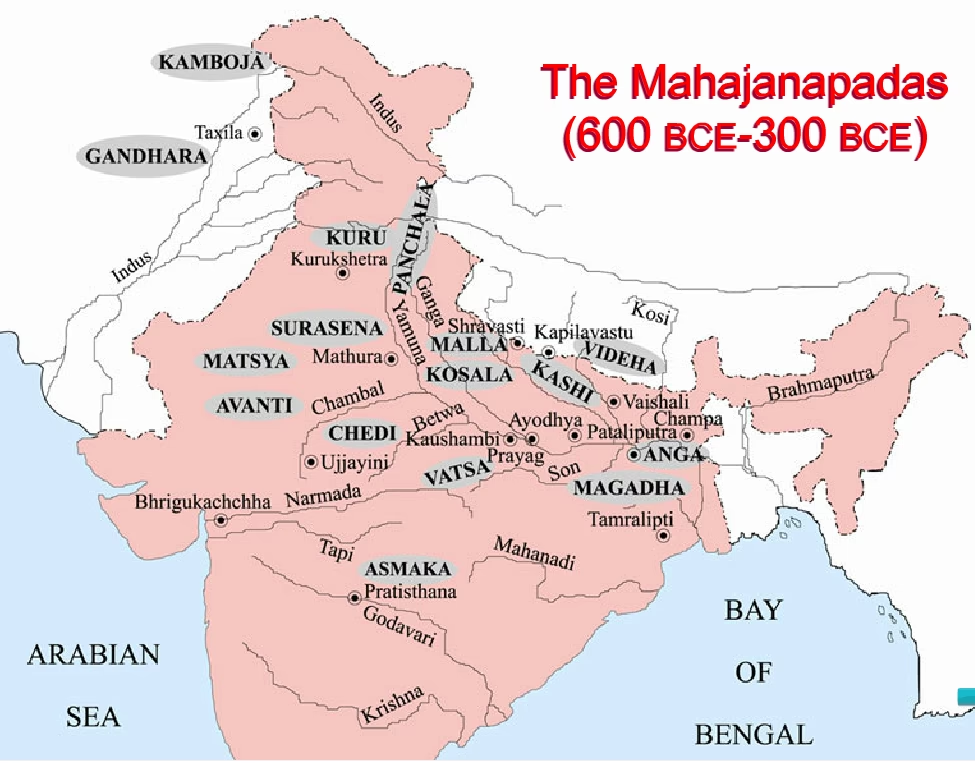
Key Mahajanapadas & Capitals Magadha (Bihar, Rajgir/Pataliputra); Vajji (Vaishali, Gana-sangha); Anga (Champa); Avanti (Ujjain/Mahishmati); Malla (Kushinara); Kosala (Sravasti); Vatsa (Kaushambi); Gandhara (Taxila); Assmaka (Godavari, only southern Mahajanapada).
2. Rise of Magadha & Pre-Mauryan Dynasties
Cue WordsNotes
Strategic Factors for Magadha Protected geography (rivers & Rajgir hills), Chotanagpur iron ore, elephant corps, fertile alluvial soil.
Haryanka & Shishunaga Dynasties Haryanka: Bimbisara (standing army); Ajatashatru (First Buddhist Council, Mahashilakantaka); Udayin (founded Pataliputra). Shishunaga: Destroyed Avanti; Kalashoka (Second Buddhist Council).
Nanda DynastyMahapadma Nanda: First non-Kshatriya king (Ekarat). Dhana Nanda: Ruler during Alexander's invasion.
3. Foreign Invasions (Persian & Greek)
Cue WordsNotes
Persian & Greek Invasions Persian: Darius I annexed NW India; introduced Kharoshthi script. Greek: Alexander (327-325 BCE); Battle of Hydaspes (Jhelum) against Porus; army mutinous at Beas.
🪙 Second Urbanisation Markers
  • Pottery Transition: Painted Grey Ware (PGW) gives way to Northern Black Polished Ware (NBPW), a marker of the Second Urbanisation (~600 BCE) centred on the Ganga plains.
  • Earliest Coinage: India's earliest coins were silver/copper Punch-Marked Coins (Karshapanas), issued by individual Mahajanapadas/guilds rather than a central authority — not by the later empires.
  • Guilds (Shreni): Rise of merchant and craft guilds accompanying urban growth and trade along the Uttarapatha and Dakshinapatha routes.
UPSC High-Yield Recall & Exam Traps
Cue WordsNotes
Only Southern Mahajanapada Assmaka (located on Godavari river).
Pataliputra Founder Udayin of Haryanka dynasty.
Panini Association Panini (grammarian) associated with Gandhara / Taxila.
Vatsa Ruler King Udayana of Vatsa (featured in Bhasa's Svapnavasavadattam).
Supplemental Asset Directory
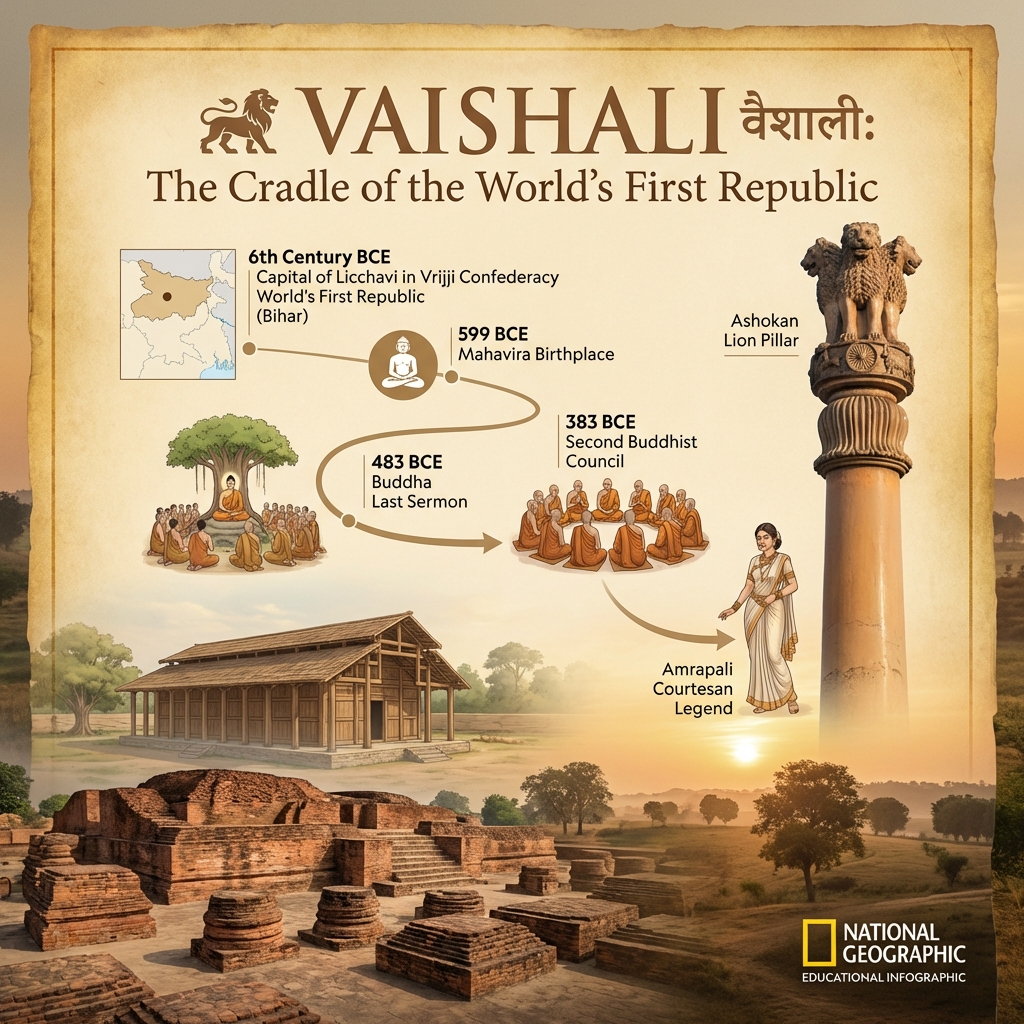
  • Vaishali Licchavi Republic: Vaishali Licchavi Republic
  • 16 Mahajanapadas Map: 16 Mahajanapadas Map

Later Vedic Period, Mahajanapadas & Religious Movements

UPSC Prelims Focused Notes — converted with zero-loss precision from source notes (LVP 1000–600 BC; Mahajanapadas & Rise of Magadha; Buddhism & Jainism).


Later Vedic Period (1000 B.C. – 600 B.C.)

Later Vedic Period — Political Organisation

Central chain of change: Discovery of IRON → Agriculture Economy → Reforms in Society and Religion.

Later Vedic Political Organisation
Cue WordsNotes
Trace Aryan expansion and territorial reorganisation in the Later Vedic Period.
  • As per Shatapatha Brahmana: Aryans moved towards Eastern Gangetic Plains.
  • India divided into 3 parts:
    • Aryavarta — North India
    • Madhyadesha — Central India
    • Dakshinapatha — South India
  • Larger kingdoms formed by amalgamation → Janapada / Rashtra.
  • Authority of Rajana and support staff called Ratnin12 jewels of the king.
  • King (almost hereditary) concept developed; fights for territory as agriculture became main occupation; still No Standing Army.
  • Sacrifices used to control the Jana (tribe) rather than for the Jana.
  • Rajana assumed titles: Samrat, Ekrat, Sarvabhumi, Virat.
List royal sacrifices and their political purposes.
  • Rajasuya — coronation for supreme power
  • Ashwamedha — to become ruler of all directions → Chakravarti
  • Vajapeya — revitalization of the aging rajana
How did tribal assemblies change in the Later Vedic Period?
  • Character of Sabha and Samiti changed — headed by the Richer Class.
  • Women were not allowed to attend these assemblies.
  • Vidatha completely disappeared.
Later Vedic Period — Society, Varna & Ashrama
Later Vedic Society
Cue WordsNotes
Explain the 4-fold varna system and Dwija concept.
  • 4-fold varna system dominated and became hereditary towards end of this period.
  • 1st appearance in Purusha Sukta of 10th Mandala of Rigveda (added in LVP).
  • Males of top 3 Varnas entitled for Upanayana (Sacred Thread ceremony) — going to teacher; known as DWIJA (Twice Born).
  • Gotra as institution mentioned in Atharvaveda; Gotra exogamy started.
  • Niyoga practice was not supported; Untouchability largely absent.
  • Sati and Child Marriage references exist but not dominating.
  • Rathakars enjoyed good status and were entitled to wear the sacred thread.
Assess the status of women in Later Vedic society.
  • Women’s status degraded, but women like Gargi and Maitreyi accomplished in the knowledge arena.
  • Widow remarriage: word punarbhu mentioned in Atharvaveda.
  • First time 8 types of marriage mentioned in Ashvalayana Grihya Sutra.
  • Amaju — lifelong unmarried girl.
List the ashramas and corresponding purusharthas.
  • 3 out of 4-fold ashram (stages) for 4 Purusharthas (goals):
  • Brahmacharya (Celibate Student) → Dharma
  • Grihastha (Householder) → Artha and Kama
  • Vanaprastha (Partial renunciation) → for spiritual wisdom
  • Sanyasa (Renunciation) → for liberation → Moksha (Developed after LVP)
Later Vedic Period — Economy, Iron & Material Culture
Later Vedic Economy
Cue WordsNotes
Link iron technology to the pastoral-to-agrarian shift.
  • Discovery of Iron (Krishna ayas mentioned in Yajurveda) → clearing forest.
  • Fertile land due to rivers → occupation changes from Pastoral to Agriculture.
  • Earliest Iron Evidence: Ahichchhatra and Atranjikhera (UP).
  • Pottery type: Painted Grey Ware (PGW).
Recall main crops, taxes, officers and crafts.
  • Main Crops:
    • Vrihi, Tandula, Sali — Rice
    • Godhuma — Wheat
    • Yava — Barley
    • Mudga — Mung Bean
    • Ikshu — Sugarcane
  • Mandatory tax revenue: Bhaga and Bali.
  • Officers:
    • Bhagadugha — Revenue
    • Sangrahitri — Treasurer
    • Akshavapa — king’s companion at game table
    • Govikartana — forest department
    • Palagala — Messenger
  • Kings and Princes do Manual Labour; Vaishya were only taxpayers.
  • Shatapatha Brahmana speaks of ploughing rituals.
  • Barter system, but reference of Shatamana, Krishnala (coins) with no archaeological evidence for the same; rivers: Kulya and Varnakoop.
  • Money lending: Shatapatha Brahmana → usurer as kusidin.
  • Art and craft: Smelting, smithery/carpentry, weaving, leather-working etc.
Later Vedic Period — Religion
Later Vedic Religion
Cue WordsNotes
How did the pantheon and religious practice change from Early to Later Vedic?
  • Status of Indra, Agni, Varuna and other Rigvedic gods degraded.
  • Prajapati or Adipurush became the Supreme God; as per Atharvaveda, Sabha and Samiti are his daughters.
  • Rudra was merged into Shiva, who appeared for the first time.
  • Rituals and sacrifices at household level with help of Priest → status of Brahmana increased; religious life made complex.
  • Reference of idol worship reported but not dominating.
  • Magic and Omen entered socio-religious life.
  • Pushan became god of Shudras; Brihaspati was Devaguru (Priest of Gods).
Later Vedic Period — Literature (Shruti, Smriti & Four Vedas)
Vedic Literature Framework
Cue WordsNotes
Distinguish Shruti vs Smriti and Karma Kanda vs Gyana Kanda.
  • Brahmanic literature transferred through:
    • Shruti (product of divine revelation) — Vedic literature: Samhita, Brahmana, Aranyaka, Upanishad
    • Smriti (prepared by human beings) — Vedanga, Dharmasutra, Purana, Smritis
  • Later compiled and written down; earliest surviving manuscript from the 11th–12th century.
  • Each of 4 Vedas generally has 4 parts, divided into two sections:
    • Karma Kanda — Vedic Samhita, Brahmana
    • Gyana Kanda — Aranyaka, Upanishads
Detail Rigveda structure, mandalas and key suktas.
  • Rigveda (1st mention of death)
    • Reciter: Hotr/Hotar; Oldest Veda; Upveda: Ayurveda; Script: Brahmi
    • 1028 hymns (Sukta) and 10552 Mantras divided into 10 Mandalas
    • Mandala 7: Dashrajana Yuddha on Purushni river and Ashwamedha yajna
    • Mandala 8: Dedicated to various gods; mostly composed by the Kanva clan
    • Mandala 9: Dedicated entirely to Soma
    • Mandala 3: Gayatri Mantra
    • Mandala 1: Dedicated to Indra and Agni; also Varuna, Surya, Mitra, Rudra, Vishnu
    • Mandala 6: Weapons sukta
    • Mandala 10: Compiled in Later Vedic Period
      • Nadi Sukta: Sindhu most mentioned; Nadittama (Saraswati) most pious
      • Purusha Sukta: 4-fold Varna system but no mention of word “Varna”
      • Nasadiya Sukta: Universe Origin; Yama–Yami Samvaad
      • Hiranyagarbha Sukta: Creation of universe
      • Surya Sukta: Marriage Ceremonies
    • Only surviving recension: Shakala Shakha
    • 1st mention of Stupa word in Rigveda (Tree Stem) raised by King Varuna
Summarise Samaveda, Yajurveda and Atharvaveda.
  • Samaveda (Veda of Chants)
    • Shortest Veda; contains famous Dhrupada Raga, later sung by Mian Tansen
    • Recensions: Kauthuma, Ranayaniya, Jaiminiya (Talavakara)
  • Yajurveda (Worship / ritual knowledge)
    • Reciter: Adhvaryu
    • Shukla (White) Yajurveda / Vajasaneyi — only mantras; recensions: Madhyandina and Kanva
    • Krishna (Black) Yajurveda — mantras + prose explanations; recensions: Kathaka, Maitrayani, Taittiriya, Kapishthala
    • Upveda: Dhanurveda by Vishwamitra; mention of SHUNYA in Yajurveda
  • Atharvaveda
    • Magic spells toward spirits or dangers; 1st reference of Silver
    • Mention of disease and medicine; 1st reference of Anga and Magadha
    • Recensions: Shaunaka and Paippalada
    • Upveda: Shilpa Veda, Ayurveda
  • Brahmanas: Explanation of Vedic hymns, applications and origin stories.
Later Vedic Period — Aranyakas, Upanishads, Vedangas, Puranas, Epics
Post-Samhita Literature
Cue WordsNotes
What are Aranyakas and major Upanishadic teachings?
  • Aranyakas (Forest books)
    • Written by hermits residing in forests for their students
    • Emphasis on Meditation, not sacrifices; opposed to sacrifices
    • Concluding portion of the Brahmanas; bridge between karma and knowledge
  • Upanishads
    • Literal meaning: “sit near someone”; introduces Atman and Brahman
    • 108 Upanishads are source of absolute knowledge
    • Mundaka Upanishad: Source of Satyameva Jayate
    • Chhandogya Upanishad: Tat Tvam Asi (God is within You)
    • First 3 ashrams; two main marriage types:
      • Anuloma — Man marrying in his own varna or below
      • Pratiloma — Woman marrying in a lower varna (not sanctioned by the Vedas)
    • Legend of Satyakama Jabala (stigma of unmarried mother)
    • Brihadaranyaka Upanishad: Tamaso ma jyotirgamaya, Aham Brahmasmi; Yajnavalkya–Gargi and Yajnavalkya–Maitreyi discussions
    • Shvetashvatara (White Horse): 1st mention of Shiva name
    • Kathopanishad: Yama and Nachiketa discussion
List the 6 Vedangas and divisions of Kalpa Sutra.
  • 6 Vedangas (Limbs of the Vedas) — supportive in study of Vedas:
    1. Shiksha (Phonetics)
    2. Jyotisha (Astronomy)
    3. Vyakarana (Grammar)
    4. Nirukta (Etymology)
    5. Chhanda (Metrics)
    6. Kalpa (Ceremonies)
  • Kalpa Sutra further divided into:
    • Shrauta Sutra: Rules for different sacrifices; 3 fires —
      • Garhapatya (Circular altar) — ignited first
      • Dakshinagni (Semi-circular)
      • Ahavaniya (Square altar)
    • Grihya Sutra: Domestic sacrifices — Upanayana, marriage, funerary practices
    • Dharmasutra: Pertaining to rituals of Dharma
Summarise Puranas, Dharma Shastra, Epics and Shatapatha Brahmana.
  • 18 Puranas (literally ‘ancient’ / ‘old’)
    • Post-Vedic; believed composed by Ved Vyasa; mostly compiled in Gupta Period; later: Bhagavata Purana (10th century), Skanda Purana (14th–16th century)
    • Sectarian — devoted to Shiva, Vishnu and Brahma
    • 5 subjects within 4 Yugas (Satya, Treta, Dvapara, Kali):
      • Sarga — Primary creation
      • Pratisarga — Recreation after annihilation
      • Manvantaras — reigns of various Manus
      • Vamsha — genealogy of gods and rishis
      • Vamshanucharita — History of Suryavanshis and Chandravanshis
    • 4 Yuga = Mahayuga → 1000 Mahayuga = 1 Kalpa (14 Manvantaras; 1st Manu = Swayambhu)
  • Dharma Shastra
    • Sanskrit texts on morality/duty; subdivided into Dharmasutras (600 B.C.–300 B.C.) and Smritis (200 B.C.–900 C.E.) and commentaries (tika, bhashya, 9th–19th CAD)
    • Purushartha: Dharma, Artha, Kama, Moksha
    • Person’s Dharma depended on gender, marital status, Varna and ashram
  • Epics
    • Mahabharata (war in Dvapara): Vedvyasa; 18 Parvas; 1 lakh verses — Shatasahasri (Jaya Samhita); name of Dwijha shreshtha (Kuninda King)
    • Ramayana (war in Treta): Valmiki; consists of seven (kandas)
  • Shatapatha Brahmana: Purushamedha (might be human sacrifices but no surety); Story of Videgha Madhava (King of Videha) and guru Rishi Gautama Rahugana

Buddhism & Jainism

Causes of Rise of Unorthodox / Nastika Philosophy
Rise of Heterodox Sects
Cue WordsNotes
Why did unorthodox (Nastika) philosophies rise in the 6th century B.C.?
  • Opposed Authority of Veda.
  • Complex Vedic rituals confused the people.
  • Clash of supremacy between Kshatriya and Brahmana.
  • Practice of killing animals → Problem in Agri Economy → Shudras unhappy.
  • Upanishads highly philosophical → Not understood by all.
  • Increasing rigidity in Jati system → disturbance in society.
  • Trade and Economic Prosperity → Vaishya desired improved social status.
Buddhism — Life of Buddha, Symbols, Doctrines
Buddhism Core Doctrines
Cue WordsNotes
Map major life events of Gautama Buddha with their symbols.
  • Elephant: Avakranti (descent)
  • Lotus and Bull: Birth
  • Horse: Mahabhinishkramana (Renunciation)
  • Bodhi Tree: Nirvana
  • Wheel: Dharmachakra Pravartana (First Sermon)
  • Buddha is Tathagata (whose truth is knowledge)
Outline biography of Gautama Buddha (563 BC–483 BC).
  • Known as Siddhartha, Sakyamuni & Tathagata
  • Belonged to Sakya Clan; Birth Place: Lumbini
  • Father: Suddhodana; Mother: Mayadevi
  • Teachers: Alara Kalama and Rudraka Ramaputta
  • Enlightenment: Under Pipal tree at Uruvella (Bodhgaya) on banks of river Niranjana (Falgu)
  • 1st Sermon: Sarnath (Deer park) to 5 disciples including Mahakasyapa (first disciple)
  • Mahaparinirvana: At Kushinagar at age of 80
State the Four Noble Truths (Arya Satya).
  • 1. World is full of misery — Sabbam Dukkam
  • 2. Desire is root cause of sorrow — Pratitya Samutpada – Dwadash Nidan
  • 3. Desire can be conquered — Dukha Nirodha
  • 4. Desire can be conquered by following Astangika Marga
List the Eightfold Path items given as theme of the 1st Sermon.
  • EIGHT FOLD PATH (Theme of 1st Sermon) — as listed in source:
    • 1. Right view
    • 3. Right intention
    • 5. Right action
    • 7. Right livelihood
Recall the Five Precepts and Triratna of Buddhism.
  • Five Precepts / Conduct rules:
    1. No killing — Respect for life
    2. Abstention from theft
    3. Abstention from sexual misconduct
    4. Abstention from falsehood
    5. Abstention from intoxication
  • Triratna:
    1. Buddha — Founder
    2. Dhamma — Doctrine
    3. Sangha — Order (Monks and nuns → Upasakas)
  • Patimokkha: 64 types of prohibited crimes
  • Women were also allowed to join Sangha
Buddhism — Scholars, Literature, Spread & Decline
Buddhist Scholars and Literature
Cue WordsNotes
Match important Buddhist scholars with their works/roles.
  • Mahakasyapa: Chairman 1st Council
  • Sabbakami: Chairman of 2nd Council
  • Moggaliputta Tissa: Chairman of 3rd Council
  • Nagarjuna: Madhyamika Shunyavada (Theory of relativity); work Madhyamikakarika; known as Indian Einstein
  • Aryadeva: Popularised Mahayana
  • Dharmakirti: Kant of India
  • Vasumitra: Credited with Mahavibhasha Shastra; Chairman of 4th Council
  • Asanga: Yogachara / Vigyanavada school
  • Vasubandhu: Abhidharmakosha — Encyclopedia of Buddhism; Yogachara / Vigyanavada school
  • Ashvaghosha: Buddhacharita in Sanskrit; Sanskrit drama Sariputra Prakarana (disciple of Buddha)
  • Buddhaghosa: Book Visuddhimagga; Samanta Pasadika (Ashoka won Avanti)
  • Dinnaga: Founder of Buddhist logic
Structure the Tripitaka and non-canonical Buddhist texts.
  • CANONICAL TEXT (believed actual word of Buddha) — TRIPITAKAS:
    • Sutta-Pitaka (Ethical Principle of Buddha’s Teachings)
      1. Digha-Nikaya
      2. Majjhima Nikaya
      3. Samyutta Nikaya
      4. Anguttara Nikaya
      5. Khuddaka Nikaya
    • Vinaya Pitaka (Monastic Rules and Regulations)
      1. Sutta Vibhanga — Maha-Vibhanga; Bhikkhuni-Vibhanga
      2. Khandaka: Mahavagga
      3. Parivara
    • Abhidhamma Pitaka (Philosophy of Buddha)
      1. Dhammasangani
      2. Vibhanga
      3. Dhatu-katha
      4. Puggala-pannatti
      5. Kathavatthu
      6. Yamaka
      7. Patthana
  • NON-CANONICAL TEXT (Commentaries / Observations):
    • Mahavastu (Sanskrit–Prakrit mixed) — Hagiography of the Buddha
    • Milindapanho (Pali) — Dialogues between Indo-Greek king Menander and monk Nagasena
    • Nettipakarana (Book of guidance) — connected account of the teachings
List reasons for spread/popularity and decline of Buddhism.
  • REASONS FOR SPREAD & POPULARITY:
    1. Liberal & democratic
    2. Simple language
    3. Personality of the Buddha
    4. Royal patronage
    5. Inexpensive
  • REASONS FOR DECLINE:
    1. Division among Buddhists
    2. Use of Sanskrit language
    3. Buddha’s idol worship
    4. Persecution of Buddhists
    5. Corruption in Buddhist Sangha
    6. Islamic invasion
Buddhism — Six Councils
Buddhist Councils
Cue WordsNotes
Tabulate all six Buddhist councils with time, place, chairman and patron.
  • 1st — 483 B.C.; Saptaparni Cave, Rajgriha; Chairman: Mahakassapa; Patron: Ajatashatru
  • 2nd — 383 B.C.; Vaishali; Chairman: Sabbakami; Patron: Kalashoka
  • 3rd — 250 B.C.; Pataliputra; Chairman: Moggaliputta Tissa; Patron: Ashoka
  • 4th — 1st Century; Kundalvan, Kashmir; Chairman: Vasumitra and Ashvaghosha; Patron: Kanishka
  • 5th — 1871 Myanmar; Chairmen: Jagarabhivamsa, Narindabhidhaja; Patron: King Mindon (Burmese)
  • 6th — 1954 Myanmar; Patron: Government
Buddhism — Schools, Sects & Comparative Dimensions
Schools of Buddhism
Cue WordsNotes
Trace the first and major divisions of Buddhist schools.
  • 1st division after 2nd Buddhist council: Sthaviravadin and Mahasanghika; then subsects arose from each.
  • Major division in 4th council: Hinayana (Theravada) and Mahayana.
Detail Sthaviravadin (Theravada) line and its subsects.
  • Sthaviravadin (Theravada) — Buddha is human; School of Elders
  • Sarvastivadin — constituents of phenomena were not wholly momentary, but existed forever in a latent form
  • Vaibhashika — Relative truth can be broken into parts; ultimate truth is indivisible
  • Sautrantika — Based on Sutras; rejection of authority of Abhidharma; events (dharmas) have only momentary existence
  • Also: Mool Sarvastivadin, Vibhajyavadin, Dharmaguptakas, Hinayana/Theravada, Pudgalavadin, Vatsiputras–Sammittiya
Detail Mahasanghika line and Mahayana philosophical schools.
  • Mahasanghika — Buddha worshipped in anthropomorphic form
  • Subsects: Lokottaravadin (Supernatural Buddha), Ekavyavaharika, Kaukkutikas, Gaulikas, Caitiyaka, Bahushrutiya, Aparashaila, Prajnaptivada
  • In 4th Council: Deification of Buddha by Mahasanghikas fostered Mahayana Buddhism
  • Madhyamika Shunyavada by Nagarjuna
  • Vigyanavada / Yogachara by Asanga, Vasubandhu
Compare Hinayana, Mahayana and Vajrayana across key dimensions.
  • Buddha: Hinayana — Great Human; Mahayana — God; Vajrayana — God
  • Salvation Through: Hinayana — Self-discipline & meditation; Mahayana — Help of Buddha & Bodhisattvas; Vajrayana — Magical power and help of female bodhisattvas
  • Buddha’s Rebirth: Hinayana — No; Mahayana — Yes; Vajrayana — Yes
  • Idol Worship: Hinayana — No; Mahayana — Yes, 1st human statue; Vajrayana — Yes
  • Language: Hinayana — Pali; Mahayana — Sanskrit; Vajrayana — Sandhya Bhasha / Twilight
  • Uniqueness:
    • Hinayana: Original teaching of Buddha i.e. Ashtangika Marg and Appa dipo bhava
    • Mahayana: Paramitas — Bodhisattva strives to perfect to purify karma and klesha and develop Bodhisattva ideal
    • Vajrayana: 2 Truth Doctrine — Conventional (consensus reality / common sense) and Ultimate (reality as perceived by enlightened mind)
  • Flourished in: Hinayana — Sri Lanka and South Asian Countries; Mahayana — Central Asia, East Asia; Vajrayana — Developed in Tibet
  • Central Concept: Hinayana — Arhat; Mahayana — Bodhisattvas; Vajrayana — Tara
  • ZEN BUDDHISM: Sect of Mahayana; originated in China during Tang dynasty as Chan school; spread to Japan in 7th century C.E.; meditation most distinctive feature
  • NAVAYANA: Neo-Buddhism — Reinterpretation by B.R. Ambedkar
List major Bodhisattvas and their attributes.
  • Maitreya (Ajita Bodhisattva): Future Buddha & Earliest bodhisattva; holds a water phial; laughing Buddha claimed incarnation of Maitreya
  • Padmapani / Avalokiteshvara: Compassion
  • Vajrapani: Manifest Power
  • Manjushri: Manifests Wisdom
  • Sadaparibhuta: Never disparaging spirit
  • Samantabhadra: Universal Bodhisattva
  • Kshitigarbha: Deity of diseased children
  • Akashagarbha: Boundless as space
  • Amitabha: Buddha of Heaven
Define key monastic terms: Nirvana, Sheel, Upasampada, Vassa, Uposatha, Pavarana.
  • NIRVANA: Annihilation of Flame of Desire and State of Supreme Bliss
  • SHEEL: When a layperson leaves home to live the life of a Buddhist renunciate among a community of bhikkhus
  • UPASAMPADA: Rite and ritual of ascetic vetting (ordination) by which a candidate, if deemed acceptable, enters the community as Upasampada (ordained) and authorised to undertake ascetic life
  • VASSA: 3-month annual retreat observed by Theravada practitioners during rainy season
  • UPOSATHA: Day for “cleansing of the defiled mind,” resulting in inner calm and joy
  • PAVARANA: Confession by monks of offences committed during Rainy Season (Vassa)
Buddhism — Rajgir, Residences, Death & Related Events
Buddha Residences and Related Events
Cue WordsNotes
Explain the importance of Rajgir for Buddhism and Jainism.
  • Vishwa Shanti Stupa at Rajgir: Nichidatsu Fujii, Japanese Buddhist monk and founder of Nipponzan-Myohoji Buddhist sect, started constructing Peace Pagodas in 1947 worldwide.
  • Rajgir, also known as Panchpahari, famous for both Buddhism and Jainism.
  • Saptaparni Cave: place of 1st congregation of the Buddhist Council.
  • Gridhakuta Hill / Vulture’s Peak: where Lord Buddha preached many teachings; 2 sermons — Lotus Sutra and Prajnaparamita (“Perfection of Wisdom”); here Buddha made Bimbisara convert to Buddhism.
  • Several Jain temples on hills surrounding Rajgir; Lord Mahavira spent 14 years of his life at Rajgir.
List Buddha’s residences, patrons and key events around the Sangha.
  • Velavan at Rajgriha by Bimbisara; Ashokarama Monastery by Ashoka at Pataliputra
  • Kutagarasala at Lichchhavi (Vaishali); Pubbarama Vihara built by Kosala King Prasenjit
  • Amrapali (royal courtesan became his disciple) provided Amravatika for residence of Buddhist monks
  • In 8th year Buddha allowed women to become Bhikshuni into Buddhist Sangha at Vaishali on advice of disciple Ananda
  • 1st woman to enter Sangha: Buddha’s Aunt Mahaprajapati
  • Devadatta (Cousin of Buddha): wanted to become leader of Sangha → fight with Buddha
  • Anathapindaka (wealthy businessman of Kosala) donated Jetavana Vihara
  • Light of Asia (based on Lalitavistara) by Edwin Arnold dedicated to Buddha
Recount the death of Buddha and later sacred sites.
  • Buddha spent last rainy season at Vaishali; while preaching reached Pava (City of Malla)
  • Theory: ate Sukaramaddava (soft pork) prepared by host Cunda Kammaraputta and became ill
  • Reached Kushinara (Capital of Republic of Malla); last sermon to Subhadda; died 483 BC
  • Buddha didn’t appoint any successor to lead Sangha
  • Mahabodhi Tree: recent one is 5th generation tree planted by Cunningham
  • Balaputradeva (Ruler of Suvarnabhumi) founded monastery at Nalanda and requested Devapala through ambassador to grant 5 villages
  • Giant Buddha Statue at Bodhgaya with help of Daijokyo sect of Japan
  • Sanchi (Ancient names: Kaknam, Kakanaya, Kakanadabota, Botasriparvata) Stupa has no relation with Buddha’s life
Comparison — Buddhism vs Jainism & Six Orthodox Philosophies
Buddhism vs Jainism and Orthodox Schools
Cue WordsNotes
Compare Buddhism and Jainism on core doctrinal dimensions.
  • God: Buddhism — Silent; Jainism — A perfect being and not a creator
  • Karma Theory: Buddhism — Yes; Jainism — Yes (Karmas are bane of Soul)
  • Rebirth / Reincarnation: Buddhism — Yes; Jainism — Yes
  • Acceptance of Authority of Veda: Buddhism — No; Jainism — No
  • Criticism of Varna System: Buddhism — Yes; Jainism — No (birth based on Previous Karma)
  • Avoidance of Extremism: Buddhism — Yes, Middle Path; Jainism — No
  • Soul: Buddhism — No; Jainism — Yes and Soul is in everything
  • Acceptance of Non-violence: Buddhism — Yes; Jainism — Yes (in extreme form)
Summarise the Six Orthodox (Astika) philosophies.
  • Orthodox: Believes in authority of Veda. Unorthodox: Doesn’t believe in authority of Veda.
  • Samkhya
    • Oldest philosophy; started by Kapila
    • Provided materialistic ontology for Nyaya and Vaisheshika
    • Dualistic: Purusha (spirit) and Prakriti (nature)
    • God not accepted; forms philosophical basis for Yoga
    • Rebirth accepted; Self-knowledge leads to liberation
  • Yoga
    • Releasing Purusha from Prakriti by physical and mental discipline; founded by Patanjali
    • God accepted at initial level for mental concentration
    • Ashtanga (Eight limbs): Yama, Niyama, Asana, Pranayama, Pratyahara, Dharana, Dhyana, Samadhi
  • Nyaya: Founded by Gautama; knowledge through logical reasoning and experience (scientific approach); believes in God; relies on several pramanas
  • Vaisheshika: Founded by Kanada; everything is combination of Atoms (atomic theory) except time, space, mind, soul; God accepted
  • Purva-Mimamsa: (source note text appears truncated/corrupt in original table)
  • Uttar-Mimamsa (Vedanta): Commentaries on Brahma Bhashya, compilation of Upanishads, written by Brihadaranyaka tradition (Vedavyasa as per some scholars)
  • Bhakti schools:
    • Madhvacharya — Dwaitavada–Bhakti
    • Nimbarkacharya — Dwaitadvaita / Bhedabheda–Bhakti
    • Vallabhacharya — Shuddha Advaita–Bhakti for Salvation
    • Srichaitanya Mahaprabhu — Achintya Bhedabheda–Bhakti
Jainism — Origin, Mahavira & Philosophy
Jainism Core
Cue WordsNotes
State origin of Jainism and list early Tirthankaras.
  • A very ancient religion. Total 24 Tirthankaras; last was Vardhamana Mahavira.
  • 1st Tirthankara: Rishabhadev
  • 23rd Tirthankara: Parshvanatha, born in Varanasi
  • All Tirthankaras were Kshatriyas by birth; Rishabhadev and Arishtanemi (Neminath) mentioned in Rigveda
Outline life of Vardhamana Mahavira (540–468 B.C.).
  • Mother: Trishala (sister of Licchavi chief Chetaka); Father: Siddhartha
  • Location: Licchhavi (Vajji Sangha)
  • Epithets: Nayaputta, Muni, Samana, Nigantha
  • Wife: Yashoda; Daughter: Anojia (Priyadarshana); Son-in-Law: Jamali
  • At age 42 attained Kevalajnana under a sal tree on bank of Rijupalika River at Jrimbhikagrama through Right Knowledge, Right Faith and Right Conduct (Triratna of Jainism – KFC) and became a Jina and then Tirthankara
  • Used Prakrit (Ardha-Magadhi) so ordinary people could understand
  • Death: Pavapuri; became a Siddha (free from cycle of birth and death)
  • Sudharman: 1st Chief of Jain Sangha after Mahavira
  • Mahamastakabhisheka: Important festival at Shravanabelagola every 12 years
Explain core philosophy of Jainism.
  • Word Jain from Jina, meaning conqueror
  • Non-Violence: Practiced in extreme sense i.e. no agricultural occupation
  • Soul: Everything has a soul even rock, pen etc.; Karma is bane of Soul
  • Concept of God: Perfect being; Creator god not accepted
  • World maintained by Universal Law; no starting/end of this world
  • Rebirth in a Varna because of Karma → no criticism of Varna System
  • Salvation: Only through renouncing the world; monastic existence necessary; asceticism and penance required to free from cycle of Karma → Jain monks and nuns had to take the five vows
  • 1st Chief disciple: Ganadhara Gautama Swami, a well-known Brahmin scholar
  • Lord Mahavira had 11 Ganadharas, who compiled 12 scriptures based on his teachings known as Agamas
  • Santhara / Sallekhana / Samadhi Maran: Fast unto Death
List Mahavrata–Anuvrata (5 vows) and Seven Tattvas.
  • Mahavrata–Anuvrata: 4 added by Lord Parshvanath and last one by Mahavira:
    1. Ahimsa (non-violence)
    2. Satya (truth)
    3. Asteya (non-stealing)
    4. Aparigraha (non-possession)
    5. Brahmacharya (chastity) — added by Mahavira
  • Seven Tattvas (7 elements of Jain Philosophy / Types of Karmas framework in source):
    1. Jiva (living substance)
    2. Ajiva (matter or non-living substance)
    3. Asrava (influx of Karmic matter in the soul)
    4. Bandha (Bondage of soul by Karmic matter)
    5. Samvara (stopping of Asrava)
    6. Nirjara (Gradual removal of Karmic matter)
    7. Moksha (Attainment of salvation)
  • Spread of Jainism: North India and to Gujarat, Tamil Nadu and Karnataka
Describe Jain Sangha composition and related terms.
  • Jain Sangha by Tirthankara:
    • Sadhus (Monks)
    • Sadhvis (Nuns)
    • Shravaks (Male householders)
    • Shravikas (Female householders)
  • Arihant: One who has destroyed his inner enemies
  • Arhat: One to whom nothing can be secret
  • Arhant: A spiritual acquisition leading a man to the state of an Arihant
  • Nirgrantha: One who has gotten rid of all attachments
Jainism — Councils, Sects, Philosophies & Royal Patrons
Jain Councils and Sects
Cue WordsNotes
Tabulate the Jain Councils.
  • 1st — 300 B.C.; Pataliputra (Bihar); Chairman: Sthulabhadra; Development: Compilation of Angas (lost)
  • 2nd — 512 A.D.; Vallabhi (Gujarat); Chairman: Devardhi Kshamasramana; Development: 12 Angas and Upangas
Explain the Digambara–Shvetambara division and their differences.
  • Reason of Division: Due to famine (12 years) in Magadha → group led by Bhadrabahu moved to South India and stuck to tough practices; other group in Magadha adopted more liberal attitude and started wearing white clothes. After famine, Southern group returned; changed practices led to division into 2 sects.
  • DIGAMBARA (Sky Clad) — Led by Bhadrabahu
    • Nudity for male; white unstitched saree to female
    • Women Salvation: No — need to take rebirth in man body
    • Vows: All 5
    • Images: Tirthankaras have downcast eyes, plain, always carved as naked figures (Kayotsarga Pose)
    • Sects: Bisapantha; Terapantha; Mula Sangh; Taranapantha / Samaiyapantha; minor — Gumanapantha, Totapantha
  • SHVETAMBARA (White Clad) — Led by Sthulabhadra
    • White clothes
    • Women Salvation: Yes
    • Vows: 4 excluding Brahmacharya (as per source table)
    • Images: Prominent staring eyes; richly decorated
    • Major: Murtipujaka / Deravasi / Mandirmargi; Sthanakvasi (avoided Idol Worship); Terapanthi (simpler worship pattern than Digambara Terapanthi)
  • Note: Yapaniya originated from Digambara but followed values of Shvetambara too.
Define Anekantavada, Syadvada, Ananta-Chatushtaya and list royal patrons.
  • Anekantavada (Metaphysics / Theory of Reality): All entities have 3 aspects — substance (dravya), quality (guna), and mode (paryaya). Non-absolutism / many-sidedness of reality; things have infinite aspects that no determination can exhaust.
  • Syadvada (Epistemology / Theory of Knowledge): All judgments are conditional i.e. partially correct. Combinations stated in 7 logical naya (judgement) called Saptabhangi / Saptabhanginaya.
  • Ananta-Chatushtaya: Ananta Gyan (knowledge), Ananta Darshana (Perception), Ananta Virya (Power), Ananta Ananda (Bliss)
  • Royal Patrons — South India: Kadamba dynasty, Ganga dynasty, Amoghavarsha, Kumarapala (Chalukya)
  • Royal Patrons — North India: Bimbisara, Ajatasatru, Chandragupta Maurya, Bindusara, Kharavela, Harshavardhana
Jainism — Tirthankaras, Symbols, Nirvana Places & Literature
Tirthankaras and Jain Texts
Cue WordsNotes
List Tirthankaras with symbols and places of Nirvana as given in source.
  • Lord Rishabha — Symbol: Bull; Nirvana: Mount Ashtapada
  • Ajitanath — Symbol cell corrupted in source as “Mشنath” (adjacent cell lists Elephant / Horse for early Tirthankaras); Nirvana: Champa Nagri
  • Sambhavanatha — Symbol: Deer; Nirvana: Samet Shikhar
  • Abhinandananatha — Symbol: Waterpot; Nirvana: Samet Shikhar
  • Sumatinatha — Symbol: Tortoise (source also places Fish in this row)
  • Padmaprabha — Symbol: Blue-Lotus (source also places Conch in this row)
  • Parshwanath — Symbol: Lion in one cell / Serpent also appears; places include Raivatgiri / Samet Shikhar in table layout
  • Mahavira — Symbol: Lion; Nirvana place listed with Samet Shikhar in table (life account: Pavapuri)
  • Other Tirthankara names appearing in source table layout: Dharmanath, Shantinath, Kunthunath, Aranath, Mallinath, Munisuvrata, Naminatha, Neminatha, Parshwanath
  • Related symbols also listed: Elephant, Horse, Fish, Conch, Serpent, Lion
Catalogue Jain texts and composers (Shvetambara & Digambara).
  • Kalpasutra — Bhadrabahu
  • Parishishta Parvan — Hemchandra
  • Syadvadamanjari — Mallisena
  • Dravya Sangraha — Nemichandra
  • Tattvartha Sutra — Umaswami
  • Nyayavatara — Diwakar
  • Nyayadipika — Dharmabhushana
  • Shlokavartika — Vidyananda
  • Panchavimshatika — Padmanandi
  • Pravachanasara — Kundakunda
  • Mahapurana — Jinasena
  • Shvetambara Texts — Agamas consist of:
    • 12 Angas
    • 12 Upangas
    • 10 Prakirnakas
    • 6 Chedasutras
    • 4 Mulasutras
    • 2 Chulikasutras — Nandi Sutra, Anuyogadvara Sutra (discussed moral stories of monks)
  • All of them written in Ardhamagadhi Prakrit
  • Digambara texts: Digambara versions of Jain Agamas are lost in time; they do not accept Svetambara version of Agama literature as valid
  • Shatkhandagama is oldest Digambara Jain text
  • Kasayapahuda: philosophy of Kasaya (the material world)
  • Anuyogas
Other Famous Philosophies (Ajivika, Charvaka, Kapalika)
Other Heterodox / Related Philosophies
Cue WordsNotes
Summarise Ajivika, Charvaka and Kapalika schools.
  • AJIVIKA
    • Started by Makkali Gosala (student of Mahavira) OR Nanda Vaccha (other sources)
    • Believed in Nudity for penance
    • One-time food only (known as hathapalekhana)
    • Hold a bar (Ekdandin)
    • Niyativada (Predeterminism) → didn’t believe in karma theory
    • Monks allowed to have relation with female (different from Mahavira’s opinion)
  • Charvaka (Lokayata)
    • Pure materialistic — no belief in Soul, god, Karma
    • Popularized by Ajita Keshakambalin
    • Theory of Dehatmavada
    • Denied existence of Akasha (space)
  • Kapalika
    • Worshipped Bhairava
    • Attributed great virtue and occult powers to drinking wine and eating disgusting substances as food in human skull sacrificed by them

Mahajanapadas & Rise of Magadha

16 Mahajanapadas — Overview & List

Second Urbanisation of India; by 6th BC, focus of political activity moved from western to eastern Gangetic plain.

Sixteen Mahajanapadas
Cue WordsNotes
What were Mahajanapadas and which sources list them?
  • Ancient India had several kingdoms after Later Vedic Age.
  • Era saw Religious, political and socio-economic growth in Indo-Gangetic plain.
  • Settlements led growth from Janapadas to Mahajanapadas i.e. SECOND URBANISATION OF INDIA.
  • By 6th BC, focus of political activity moved from western part of Gangetic plain to eastern part.
  • Sources:
    • 16 Mahajanapadas by Anguttara Nikaya
    • 16 by Jain text Bhagavati Sutra
    • 22 by Ashtadhyayi
List all 16 Mahajanapadas with capital, modern location and key notes.
  • Kamboja — Capital: Pooncha (Hindukush region); Several literary sources mention Kamboja was a republic
  • Gandhara — Capital: Taxila; Modern: Rawalpindi; Mentioned in Atharvaveda
  • Kuru — Capital: Indraprastha; Modern: Meerut; moved to a republic form of governance
  • Panchala — Capitals: Ahichchhatra and Kampilya; Western UP; governance shifted from monarchy to republic
  • Matsya — Capital: Viratnagar; Jaipur; West of Panchalas and south of Kurus
  • Shurasena — Capital: Mathura; Western UP; Centre of Hinduism + Buddhism
  • Ashmaka / Assaka — Capital: Pratishthan; Bank of Godavari
  • Vajji (Vaiji) — Bihar; Republic; Main races: Licchavis, Videhans, Jnatrikas and Vajjis
  • Malla — Capital: Kushinara; Deoria, UP; Republic; referenced in Buddhist + Jain texts and Mahabharata
  • Avanti — Capitals: Ujjaini or Mahismati; Malwa and Madhya Pradesh
  • Chedi — Capital: Sothivati; UP–MP region; Eastern parts of Bundelkhand and adjoining areas
  • Kosala — Capital: Sravasti; Eastern UP
  • Vatsa — Capital: Kausambi; Allahabad; Monarchical; after rise of Buddha, ruler Udayana made Buddhism a state religion
  • Kasi — Capital: Kasi; Banaras
  • Anga — Capital: Champa; Bhagalpur, Munger; Took over by Bimbisara
  • Magadha — Capital: Girivraja / Rajagriha; Gaya and Patna; Close to Anga, divided by river Champa; later centre of Jainism; 1st Buddhist Council held in Rajagriha
  • Svapnavasavadattam by poet Bhasa: story of Vatsa king Udayana and Avanti princess Vasavadatta related to Ujjain
Rise of Magadha — Geographical, Economic, Cultural & Political Factors
Reasons for Rise of Magadha
Cue WordsNotes
Analyse geographical factors behind Magadha’s rise.
  • Location: Upper and lower parts of Gangetic valley → Fertile soil
  • Mainland route between west and east India
  • Encircled by rivers on 3 sides i.e. Ganga, Son and Champa
  • Both Rajgir and Pataliputra located in strategic positions
  • Huge copper and iron deposits + received enough rainfall
Analyse economic factors behind Magadha’s rise.
  • Easy control over trade due to location and rivers
  • Better agriculture, mining, building cities and in the army
  • Economic hegemony due to mastery over Ganga
  • Bimbisara annexed Anga and controlled river Champa → important in trade with South-East Asia, Sri Lanka + South India
Analyse cultural/societal and political factors.
  • Cultural / Societal:
    • Unorthodox character of society → Aryan + Non-Aryan peoples
    • Emergence of Jainism and Buddhism → liberal traditions → Stable Society
    • Society not so much dominated by upper class
    • Even many kings of Magadha were ‘low’ in origins
  • Political:
    • Location making the region impregnable to enemies
    • Large population → strong standing armies
    • Better economy + availability of iron → advanced weaponry
    • Many powerful and ambitious rulers
    • 1st kings to use elephants in the army
Important Dynasties of Magadha — Brihadratha to Haryanka
Early Magadha Dynasties
Cue WordsNotes
Note Brihadratha and Pradyota dynasties.
  • Brihadratha Dynasty (18th CBC – 8 CBC)
    • Brihadratha: As per Ramayana — his father Vasu established Vasumati / Girivraja / Rajgriha
    • Jarasandha: Son of king Brihadratha; killed by Bhima (Mahabharata)
  • Pradyota (648 B.C. – 558 B.C.)
    • Founder of dynasty and ruler of Avanti & Magadha
    • Son of Pulika (Punika), who killed Ripunjaya of Brihadratha dynasty at Rajagriha to make his son king
Detail Bimbisara of the Haryanka (Hayanaka) Dynasty.
  • Haryanka Dynasty 558 B.C. – 413 B.C. (also called Pitrahanta Dynasty)
  • Bimbisara (558 BC – 491 BC; Buddhist sources: 544 BCE – 492 BCE)
    • Founder of Haryanka dynasty; Son of Bhattiya
    • Contemporary and follower of the Buddha; said to be admirer of Mahavira
    • Capital: Girivraja / Rajagriha → surrounded by 5 hills; known as Sreniya (1st king to have a standing army)
    • Rivalry with Avanti king Pradyota, but later Bimbisara sent royal physician Jivaka to Ujjain (friendship)
    • Built Velavan at Rajgriha (Mahavihara for Buddha)
    • Started matrimonial alliances to strengthen political position
    • 3 wives:
      • Kosaladevi (Sister of Prasenjit)
      • Chellana (daughter of Lichchavi chief of Vaishali)
      • Khema (Madra, Punjab)
    • Most notable conquest: Anga
    • Effective administrative system — executive, military and judicial
Detail Ajatashatru and Udayin.
  • Ajatashatru (492 BC – 460 BC)
    • Son of Bimbisara and Chellana; killed his father
    • 1st Buddhist Council at Rajagriha in 483 BCE
    • Won wars against Kosala and Vaishali; destroyed Vaishali and added it to empire
    • Weaponry: War engine to throw stones like catapults + chariots with maces for mass killings
    • Began fortification of Rajgriha
    • Establishment of Pataliputra city
  • Udayabhadra / Udayin (460 BCE – 444 BCE)
    • Son of Ajatasatru; killed his father for empire
    • Established capital city Pataliputra (Patna)
    • Built fort upon confluence of rivers Ganga and Son at Pataliputra
    • Killed at behest of Palaka (Avanti Ruler) by his son
    • Succeeded by three kings — Aniruddha, Manda and Nagadasaka (Last Ruler)
Important Dynasties of Magadha — Sisunaga & Nanda
Sisunaga and Nanda Dynasties
Cue WordsNotes
Detail Sisunaga dynasty rulers.
  • Sisunaga (Founder) (413 BCE – 345 BCE span for dynasty)
    • Viceroy of Kasi before becoming king of Magadha
    • Capital: Girivraja (Rajgriha)
    • Destruction and assimilation of Avanti to Magadha
    • Second capital to Vaishali, which became main capital
  • Kalasoka (395 B.C. – 367 B.C.)
    • Son of Sisunaga; also known as Kakavarna
    • Capital shifted to Pataliputra
    • 2nd Buddhist Council at Vaishali
    • Killed in a palace revolution by Mahapadma Nanda as per some viewpoints
  • Followed by Nandivarman and Mahanandin (Last Ruler of Sisunaga line)
Detail Nanda Dynasty (345 B.C. – 321 B.C.) — first non-Kshatriya dynasty.
  • Mahapadma Nanda (Founder)
    • 1st historical emperor of India but origins not clear
    • Puranas: Son of last Sisunaga king + Shudra woman
    • Jain texts and Greek writer Curtius: Son of a barber and a courtesan
    • Titles: Sarva-kshatriyantaka (Destroyer of all the Kshatriyas); Ekrat (Sole sovereign) → destroyed all ruling princes
    • Called Adharmika (don’t follow norms of Dharma); Buddhist texts: belonging to annatakula (unknown lineage)
    • Expansion: Kuru (N), Godavari Valley (S), Magadha (E), Narmada (W)
    • Acquired Kosala; called Ugrasena (large army) in Pali
    • Added Kalinga to Magadha; brought image of Jinasena as victory trophy and built a canal in Kalinga (Hathigumpha inscription of Kharavela)
  • Dhanananda (Last Nanda ruler; son of Mahapadma Nanda)
    • Greek texts: known as Agrammes or Xandrames
    • Alexander invaded North-Western India during his reign, but could not proceed towards Gangetic plains because of his army’s refusal
    • Credited with invention of Nandopakramani (a particular measure)
    • Became unpopular: Oppressive tax regime and anti-Kshatriya policy
Magadha Empire — Society, Economy, Administration
Other Important Aspects of Magadha
Cue WordsNotes
Describe Magadhan society, villages and social order.
  • 3 types of villages:
    1. Various castes and communities headed by Bhojaka
    2. Dominated by craftsmen and linked the rural to urban
    3. Fowlers, hunters lived a comparatively backward life
  • Writing System: Started
  • Discrimination to Lower Varnas
  • Severe punishments awarded by royal agents
  • Merchants and artisans organized into a sartha guild
  • Trade and crafts: Occupation more hereditary
Detail Magadhan economy, coins, pottery and taxation.
  • Coins: 1st archaeological evidences i.e. Punch Marked Coins / Aahat coins / Negama Coins (Silver) — issued by merchants first and in later phase by State
  • Agriculture: Paddy, barley, cotton, pulses, millets and sugarcane etc.
  • Taxation: 1/6th of farm produce; no intermediate landlords
  • Grihapatis: Rich peasants; Vessa: Merchants’ street
  • Northern Black Polished Ware (NBPW) with 90 percent black and polished pottery (monochrome and polychrome) — best indicator of starting of Second Urbanisation
List Magadhan administrative officers.
  • Mahamatras: Mantrin (minister); Senanayaka (Commander)
  • Tax Officer: Balisadhakas collected tax from peasants and vaishyas only
  • Head of village: Gramabhojaka, gramini or gramika
Foreign Invasions during Magadha Dynasties
Achaemenid and Alexander Invasions
Cue WordsNotes
Explain the Achaemenid (Persian/Iranian) invasion of India (~500 B.C.).
  • Founder: Cyrus, invaded region west of river Indus
  • Indian context: during Bimbisara’s reign in Magadha
  • Control over Gandhara, Kamboja, and Madra
  • Cyrus’s grandson Darius-I conquered Punjab and Sindh — 1st to invade India (as per source note)
  • Impact: Indo-Iranian trade, Kharoshthi script, Bell-shaped capital, Ashokan inscriptions
  • Darius-III (last Achaemenid emperor) was defeated by Alexander
Outline Alexander’s invasion (327 BC – 325 BC).
  • Crossed the Hindukush and entered north-western India
  • Ambhi (Omphis), king of Takshashila, submitted to Alexander
  • Battle of Hydaspes (Jhelum): Porus (ruling area: Jhelum and Ravi) was defeated but Alexander, impressed with his bravery, reinstated him in power
  • Alexander’s army refused to cross river Hyphasis (Beas) → No war with Nanda Dynasty (Dhanananda)
  • Alexander returned and died in 323 BC in Babylon