UNESCO Heritage & Foreign Travellers' Accounts of India
UNESCO Heritage Listings in India
UNESCO Heritage Listings in India
| Cue Words | Notes |
|---|---|
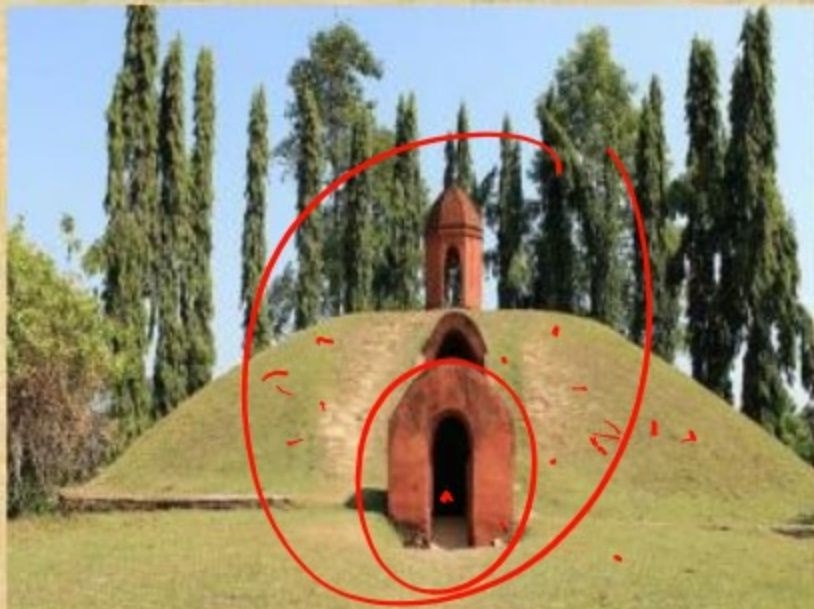
| UNESCO Cultural Sites (Tangible) | - Dholavira: Harappan metropolis in Gujarat - Ramappa Temple: Kakatiya architecture in Telangana - Santiniketan: Rabindranath Tagore's university in West Bengal - Sacred Ensembles of Hoysalas: star-shaped temples at Belur, Halebidu, Somanathapura (Karnataka) - Moidams: royal burial mounds of Ahom Dynasty in Assam |
| UNESCO Natural & Mixed Sites | - Natural Sites: Western Ghats, Kaziranga National Park, Sundarbans National Park - Mixed Site: **Khangchendzonga National Park** (Sikkim) = India's **only** mixed site (biodiversity + sacred associations) |
| Intangible Cultural Heritage (ICH) | - Garba of Gujarat (2023) - Durga Puja in Kolkata (2021) - Kumbh Mela: largest religious congregation - Yoga, Kutiyattam (Sanskrit temple theater), Vedic Chanting |
| UNESCO Creative Cities Network (UCCN) | - Kozhikode (Kerala): first Indian **City of Literature** (2023) - Gwalior (MP), Varanasi & Chennai: **Cities of Music** - Srinagar & Jaipur: **Cities of Crafts & Folk Art** - Hyderabad: City of Gastronomy; Mumbai: City of Film |
Antiquities and Art Treasures Act, 1972
Antiquities and Art Treasures Act, 1972
| Cue Words | Notes |
|---|---|
| Overview | - Primary legal framework in India for protection, regulation of trade, and prevention of smuggling of **antiquities** and **art treasures** - Ensures India's tangible cultural heritage remains within the country or is traded under strict government supervision |
| Key Definitions |
|
| Core Provisions |
|
| Enforcement & Institutions |
|
| UPSC Relevance & PYQ Targets |
|
Foreign Travellers' Accounts of India
Foreign Travellers' Accounts of India
| Cue Words | Notes |
|---|---|
| Megasthenes (Greek - 4th BCE) | - Ambassador from Seleucus I Nicator to Chandragupta Maurya court - Wrote **Indika**; described Pataliputra municipal administration, recorded **7 castes**, noted no slavery (Greek misinterpretation) |
| Fa-Hien / Faxian (Chinese - 5th CE) | - Visited during Chandragupta II (Gupta Empire) to collect Buddhist texts - Documented peace/prosperity of Gupta empire, charity houses, Buddhist monastic life |
| Hiuen Tsang / Xuanzang (Chinese - 7th CE) | - Visited during King Harshavardhana ("Prince of Pilgrims") - Studied at Nalanda University; documented Harsha's Buddhism patronage, Prayag assemblies, socio-economic conditions |
| Al-Beruni (Persian - 11th CE) | - Accompanied Mahmud of Ghazni; wrote **Kitab-ul-Hind** (*Tahqiq-i-Hind*) - Scientific study of Indian religion, philosophy, mathematics, astronomy; translated Sanskrit texts to Arabic |
| Ibn Battuta (Moroccan - 14th CE) | - Visited during Muhammad bin Tughlaq; served as Qadi (judge) of Delhi - Travelogue **Rihla**; documented Delhi, trade routes, court politics, Tughlaq postal system (*Uluq* horse post, *Dawa* foot post) |
| Francois Bernier (French - 17th CE) | - Physician to Prince Dara Shikoh & Aurangzeb; wrote *Travels in the Mogul Empire* - Emphasized absence of private land property under Mughals vs Europe |
UPSC Recall & Traps
UPSC Recall & Traps
| Cue Words | Notes |
|---|---|
| Khangchendzonga Mixed Site Trap |
|
| Megasthenes 7 Castes & Slavery Trap | - Recorded **seven castes**; claimed no slavery (contradicts Arthashastra dasas list) |
| Ibn Battuta Postal Terms | - *Uluq* (horse post every 4 kos) & *Dawa* (foot post every 1/3 kos) |
| City of Literature 2023 |
|
🖼️ Supplemental Asset Directory
Supplemental Asset Directory
- Moidams: Royal Burial Mounds of Ahom Dynasty:
- Lucknow was declared a UNESCO "Creative City of Gastronomy" at the 43rd UNESCO General Conference for its Awadhi cuisine, joining Hyderabad, Telangana (designated 2019).
- UNESCO Virtual Museum of Stolen Cultural Objects, launched at the MONDIACULT conference, digitally reconnects communities with heritage stolen mainly due to colonialism and aims to "empty itself" as items are returned.
- MONDIACULT (UNESCO World Conference on Cultural Policies and Sustainable Development), first held in 1982 and relaunched in 2022, is a quadrennial ministerial forum on global cultural policy.
- UNESCO World Heritage Site defined as place of outstanding universal value representing cultural, natural, or mixed significance
- UNESCO World Heritage Convention adopted 1972, Committee meets at least once yearly to deliberate on World Heritage List additions
- UNESCO World Heritage Committee comprises 21 members selected from 196 States Parties of World Heritage Convention
- 16 inscribed Intangible Cultural Heritage elements from India include Deepavali (2025), Garba (2023), Durga Puja (2021), Kumbh Mela (2017)
- Deepavali inscribed on UNESCO Representative List of Intangible Cultural Heritage of Humanity (2025)
- Lucknow declared UNESCO 'Creative City of Gastronomy' during 43rd UNESCO General Conference in Uzbekistan, joining Hyderabad, celebrating centuries-old Awadhi cuisine and living food traditions
🧭 Marco Polo — Venetian Account (13th Century)
- Marco Polo (Venetian, c. 1254–1324): On his return sea voyage from China (c. 1292–93), he touched the Coromandel and Malabar coasts of South India, describing local kingdoms, the pearl fisheries near the Pandya coast, and Hindu customs — recorded in his travelogue Il Milione (The Travels of Marco Polo), dictated to Rustichello da Pisa while imprisoned in Genoa.
- Distinct from the earlier land-route travellers in this note (Megasthenes, Fa-Hien, Hiuen Tsang) — Polo's account is a maritime, late-medieval, Venetian source, useful for contrasting with Ibn Battuta's near-contemporary 14th-century overland Tughlaq-era account.