Science, Technology, Ports & Coinage in Ancient India
Science, Mathematics and Medicine
Science, Mathematics and Medicine
| Cue Words | Notes |
|---|---|
| Aryabhata (Mathematics & Astronomy) | - Authored *Aryabhatiya* & *Surya Siddhanta* - Stated Earth is spherical, rotates on axis, revolves around Sun (explained eclipses) - Introduced concept of **Zero**, calculated **Pi** ($\pi \approx 3.1416$), developed early sine tables |
| Brahmagupta & Baudhayana |
|
| Bhaskara II & Varahamihira |
|
| Sushruta (Father of Plastic Surgery) | - Authored *Sushruta Samhita*; detailed 120+ surgical instruments & suturing methods - Pioneered **Rhinoplasty** (nasal reconstruction) & cataract surgeries |
| Charaka (Father of Indian Medicine) | - Authored *Charaka Samhita*; main text on Ayurveda - Detailed **Tridosha** theory (balance of Vata/air, Pitta/fire, Kapha/water); emphasized diet, hygiene, medical ethics |
Metallurgy and Engineering
Metallurgy and Engineering
| Cue Words | Notes |
|---|---|
| Mehrauli Iron Pillar (Delhi) | - Crafted during Gupta period (4th century CE) - Stands **rust-free** for 1,600+ years in open air (high phosphorus, protective crystalline iron hydrogen phosphate layer) |
| Wootz Steel | - High-carbon crucible steel developed in South India - Highly prized globally, exported to Middle East to forge **Damascus Blades** |
| Zinc Smelting at Zawar | - Ancient India pioneered industrial distillation & extraction of zinc at **Zawar (Rajasthan)** from 4th century BCE |
| Ramappa Temple & Chola Bronzes |
|
Maritime History and Ancient Ports
Maritime History and Ancient Ports
| Cue Words | Notes |
|---|---|
| Lothal (Gujarat) | - World's oldest artificial tidal dockyard (Indus Valley Civilisation) - Connected Sabarmati river to Arabian Sea trade routes |
| Muziris (Kerala) | - Key Malabar Coast port; epicenter of pepper ("Black Gold") & spice trade with Roman Empire/West Asia |
| Arikamedu (Tamil Nadu) | - Indo-Roman trade station on Coromandel coast - Excavations revealed Roman amphorae, Arretine ware, bead workshops, Roman coins |
| Tamralipti (West Bengal) | - Primary eastern port on Ganges delta; departure point for trade & Buddhist pilgrims to Sri Lanka & SE Asia |
| Barygaza / Bharuch (Gujarat) | - Key Western port linked to silk route & Persian Gulf trade |
Numismatic Evolution (Coinage)
Numismatic Evolution (Coinage)
| Cue Words | Notes |
|---|---|
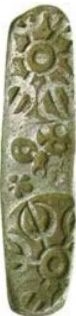
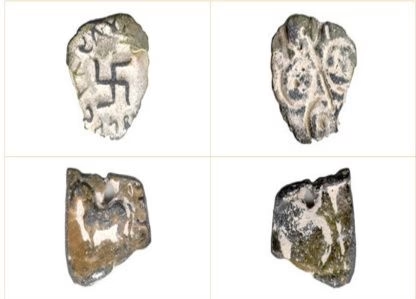
| Punch-marked Coins | - Earliest currency (c. 6th century BCE); silver & copper - Irregularly shaped, no inscriptions or portraits; stamped with individual symbols (sun, bull, hills) |
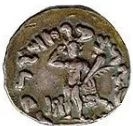
| Indo-Greek Coinage | - First to issue **gold coins** in India - Introduced detailed portraits of kings, names, bilingual inscriptions (Greek & Kharosthi scripts) |
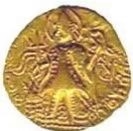
| Kushan Coinage | - Issued gold coins of high purity on large scale - Portrayed King Kanishka & depicted Greek, Roman, Persian, Hindu deities (Shiva with trident) |
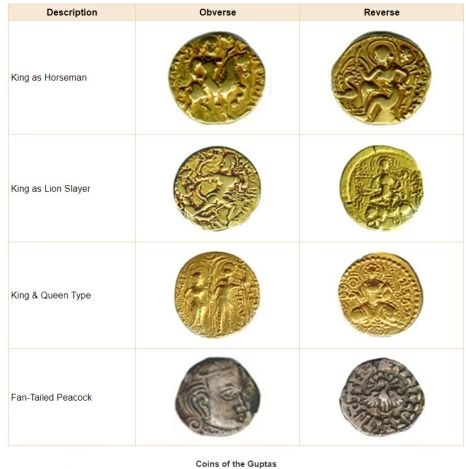
| Gupta Coinage (Dinara) | - Golden age of numismatic art in India; detailed gold coins showing dynastic propaganda - Depicted king hunting lions, playing Veena (Samudragupta), performing Ashvamedha |
| Satavahana Coinage | - Famous for issuing coins made of **Lead**, potin, copper - Depicted ships with double masts, reflecting maritime trade power |
UPSC Recall & Traps
UPSC Recall & Traps
| Cue Words | Notes |
|---|---|
| Sulba Sutras Trap | - Relates to **geometry** for constructing Vedic altars (NOT astronomy) |
| Gold Coins History Trap | - Indo-Greeks **introduced** gold coins in India; Kushans issued them on the **largest/purest** scale |
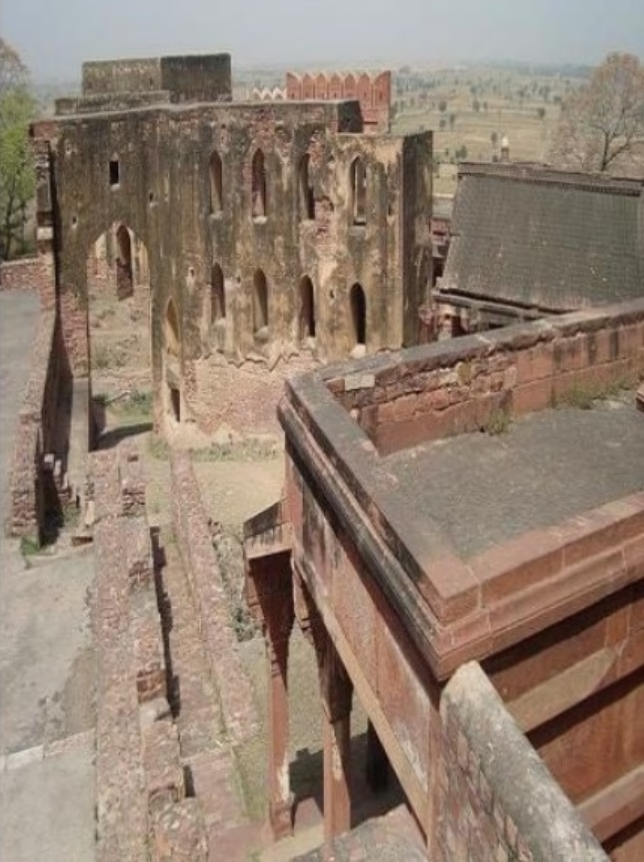
| Pachisi Court | - Ancient board game (precursor to Ludo) played by Akbar on large scale at Fatehpur Sikri |
| Ancient Ports Directory | - Korkai (Pandya): major pearl-fishing port - Puhar/Kaveripattinam (Chola): largest Sangam-era east coast port - Muchiri/Muziris (Chera): Roman trade center (spices/black pepper) - Arikamedu: Indo-Roman trading station (Roman pottery) - Ghantasala (Gupta): East Coast port for SE Asian trade |
| Ancient Glossary Terms | - Eripatti: land assigned for local tank maintenance (Chola) - Taniyurs: large autonomous Brahmin-dominated villages (Chola) - Vishti: forced labor extracted as tax (Gupta) - Kulyavapa / Dronavapa: units of land measurement (Gupta) - Ghatikas: Brahmin learning centers in Pallava kingdom - Araghatta: Persian water-wheel for crop irrigation |
🖼️ Supplemental Asset Directory
Supplemental Asset Directory
- Jantar Mantar Jaipur:
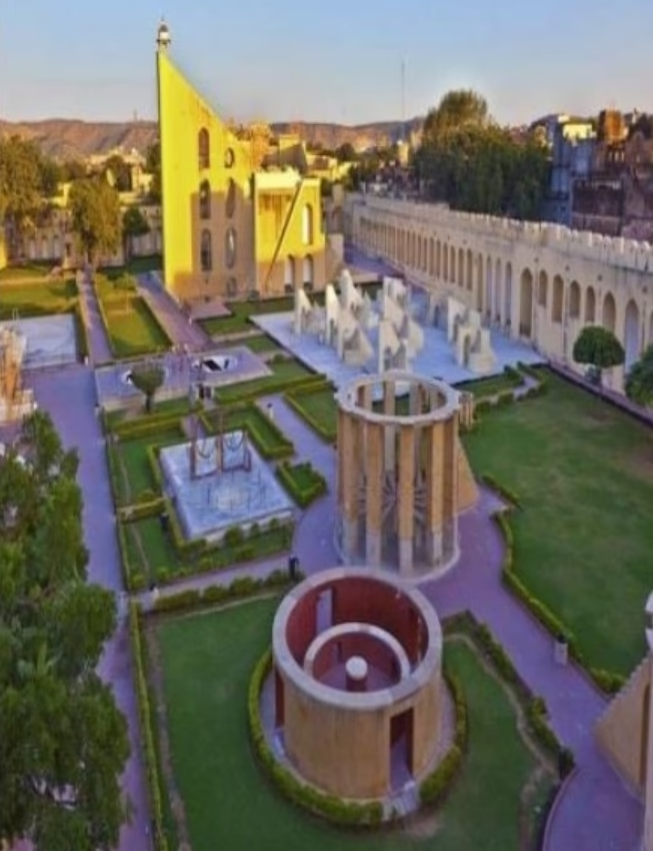
- Chola Bronze Nataraja Iconography:
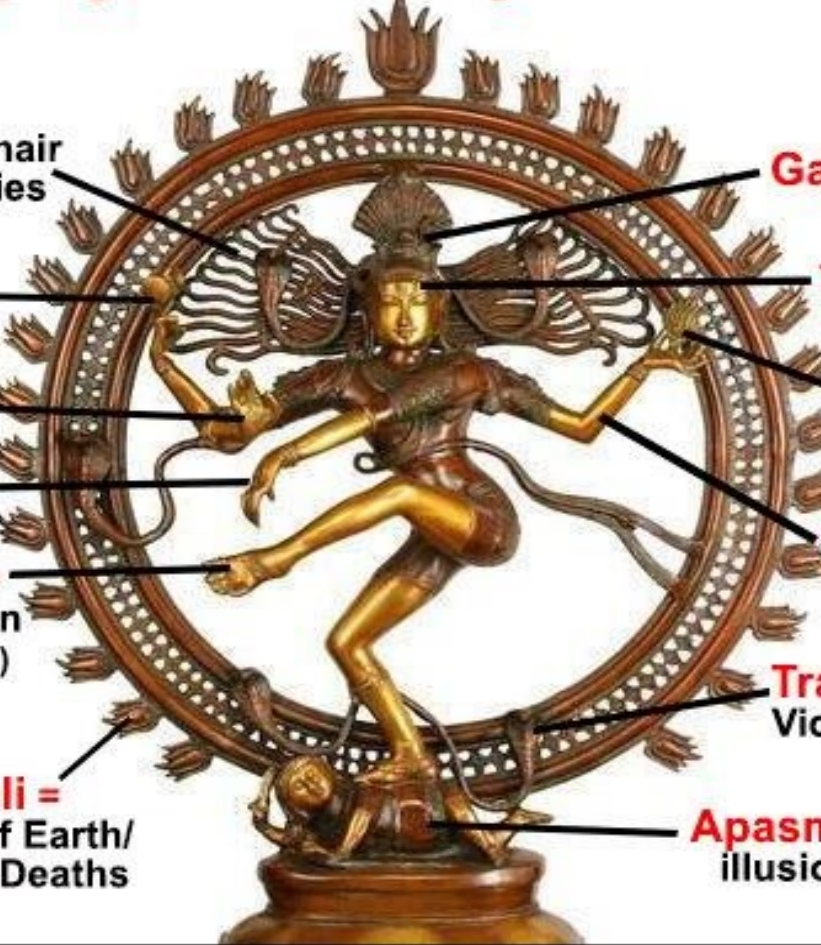
- Bharat Mandapam Nataraja:
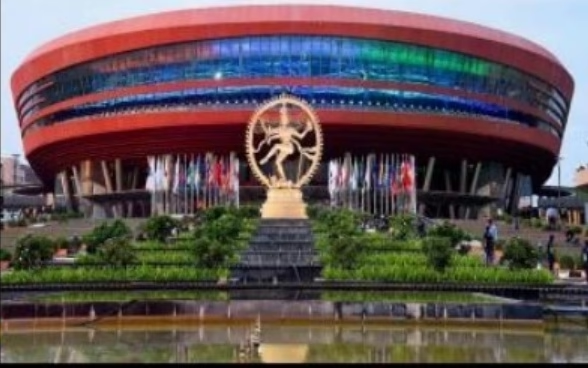
- Lothal Dockyard: Harappan Maritime Engineering:
- Punch-marked Coins: Earliest Currency:
- Indo-Greek Coins: Portraits & Script:
- Kushan Gold Coinage:
- Gupta Dynamic Coinage: Veena Player:
- Satavahana Lead Coins: Ship Symbols:
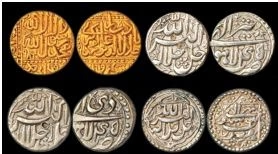
- Akbar's Coins:
- Ancient Pachisi Court at Fatehpur Sikri:
- PM reviewed progress of the National Maritime Heritage Complex (NMHC) at Lothal, Ahmedabad - once a thriving Indus Valley trading port 5,000 years ago; the NMHC, set up by MoPSW, is expected to be the world's largest maritime museum by 2029.
- The Indian Navy inducted the ancient stitched ship INSV Kaundinya, built using the 2,000-year-old Tankai stitched-shipbuilding method (coconut fibre, coir rope, natural resins, no nails), based on a 5th-century CE ship depicted in Ajanta Caves paintings.
- INSV Kaundinya sailed its maiden overseas voyage from Porbandar, Gujarat to Muscat, Oman; it is named after the legendary mariner Kaundinya, who sailed to Southeast Asia ~2,000 years ago and founded the Funan kingdom.
- Yuktikalpataru, a Sanskrit treatise by Bhoja Narapati, describes ancient Indian shipbuilding techniques, ship types, sizes, and materials.
- Sushruta described eight surgical procedures: chedya (excision), lekhya (scarification), vedhya (puncturing), esya (exploration), ahrya (extraction), vsraya (evacuation), sivya (suturing)
- National Ayurveda Day is now fixed on 23 September every year; it was earlier celebrated on Dhanvantari Jayanti (Dhanteras), the birth anniversary of Dhanvantari, physician of the Gods.
- Key Ayurveda texts include the Charaka Samhita (Charaka), Sushruta Samhita (Sushruta), Ashtanga Hridaya (Vagbhata), Madhava Nidana (Madhavakara), Bhavaprakasha (Bhavamishra), and Sharangadhara Samhita (Sharangadhara); the Yoga Sutras of Patanjali developed as an allied science of Ayurveda.
- The National AYUSH Mission (2014), a Centrally Sponsored Scheme, supports Ayurveda, Yoga & Naturopathy, Unani, Siddha, and Homoeopathy systems in India.
- The World Ayurveda Congress is a biennial event; the first was held in 2002 at Kochi and the most recent in 2024 at Dehradun, Uttarakhand.
- Rashtriya Vigyan Puraskar (RVP) 2025, instituted in 2023 replacing earlier science awards including the Shanti Swarup Bhatnagar Prize, has four categories: Vigyan Ratna, Vigyan Shri, Vigyan Yuva-SSB (under 45) and Vigyan Team, capped at 56 awards total.
- 2025 ICTP Prize (International Centre for Theoretical Physics, founded 1964 by Abdus Salam) was awarded to Titas Chanda (IIT-Madras) and Shitadhi Roy (ICTS Bengaluru) for work on quantum many-body systems.
- Astrophysicist Jayant Narlikar, Founder-Director of IUCAA Pune, co-developed the "steady state" model of the universe with Fred Hoyle (Hoyle-Narlikar theory), challenging the Big Bang theory; the 1965 discovery of cosmic microwave background radiation strengthened the Big Bang model instead.
- Saroj Ghose, founding Director-General of the National Council of Science Museums (NCSM, HQ Kolkata, formed 1978), built India's decentralised science museum network and later served as President of the International Council of Museums (ICOM), Paris.
- ICOM maintains formal ties with UNESCO/UN ECOSOC and, with INTERPOL, WIPO and the World Customs Organization, combats illicit trafficking of cultural goods; it is a founding member of the Blue Shield for heritage protection in conflicts.
- M.R. Srinivasan worked with Homi Bhabha on India's first research reactor Apsara, later became Chief Project Engineer of Tarapur and Madras Atomic Power Stations, Chairman of the Atomic Energy Commission (1987) and Founder-Chairman of NPCIL.
- Prasanta Chandra Mahalanobis, father of modern Indian statistics, established the Indian Statistical Institute (1931), laid the foundations of the NSSO and CSO, and gave the Mahalanobis Distance measure; National Statistics Day is observed on his birthday, June 29.
- Sushruta (~600 BCE, Kashi), disciple of Divodasa, authored the Sushruta Samhita (part of Ayurveda's Great Trilogy with Charaka Samhita and Vagbhata's Astanga Hridaya) and is known as the "Father of Surgery," describing 8 surgical procedures.
- Sushruta was first to study human anatomy using a dead body, is called the "Father of Plastic Surgery" for nose reconstruction/skin grafting, and established an early code of medical ethics at Benares University.
- Charaka (2nd century BCE-2nd century CE, NW India), royal physician of the Kushan Kingdom and "father of Indian medicine," authored the Charaka Samhita based on the Agnivesha Tantra, divided into 8 Ashtanga Sthanas.
- Charaka's Tridosha theory holds body function relies on Vata (movement), Pitta (transformation), Kapha (lubrication/stability), with disease arising from their imbalance; the Charaka Samhita also catalogues medicinal plants like Ashwagandha, Tulsi, Triphala.
- Radiocarbon (Carbon-14) dating, developed in the late 1940s by Willard Libby at the University of Chicago, determines the age of organic material up to ~60,000 years old by measuring the decay of C-14 after an organism's death.
⚗️ Panini's Ashtadhyayi & Rasashastra (Ancient Alchemy)
- Panini (c. 6th–4th century BCE): Sanskrit grammarian from Shalatula (near modern Attock); authored the Ashtadhyayi, a treatise of ~4,000 sutras systematising Sanskrit grammar and phonetics — regarded as a foundational text in linguistics and an early example of formal/generative grammar, predating modern linguistic theory by over two millennia.
- Rasashastra: Branch of Ayurveda dealing with metals, minerals, and their medicinal/alchemical processing (Rasa = mercury); associated with the alchemist-scholar Nagarjuna (distinct from the Buddhist Madhyamaka philosopher of the same name), traditionally credited with texts on mercury-based preparations (Rasa Ratnakara).
I'll check how existing Cornell Notes sections are structured in this project so the conversion matches the house style.Converting every detail from the source into zero-loss VitePress Cornell Notes markdown:
Cities of the Far South
Cities of the Far South — Overview & Greco-Roman Context
| Cue Words | Notes |
|---|---|
| How do Greco-Roman sources and modern scholarship frame early historical South Indian urban centres? | Sources & Framework:
|
Chera Cities — Vanji / Kuravur / Karur
| Cue Words | Notes |
|---|---|
| Analyse Vanji/Kuravur/Karur as a Chera political, craft, and trade centre with literary, numismatic, and excavation evidence. | Identity & Location:
Numismatics & Roman Contact:
Excavations:
Crafts & Inscriptions:
|
Chera Cities — Muchiri / Muziris
| Cue Words | Notes |
|---|---|
| What do the Periplus, Pliny, and the Vienna Papyrus record about Muchiri/Muziris as a Chera trade emporium? | Classical & Documentary Sources:
|
Pandya Cities — Madurai
| Cue Words | Notes |
|---|---|
| Describe Madurai as a Pandya urban centre from Maduraikkanchi, Arthashastra, craft references, and Alagarmalai inscriptions. | Literary Description (Maduraikkanchi / Pattuppattu):
Crafts & Trade:
Epigraphy:
|
Pandya Cities — Korkai
| Cue Words | Notes |
|---|---|
| Why was Korkai celebrated as a pearl-fisheries centre, and what do excavation and location evidence show? | Reputation & Sources:
Location Then vs Now:
Material Culture & Chronology:
|
Chola Cities — Uraiyur
| Cue Words | Notes |
|---|---|
| Analyse Uraiyur as early Chola capital: fortifications, textiles, megalithic burial grounds, and three excavation periods. | Political & Literary Profile:
Excavation Phases:
|
Chola Cities — Kaverippumpattinam / Pumpuhar / Puhar
| Cue Words | Notes |
|---|---|
| Detail Puhar (Kaverippumpattinam) as port capital: classical names, Pattinappalai markets, irrigation, boat platforms, Buddhist remains, and later Chola coin evidence. | Names, Span & Classical Identity:
Urban Layout & Society:
Infrastructure & Archaeology:
Later Continuity:
|
Chola Cities — Kachchi (Kanchi) & Vasavasamudram
| Cue Words | Notes |
|---|---|
| What early historical remains link Kanchi of the Sangam texts to later Pallava Kanchipuram, and how does Vasavasamudram fit as its sea port? | Kachchi (Kanchi):
Findings (Shankara Matha Area):
Findings near Kamakshi Temple:
Vasavasamudram (Port Link):
|
Chola Cities — Kodumanal
| Cue Words | Notes |
|---|---|
| Why is Kodumanal critical for early literacy and craft production in the Tamil region (3rd CBC–3rd CAD)? | Site Profile:
Industrial Evidence:
Literacy Evidence:
|
Kautilya’s Timetable for a King
Kautilya’s Timetable for a King (Arthashastra 1.19.16)
| Cue Words | Notes |
|---|---|
| How does Arthashastra 1.19.16 structure the king’s day and night, and what activities fill each unit? | Time Division:
Day Timetable (Immediately After Sunrise):
Night Timetable:
|
Raja Sawai Jai Singh II (1686–1743)
Raja Sawai Jai Singh II — Title, Politics & Jaipur City Planning
| Cue Words | Notes |
|---|---|
| How did Sawai Jai Singh II obtain the title ‘Sawai’, abolish Jaziya influence, and plan Jaipur on a grid of nine cosmic zones? | Title ‘Sawai’:
Political Role:
Jaipur Grid Planning:
|
Raja Sawai Jai Singh II — Jantar Mantar Observatories & Zij-e-Muhammad-Shahi
| Cue Words | Notes |
|---|---|
| What was Jai Singh’s astronomical programme: observatories, Zij-e-Muhammad-Shahi, and his eclectic manuscript library? | Observatories (Jantar Mantar Tradition):
Zij-e-Muhammad-Shahi:
Grand Passion — Scholarship & Instruments:
|
Rana Kumbha (1433–1468 CE)
Rana Kumbha — Forts, Wars & Vijay Stambha
| Cue Words | Notes |
|---|---|
| List Rana Kumbha’s five forts, his foes, and the context and dimensions of the Vijay Stambha at Chittorgarh. | Five Forts:
Military Context:
Vijay Stambha (Victory Tower):
|
Rana Kumbha — Music, Literature & Kirti Stambh Prashashti
| Cue Words | Notes |
|---|---|
| What music treatises and literary works are associated with Rana Kumbha’s reign? | Personal Scholarship:
Music Treatises:
Court Scholars:
|
Rani ki Vav
Rani ki Vav (Also on ₹100 Note)
| Cue Words | Notes |
|---|---|
| Who built Rani ki Vav, for whom, in what style, and what is its architectural character? | Patronage & Setting:
Style & Structure:
|
Rakhigarhi
Rakhigarhi — Harappan Township & Excavation Findings
| Cue Words | Notes |
|---|---|
| What is Rakhigarhi’s rank among Harappan townships, who excavated it, and what materials and structures were found? | Status:
Excavator:
Material and Findings:
|
Different Versions of the Ramayana
International & Regional Versions of the Ramayana
| Cue Words | Notes |
|---|---|
| Map major Indian and international Ramayana versions with country and distinctive points. | Indian / Regional Versions:
Southeast / East Asian Versions:
|
Vijaya Temple / Bijamandal Mosque (Vidisha)
Vijaya Temple / Bijamandal Mosque — Builders, Dedication & Later History
| Cue Words | Notes |
|---|---|
| Clarify the contested builders, dedication, Al-Biruni/Aurangzeb layers, and famous sculptures of the Vijaya Temple (Bijamandal) at Vidisha. | Modern Association:
Builders (No Clarity):
Dedication & Local Tradition:
Destruction & Rebuilding:
Aurangzeb Phase:
Famous Sculpture:
Pavilion, Surya Temple & Stepwell:
|