Religion & Cultural Vocabulary: Shramana, Bhakti & Sufi Terms
Buddhism and Jainism Lexicon
Buddhism and Jainism Lexicon
| Cue Words | Notes |
|---|---|
| Buddhist Sects (Theravada, Mahayana, Vajrayana) | - Theravada (Hinayana): orthodox; Buddha as teacher, Pali texts, rejects idol worship - Mahayana: theistic; Buddha as deity, Sanskrit texts, worships Bodhisattvas & idols - Vajrayana: Tantric school; magical formulas, symbols, ritual practices |
| Bodhisattvas (Avalokiteshvara, Manjusri, Maitreya) | - Avalokiteshvara (Padmapani): lotus bearer, compassion - Manjusri: sword bearer, wisdom - Maitreya: Future Buddha, will restore Dharma |
| Sacred Architecture (Stupa, Chaitya, Vihara) | - Stupa: hemispherical mound enclosing relics of Buddha/disciples - Chaitya: rock-cut or structural prayer/worship hall containing stupa - Vihara: residential hall or monastery for monks |
| Buddhist Mudras (Hand Gestures) | - Bhumisparsha: Earth touching witness of truth, victory over temptation - Dharmachakra: Wheel of Dharma, first sermon at Sarnath - Abhaya: raised hand, fearlessness & protection - Varada: downward palm, charity & granting boons |
| Jaina Philosophy & Sects | - Philosophy: *Anekantavada* (pluralism/manifold reality), *Syadvada* (relative judgment) - Sects: *Digambara* (sky-clad/naked, orthodox) vs *Shvetambara* (white-clad) |
| Jaina Practices & Tirthankaras | - *Sallekhana / Santhara:* spiritual practice of fasting to death to cleanse karma - *Kevala Jnana:* omniscience, highest knowledge & liberation - *Tirthankaras:* 24 spiritual teachers (1st: Rishabhanatha, 23rd: Parshvanatha, 24th: Mahavira) |
Bhakti and Sufi Synthesis
Bhakti and Sufi Synthesis
| Cue Words | Notes |
|---|---|
| Bhakti Classification: Alvars & Nayanars | - Alvars: South Indian Vaishnavite saints (Vishnu worshipers) - Nayanars: South Indian Shaivite saints (Shiva worshipers) |
| Bhakti Division: Saguna & Nirguna | - Saguna: devotion to God with attributes/form/incarnation (Mirabai, Tulsidas, Chaitanya) - Nirguna: devotion to formless absolute God (Kabir, Guru Nanak) |
| Bhakti Concepts (Kirtan, Guru-Shishya) | - *Kirtan:* devotional group singing of hymns (popularized by Chaitanya Mahaprabhu) - *Guru-Shishya Parampara:* spiritual lineage & transmission from master to disciple |
| Sufi Orders: Chishti & Suhrawardy | - Chishti Order: founded by Moinuddin Chishti in India; poverty, simple living, devotional music (*Sama*) - Suhrawardy Order: orthodox; accepted state patronage, wealth, court offices |
| Sufi Vocabulary (Khanqah, Ziyarat, Fana) | - *Khanqah:* hospice/monastery for Sufi saints & travelers - *Ziyarat:* pilgrimage to tombs (*dargahs*) of Sufi saints - *Fana:* spiritual annihilation of ego, union with Divine |
UPSC Recall & Traps
UPSC Recall & Traps
| Cue Words | Notes |
|---|---|
| Chaitya vs Vihara Trap | - Chaitya = place of **worship** (contains Stupa); Vihara = **monastery/residence** for monks |
| Bhumisparsha Mudra Meaning | - Buddha touching earth to witness purity (Gupta Sarnath sculpture context) |
| Future Buddha Identity |
|
| Anekantavada Affiliation | - Strictly **Jain** doctrine (NOT Buddhist middle path) |
🖼️ Supplemental Asset Directory
Supplemental Asset Directory
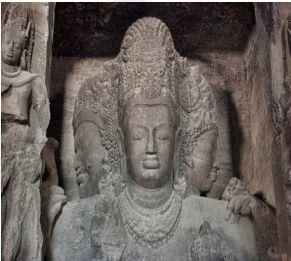
- Elephanta Trimurti: Iconographic Excellence:
- Buddhism emerged in India around the 5th-6th century BCE during the "Second Urbanisation," arising as a heterodox tradition alongside Jainism, an alternative to ritualistic hierarchical Vedic Hinduism; Buddha (Siddhartha) was son of King Suddhodana of the Sakya clan of Kapilavastu.
- Canonical Pali Pitakas (Sutta and Vinaya) contain Buddha's hagiography, supplemented by texts like Mahavastu and Buddhacharita.
- Buddha's first sermon at Sarnath referred to as dhammachakka-pavattana, meaning 'turning of the wheel of dhamma'
- Sarnath (near Varanasi) is where the Buddha delivered his first sermon (dhammachakka-pavattana, "turning of the wheel of dhamma") around 528 BCE; India has nominated it for the UNESCO World Heritage List 2025-26 after 27 years on the tentative list.
- Sarnath was rediscovered by workers of Jagat Singh, diwan of Raja Chait Singh of Benares, while digging for building material for a new marketplace.
🪯 Sikh Religious Vocabulary
- Guru Granth Sahib: Eternal scripture-Guru of Sikhism, compiled by Guru Arjan Dev (Adi Granth, 1604) and given Guruship status by Guru Gobind Singh (1708), ending the line of human Gurus.
- Langar: Community kitchen serving free meals to all visitors regardless of religion, caste, or status — institutionalised by Guru Nanak and Guru Amar Das to promote equality.
- Panj Pyare ("Five Beloved Ones"): The first five Sikhs initiated by Guru Gobind Singh at the founding of the Khalsa (Baisakhi, 1699), from whom he himself then sought initiation.
- Amrit Sanskar / Khande di Pahul: Sikh baptism ceremony initiating a person into the Khalsa, administered using a double-edged sword (Khanda).
- Gurdwara: Sikh place of worship ("doorway to the Guru"), housing the Guru Granth Sahib; distinguished by the Nishan Sahib (saffron triangular flag) flying outside.