Calendars, Festivals & Geographical Indications (GI Tags) of India
Indian Calendar Systems
Indian Calendar Systems
| Cue Words | Notes |
|---|---|
| Vikram Samvat (57 BCE) | - Founded by King Vikramaditya to commemorate victory over Shakas - Luni-Solar calendar; new year starts with Chaitra Shukla Pratipada (following new moon) |
| Shaka Samvat (78 CE) | - Founded by Kushan King Kanishka - Luni-Solar calendar; basis of India's official National Calendar |
| Hijri Era (622 CE) | - Purely lunar calendar used in Islamic world; marks migration (*Hijrah*) of Prophet Muhammad from Mecca to Medina |
| Indian National Calendar (1957) | - Adopted **March 22, 1957** (1 Chaitra 1879 Shaka) on Calendar Reform Committee recommendations - Based on Shaka Era, solar-adjusted; year starts on **Chaitra 1** (March 22 normal year, March 21 leap year) |
Regional Festivals and New Years
Regional Festivals and New Years
| Cue Words | Notes |
|---|---|
| Makar Sankranti & Regional Variants | - Pan-Indian solar festival marking Sun's transition into Capricorn (*Makara rashi*) - Variants: *Pongal* (TN), *Magh Bihu* (Assam), *Lohri* (Punjab), *Uttarayan* (Gujarat) |
| Chhath Puja | - Celebrated in Bihar, Jharkhand, UP - Dedicated to Sun God (*Surya*) & *Chhathi Maiya* (*Usha*, first sun ray); no idols, standing in water bodies during sunrise/sunset |
| Regional New Years (Luni-Solar Cycles) | - Ugadi: Karnataka, AP, Telangana (first day of Chaitra) - Gudi Padwa: Maharashtra & Goa (silk flag/*Gudi* hoisting) - Vishu: Kerala (ritual viewing of auspicious items at dawn, *Vishukkani*) - Puthandu: Tamil Nadu (first day of Tamil month Chithirai) - Poila Baisakh: West Bengal & Bangladesh - Baisakhi: Punjab (harvest & Khalsa foundation) - Navreh: Kashmir (Kashmiri Pandits New Year) |
| Kumbh Mela (UNESCO Listed) | - Largest peaceful pilgrim congregation; UNESCO Intangible Cultural Heritage - Held every 12 years by rotation at 4 sacred river locations: - Prayagraj (Allahabad): Triveni Sangam (Ganga, Yamuna, Sarasvati) - Haridwar: River Ganga - Nashik: River Godavari - Ujjain: River Shipra |
Handicrafts & Geographical Indication (GI) Tags
Handicrafts & Geographical Indication (GI) Tags
| Cue Words | Notes |
|---|---|
| Geographical Indication (GI) System | - Sign on products with specific geographical origin & reputation; GI of Goods Act, 1999 - Valid for **10 years** (renewable); regulated under WTO TRIPS Agreement |
| High-Yield GI Handicrafts Examples | - Madhubani Paintings (Bihar): Mithila art, natural dyes, double borders - Kancheepuram Silk (TN): high-quality silk sarees, heavy gold zari - Chanderi Fabrics (MP): lightweight sheer fabric, gold borders - Blue Pottery (Jaipur): cobalt blue glaze, no clay used - Aranmula Kannadi (Kerala): unique metal-alloy mirror (secret metallurgy) |
UPSC Recall & Traps
UPSC Recall & Traps
| Cue Words | Notes |
|---|---|
| National Calendar Date Trap | - Adopted on **March 22, 1957** (NOT Jan 26, 1950) |
| Vikram vs Shaka Calculation | - Vikram = Gregorian + 57; Shaka = Gregorian - 78 |
| First GI Tag Product |
|
| Kumbh River Matching Trap | - Ujjain = **Shipra** river (NOT Chambal); Nashik = **Godavari** river (NOT Krishna) |
🖼️ Supplemental Asset Directory
Supplemental Asset Directory
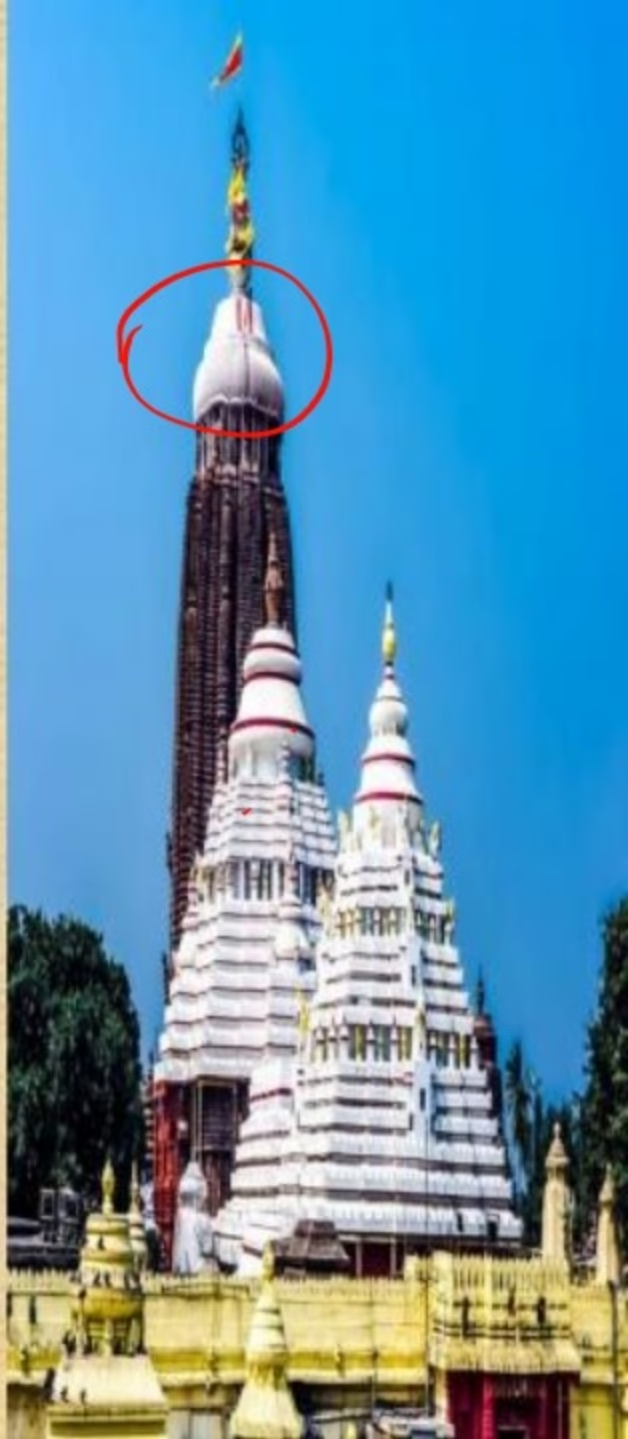
- Jagannath Puri: Rath Yatra Heritage:
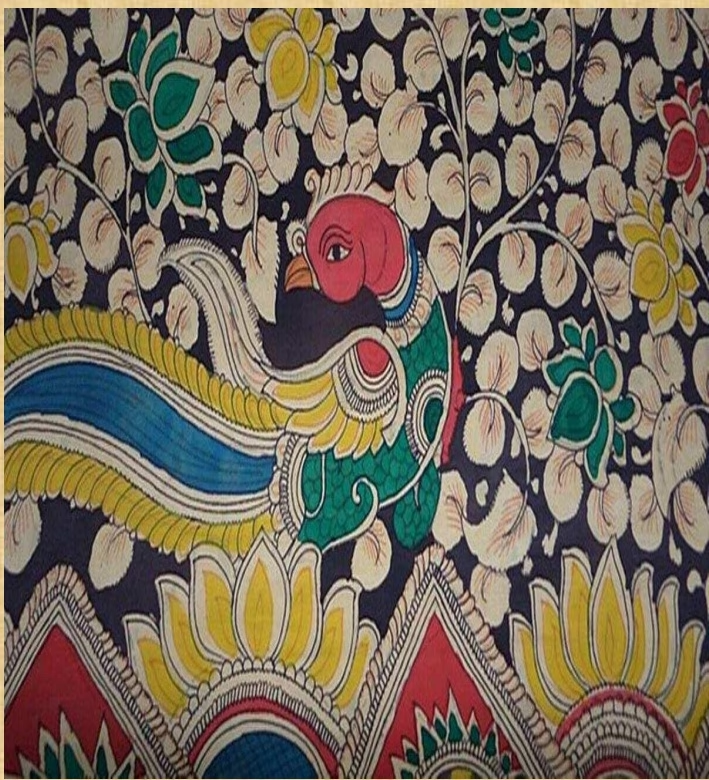
- Kalamkari Painting (AP):
- Rogan Painting (Gujarat):
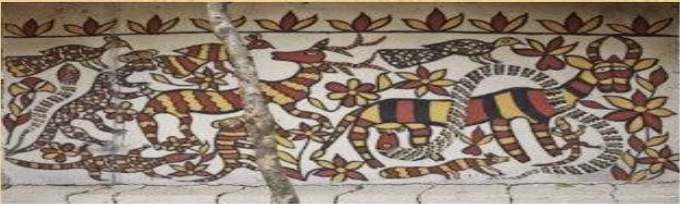
- Sohrai Mural (Jharkhand):
- Kolhapuri chappal, GI-tagged footwear from Kolhapur, Maharashtra with 800+ years of history worn by Chhatrapati Shahu Maharaj, sparked controversy after Prada's 2026 collection resembled it without acknowledging the artisans.
- Kolhapuri chappals are handcrafted by decentralised family artisans across Maharashtra and Karnataka using eco-friendly vegetable-tanned leather.
- A GI (Geographical Indication) identifies goods originating from a specific place whose qualities are linked to that location; GIs are public community property, non-transferable, protected under the Paris Convention (1883) and TRIPS (1995).
- India's Geographical Indications of Goods (Registration and Protection) Act, 1999 (in force 2003) is administered via the GI Registry in Chennai under DPIIT, Ministry of Commerce; registration is valid for 10 years and renewable; India has 650+ GI-tagged goods with a target of 10,000 by 2030.
- Kumbakonam Vetrilai (betel leaf from Thanjavur's Cauvery basin, rich in chavicol) and Thovalai Maanikka Maalai (ruby-patterned flower garland) from Tamil Nadu were granted GI tags.
- Government launched a drive to secure GI tags for traditional items of 26 Assam communities (Adivasis, Gurkhas, Koch-Rajbongshis, Hajongs, Kurukhs, Madahi Kacharis, Hiras, Patnis) to create "GI villages" supporting artisan clusters.
- GI tag application fee has been reduced from Rs 5,000 to Rs 1,000; recent GI tags include Kannadippaya (Kerala), Apatani textile (Arunachal Pradesh), Marthandam honey (Tamil Nadu), Lepcha Tungbuk (Sikkim), Bodo Aronai (Assam), Ambaji white marble (Gujarat) and Bedu & Badri cow ghee (Uttarakhand).
- Ambaji marble (Gujarat), used in Dilwara Jain Temple-era construction (1,200-1,500 years old) and known for high calcium content, received a GI tag.
- Ponduru Khadi from Srikakulam, Andhra Pradesh, appreciated by Gandhi, received a GI tag.
- Telangana has 18 GI products including Pochampally Ikat, Adilabad dokra, Warangal durries and Hyderabad haleem, with Hyderabad lac bangles (2024) and Warangal chapata chilli (2025) secured recently.
- 79th Independence Day President''s "At Home" invite (designed by NID Ahmedabad) featured GI/folk crafts of eastern states: Tikuli art (Bihar), Pattachitra (West Bengal), Talapatra Chitra/palm-leaf scroll painting (Odisha, GI-tagged) and Paitkar painting (Jharkhand).
- 76th Republic Day President's invite showcased southern crafts with GI tags: Pochampally Ikat (Telangana), Etikoppaka toys (Andhra), Kancheepuram silk (Tamil Nadu), Ganjifa art (Karnataka) and screw-pine weaving (Kerala), packaged in a Kalamkari-motif bamboo box.
- Kashi Tamil Sangamam (fourth edition, theme "Learn Tamil-Tamil Karkalam") is held under the Ek Bharat Shreshtha Bharat programme, which pairs states/UTs via MoUs to promote mutual cultural understanding.
- Ambubachi Mela held during monsoon at Kamakhya Temple, marks annual menstruation of Goddess Kamakhya, shrine closed to devotees
- Ambubachi period symbolizes fertility and monsoon; complete halt to ploughing, sowing, agricultural activities during festival
- Kashi Tamil Sangamam organized to promote Ek Bharat Shreshtha Bharat concept and strengthen Indian unity
- Shree Lairai Devi Temple ancient Hindu temple to Goddess Lairai (form of Shakti); annual Lairai Jatra in April/May at Shirgao
- Lairai Jatra features Agnidivya fire-walking ritual where devotees walk barefoot on burning embers symbolizing moral integrity
- Jatra originated 16th century linked to Vaishnavism and Bhakti movement; performed on open-air stage; now incorporates modern stunts
- Nanda Devi Fair Nainital organized since 1926 by Ram Sewak Sabha; features banana tree idols decorated with flowers and spices
- Kheer Bhawani Festival Jyeshtha Ashtami at Tulmulla Kashmir largest annual gathering of Kashmiri Hindus after Amarnath Yatra
- Deepavali recognized as living heritage strengthening social bonds, supporting traditional craftsmanship, reinforcing generosity values
- The 26th edition of the Hornbill Festival, "Festival of Festivals", began in Nagaland; it is named after the Great Hornbill (IUCN Vulnerable, Schedule I of Wildlife Protection Act 1972), found in the Western Ghats and Himalayas.
- The North East India Festival (NEIF), launched under Indias Act East Policy, held its 4th edition in Singapore, marking 60 years of India-Singapore ties and the India-ASEAN Year of Tourism; it showcases Bihu, Sattriya, and Manipuri folk dances.
- Rashtriya Ekta Diwas (October 31, instituted 2014) marks Sardar Vallabhbhai Patels birth anniversary; the 2025 theme was "Unity in Diversity" at Ekta Nagar, home to the Statue of Unity.
- World Habitat Day (established by the UN in 1985) is observed on October 6; the 2025 theme was "Urban Crisis Response".
- Bathukamma: Telangana festival of women honouring nature via floral arrangements; nine-day festival ending on Durgashtami; 2025 saw a record 63-foot Bathukamma (13 tonnes of flowers) enter Guinness World Records; marigold is a key flower used.
- Ningol Chakouba: Manipuri festival where "Ningol" (married woman) is invited by "Chakouba" (feast) to her parental home; marked with the Fish Fair-cum-Fish Crop Competition at Hatta Kangjeibung, Imphal.
- Chhath Puja: four-day Sun-worship festival of Bihar, eastern UP and Nepal with a long waterless fast and offerings to Usha and Pratyusha; Chhathi Maiya (Sun's sister) is worshipped; Government of India is seeking UNESCO Intangible Cultural Heritage status for Chhath Mahaparva.
- Konkan's Naangarni Spardha: traditional ploughing race held at Ratnagiri, Maharashtra during the monsoon, run on a horseshoe-shaped mud track with racing order decided by drawing chits.
- Dhirio (Goa's bull fight): unlike Spanish bullfighting has no matadors and bulls are not killed; historically linked to Church feast gatherings; held in paddy fields/football grounds; Bombay HC at Goa has declared it illegal despite continued practice.
- Legislators sought exemption for Dhirio under the Prevention of Cruelty to Animals Act similar to Tamil Nadu's jallikattu exemption; in 2023 a five-judge SC Bench upheld state amendments allowing jallikattu, kambala and bullock-cart races.
- Jallikattu (eruthazhuvuthal): Tamil Nadu bull-taming sport held during Pongal, a harvest thanksgiving festival celebrating nature and cattle worship.
- Kaleshwaram, Telangana held a 12-day Saraswati Pushkaralu (once-in-12-years event) at Sri Kaleshwara Sri Mukteshwara Swamy temple ("Trilinga Kshetram"), with rituals at Triveni Sangamam - the confluence of Godavari, Pranahita and subterranean Saraswati rivers.
- Manipur's Sangai Festival (launched 2010, named after the endangered brow-antlered deer found only in Keibul Lamjao National Park) showcases arts, handlooms, cuisine, and sports (Thang-Ta, Yubi-Lakpi, Mukna Kangjei, Sagol Kangjei) under a "Festival of Oneness" theme.
- Karthigai Deepam, celebrated at Kaliamman temple, Perumal Kovilpatti (Dindigul), marks Karthika month's full moon and Shiva's cosmic fire-pillar appearance with lamp-lighting rituals; Thiruvannamalai's Maha Deepam is iconic.
- Gajapayana is the traditional symbolic march of elephants from forest to city ahead of the Mysuru Dasara festival.
- Ramman festival is celebrated annually in late April (Baisakhi) at twin villages Saloor-Dungra, Chamoli (Uttarakhand), with theatrical Ramayana performances using 18 types of Bhojpatra (Himalayan birch) masks; inscribed on UNESCO's ICH list in 2009.
- Pushkar Kumbh commenced at Keshav Prayag, Mana village, Chamoli after 12 years, held when Jupiter enters Gemini at the confluence of Alaknanda and Saraswati rivers, mainly attended by South Indian Vaishnavite devotees.
- Kumbh types by frequency: Magh Mela (annual, Prayagraj), Kumbh (3 yrs, 4 sites), Ardh Kumbh (6 yrs, Haridwar/Prayagraj), Purna Kumbh (12 yrs, 4 sites), Maha Kumbh (144 yrs, Prayagraj - rarest); the Kumbh Mela was inscribed on UNESCO's ICH list in 2017.
- Nashik-Trimbakeshwar Simhastha Kumbh Mela begins Oct 31, 2026 with flag hoisting at Trimbakeshwar/Ramkund, Nashik; the first Amrut Snan in the Godavari will take place in 2027.
- Bonalu, a major Telangana festival (Hyderabad/Secunderabad) during Ashada Masam, is dedicated to Goddess Mahakali (also worshipped as Yellamma/Pochamma); it originated in the early 19th century after a Hyderabad plague, with women carrying Bonam pots and Pothuraju dance processions.
- Rath Yatra takes Lord Jagannath, Balabhadra and Subhadra on a 9-day sojourn from Puri's Jagannath Temple to the Gundicha Temple; the three chariots are Taladhwaja (Balabhadra), Darpadalan (Subhadra), Nandighosa (Jagannath).
- Puri is one of the four Char Dham (Badrinath, Dwarka, Puri, Rameswaram); the "Chota Char Dham" comprises Yamunotri, Gangotri, Kedarnath, Badrinath.
- Onam marks the annual visit of King Mahabali, symbolising equality in Mavelinad, and sustains Kerala's art, craft and rural sports including snake-boat races (Vallam Kali).
- Dong village, Anjaw district (Arunachal Pradesh), India's easternmost point bordering Tibet and first to receive sunrise, hosted the inaugural Sunrise Festival featuring performances by the Meyor tribe.
- Langkhun (Lankhong) is a socio-religious harvest festival celebrated by the Tiwa community, notably in Karbi Anglong district, Assam.
- The Music Academy's 99th annual festival, Chennai (inaugurated by A.R. Rahman), marked the 250th anniversary of Muthuswami Dikshitar, third of the Carnatic music Trinity with Tyagaraja and Syama Sastri.
- Muthuswami Dikshitar (1775-1835) composed ~500 kritis in Sanskrit using the "Guruguha" mudra, mastered all 72 Melakarta ragas, pioneered nottu swara/Samashti Charanam, and is known for compositions like "Balagopala" and "Rangapuravihari".
- Kehwa is piping hot brew of crushed almonds, saffron, cardamom, cinnamon from Kashmir
- Wazwan is a multi-course traditional Kashmiri mutton feast symbolising hospitality and Kashmirs Central Asian connections, with signature dishes rista, roganjosh, gushtaba, and tabakh maaz.
- Cherrapunji Eastern Craft Gin, the first alcohol label from Northeast India to be exported, is distilled from rainwater sourced from Sohra and Mawsynram (the wettest places on Earth) using local ingredients like kaji nemu, Khasi mandarin, Sohmarit pepper.
- Cherrapunji gin is produced using traditional copper stills, packaged in a reusable military-grade steel bottle, and has won 13 international spirits awards including a Master medal at the Global Spirits Masters 2023.
- Kolhapuri chappals have 800+ years history originating from Kolhapur, Maharashtra, known for durability and aesthetic
- Kolhapuri chappals handcrafted by skilled family-based artisans using vegetable-tanned leather with natural tannins
- National Crafts Museum New Delhi established 1956 by All India Handicrafts Board; designed by Charles Correa; houses 35,000+ artifacts
- National Crafts Museum collections: Banarasi brocades, Patolas, Maheshwaris, Kalamkari, Phulkari, Ikat, Naga shawls; operates under Ministry of Textiles
- Geographical Indication is intellectual property identifying goods originating from specific place with linked qualities/reputation
- India has 650+ GI-registered goods including Chanderi sarees, Madhubani painting, Pashmina shawls, Kancheepuram silk, Darjeeling tea
- GI tags are public property of producer community, not tradable like trademarks, promote rural development and cultural preservation
- Paris Convention (1883) and TRIPS Agreement (1995) protect Geographical Indications globally
- India's Geographical Indications of Goods Act (1999) enforced from 2003, registration valid for ten years, renewable
- Geographical Indications Registry located in Chennai; Department for Promotion of Industry and Internal Trade awards GI tags
- Uttar Pradesh holds highest number of GI tags; Commerce & Industry Ministry set target of 10,000 GI tags by 2030
- GI tag application fee reduced from ₹5,000 to ₹1,000
- Kumbakonam Vetrilai is betel leaf grown in Thanjavur's fertile Cauvery River basin, known for antioxidant and anti-inflammatory properties
- Thovalai Maanikka Maalai is special garland type made only in Thovalai, flowers carefully folded to resemble gems in geometric patterns
- Changthangi goat (Pashmina goat) raised in high-altitude Changthang plateau of Ladakh by nomadic Changpa community at 3,000-6,000 meters
- Kashmiri Pashmina shawl woven from fine undercoat of Changthangi goat, celebrated for exceptional softness and warmth
- Bidriware vases from Bidar, Karnataka made from zinc-copper alloy with black finish and fine silver inlay
- Tarakasi work (Silver Filigree Purse) from Cuttack, Odisha combines floral and vine designs with modern craftsmanship
- Assam launched special drive to secure GI tags for 26 traditional communities including Adivasis, Gurkhas, Koch-Rajbongshis
- 21 items from Assam received GI tags: textiles (Aronai, Dokhona, Zwmgra), musical instruments (Kham, Serza, Siphung)
- Assam GI tags include alcoholic beverages (Maibra Zwu Bidwi, Zwu Gisi), cuisine (Gwkha Gwkhwi, Napham), medicinal plants
- Ambaji Marble from Gujarat's pilgrimage site awarded GI tag for high-quality white stone, dates back 1,200-1,500 years
- Ambaji Marble known for strength and high calcium content, used in temple construction in U.S., New Zealand, England
- Ponduru Khadi from Andhra Pradesh appreciated by Gandhi, received GI tag, located 20 km from Srikakulam
- Telangana filed GI tag applications with five in final approval: Narayanpet jewellery, Hyderabad pearls, Banjara tribal jewellery
- Telangana secured GI tags for Hyderabad lac bangles (2024) and Warangal chapata chilli (2025); has 18 total GI products
- The President carried the irumudi (sacred bundle) at Sabarimala's Lord Ayyappa temple, Kerala, becoming the second Indian President and first woman head of state to visit.
- Irumudi is a double-compartment cloth bag carried on the head after a 41-day vratham; the front (munmudi) holds offerings like ghee-filled coconut (Nei Thengai, symbolising body/soul surrender), the rear (pinmudi) holds personal provisions.
- Shree Lairai Devi Temple, Goa (dedicated to Goddess Lairai, incarnation of Parvati) saw 7 deaths during the annual Lairai Jatra, known for the barefoot fire-walking ritual (Agnidivya/Homkhand) by devotees called "dhonds".
- Goa's Jatra tradition originated in the 16th century linked to the Bhakti movement/Vaishnavism, initially devotional songs/dances/plays, later addressing social issues and now incorporating modern stunts.
- Naina Devi temple's Nanda Devi Fair, organised since 1926 by Ram Sewak Sabha in Nainital, involves banana-tree idols carried in a palanquin procession and immersed in water; the Uttarakhand HC recently allowed restricted animal sacrifice at the fair.
- Kheer Bhawani festival at Tulmulla (Ganderbal) and other Kashmir sites is dedicated to Goddess Ragnya Devi; devotees offer kheer at a sacred spring believed to change colour as an omen; it is the largest Kashmiri Pandit gathering after the Amarnath Yatra.
- Kashmiri Pashmina shawl is woven from the fine undercoat of the Changthangi (Pashmina) goat, raised by the nomadic Changpa community on the high-altitude Changthang plateau of Ladakh (3,000-6,000m).
- Handicrafts gifted by PM to Ghana leaders included GI-tagged Bidriware vases (Bidar, Karnataka, zinc-copper alloy with silver inlay) and GI-tagged Silver Filigree/Tarakasi purses (Cuttack, Odisha).
- Assam is set to receive the 16th-century Vrindavani Vastra silk textile from London's British Museum on an 18-month loan for a 2027 exhibition; it was woven under neo-Vaishnavite saint-reformer Srimanta Sankaradeva's guidance and depicts scenes from Krishna's life.
- The Vrindavani Vastra reached the British Museum via Tibet in the 20th century, with parts also housed in other European museums.
- The first-ever Jamdani Exposition was organised at the National Crafts Museum, New Delhi; Jamdani is a centuries-old cotton handwoven textile from Bengal, its name from Persian jam (flower) and dani (vase), recognised by UNESCO as Intangible Cultural Heritage in 2013.
- The National Crafts Museum & Hastkala Academy (New Delhi, est. 1956 by the All India Handicrafts Board, championed by Kamaladevi Chattopadhyay, designed by architect Charles Correa) houses 35,000+ artifacts including Banarasi brocades, Patolas, Maheshwaris, Kalamkari, Phulkari, Ikat, and Naga shawls under the Ministry of Textiles.
- Aadi Vaani is an AI-based translation model (Tribal Affairs Ministry, with IIT Delhi, BIT Pilani, IIIT) translating between Hindi, English, and six Adivasi languages: Bhili, Mundari, Gondi, Santali, Kui, and Garo; Bhili is the most widely spoken non-scheduled language with over one crore speakers.
- Adi Sanskriti is a digital platform for tribal artforms and heritage with three components: Adi Vishwavidyalaya (Digital Tribal Art Academy), Adi Sampada (Socio-Cultural Repository), and Adi Haat (Digital Marketplace).
🌙 Amanta vs Purnimanta Lunar Month Systems
- Amanta ("ending with no-moon"): Lunar month runs from one new moon (Amavasya) to the next; followed in most of South India, Maharashtra, Gujarat, and West Bengal.
- Purnimanta ("ending with full moon"): Lunar month runs from one full moon (Purnima) to the next; followed in most of North India (UP, Bihar, MP, Rajasthan) and used in the traditional Vikram Samvat reckoning.
- Both systems have identical Krishna Paksha (waning) and Shukla Paksha (waxing) fortnights but differ in which fortnight starts the month — a frequent source of date mismatches for the same festival across regions (e.g., differing Holi/Diwali calculations in older almanacs).