Indian Literature & Languages: Ancient Canons to Classical Languages
Ancient Sanskrit and Canonical Literature
Ancient Sanskrit and Canonical Literature
| Cue Words | Notes |
|---|---|
| Vedic Literature (Shruti & Smriti) |
|
| Classical Sanskrit Drama |
|
Buddhist and Jain Canons
Buddhist and Jain Canons
| Cue Words | Notes |
|---|---|
| Buddhist Literary Tradition (Pali & Sanskrit) |
|
| Jaina Literary Tradition (Prakrit & Ardhamagadhi) |
|
Sangam Tamil and Southern Literature
Sangam Tamil and Southern Literature
| Cue Words | Notes |
|---|---|
| Sangam Literature (Tamil Assembly & Themes) | - Secular assemblies (Sangams) in Madurai under Pandya kings - Predominantly secular themes: - *Akam:* inward-looking poems on love & human emotions - *Puram:* outward-looking poems on war, heroism, public actions |
| Sangam Compilations & Epics |
|
Medieval Vernacular and Persian Literature
Medieval Vernacular and Persian Literature
| Cue Words | Notes |
|---|---|
| Vijayanagara & Bhakti Vernacular Literature |
|
| Persian Court Literature & Chronicles |
|
Language Families and Classical Status
Language Families and Classical Status
| Cue Words | Notes |
|---|---|
| Language Families of India |
|
| Classical Languages Status & Criteria |
|
Contemporary Indian Literature & Writers
Recent Literary Figures (2024-2025)
| Cue Words | Notes |
|---|---|
| Jnanpith Award Winners & Criteria |
|
| Vinod Kumar Shukla (2024 Winner) |
|
| Contemporary Mathematicians of Indian Origin |
|
UPSC Recall & Traps
UPSC Recall & Traps
| Cue Words | Notes |
|---|---|
| Exam Traps & Key Facts |
|
🖼️ Supplemental Asset Directory
Supplemental Asset Directory
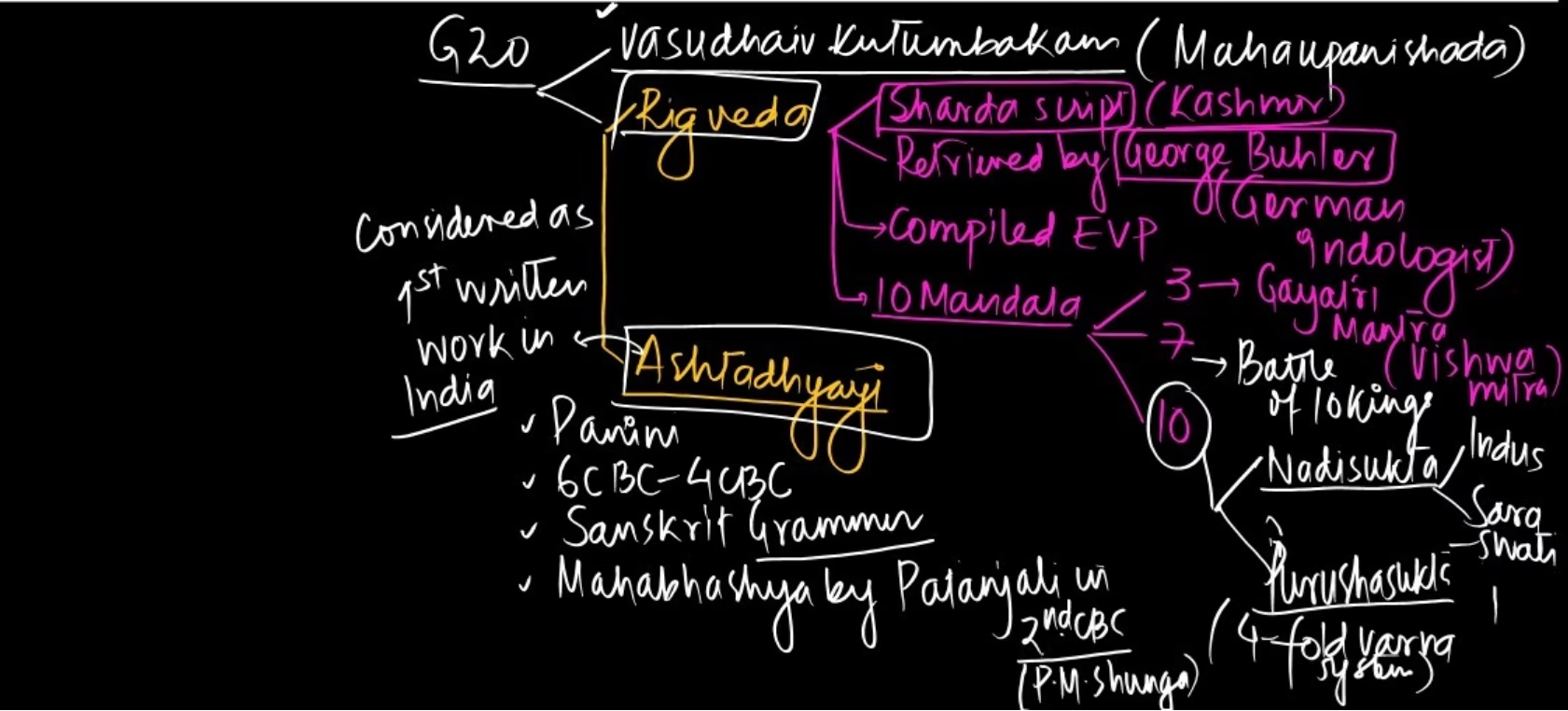
- Rigveda Manuscript (G20 Exhibit):
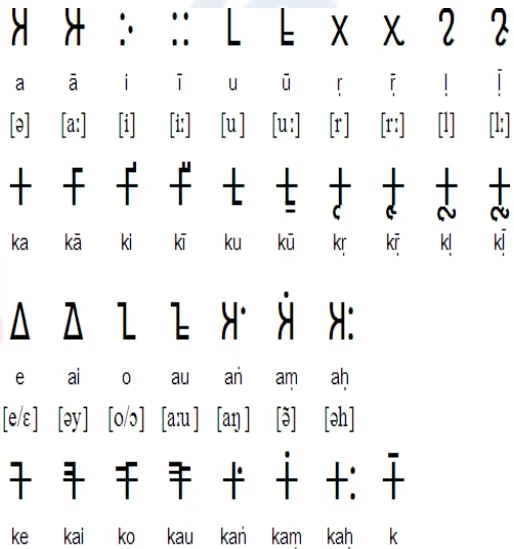
- Brahmi Script Evolution:
- Vinod Kumar Shukla, the 2024 Jnanpith Award winner, was the first Chhattisgarh writer to receive the Jnanpith; known for Kavita Se Lambi Kavita, Deewar Mein Ek Khidki Rehti Thi, and Naukar Ki Kameez.
- The Jnanpith Award, instituted in 1961 and first awarded in 1965 by the Bharatiya Jnanpith, includes a Rs 11 lakh cash prize, a citation, and a bronze replica of Vagdevi (Saraswati); it is open to authors writing in any of the 22 Eighth Schedule languages or English (added 2013).
- Since 1982, the Jnanpith Award has been given for an authors lifetime contribution; first recipient was G. Sankara Kurup (Malayalam), first woman was Ashapoorna Devi (Bengali), and first English-writing recipient was Amitav Ghosh (2018).
- The 58th Jnanpith Award (2023) was given to Sanskrit scholar Jagadguru Rambhadracharya and Urdu poet-lyricist Gulzar.
- Kannada writer Banu Mushtaq won the International Booker Prize 2025 for her short story collection Heart Lamp, portraying Muslim women's lives; it is the first Booker win for Kannada and for a short story collection.
- The International Booker Prize (translated fiction) began in 2005 and became an annual single-book award in 2015; five Indian-origin writers have won the main Booker Prize: V.S. Naipaul (1971), Salman Rushdie (1981, Midnight's Children), Arundhati Roy (1997), Kiran Desai (2006) and Aravind Adiga (2008).
- Hungarian writer David Szalay won the Booker Prize 2025 for Flesh; Hungarian author Laszlo Krasznahorkai separately won the 2025 Nobel Prize in Literature, known for works like Satantango and The Melancholy of Resistance (both filmed by Bela Tarr).
- Sahitya Akademi Award, India's second-highest literary honour presented annually since 1955 across 24 languages, comes with an engraved copper-plaque casket, shawl and Rs 1,00,000 cash prize.
- Pulitzer Prize, founded by Joseph Pulitzer (bequeathed to Columbia University on his 1911 death) and awarded since 1917, recognises achievements in journalism, letters and music; in 2024 The New York Times won 4 Pulitzers and The New Yorker won 3.
🏛️ Classical Languages — 2024 Expansion to Eleven
- In October 2024 the Union Cabinet approved Classical Language status for five more languages — Marathi, Pali, Prakrit, Assamese, and Bengali — taking the total from six to eleven.
- This followed a 2024 revision of the eligibility criteria by the Ministry of Culture's Linguistic Experts Committee, which now requires origin/high antiquity of texts spanning 1,500–2,000 years, considered ancient by a community of speakers, and a body of knowledge texts (not only literary).
- Benefits of Classical status include two major international annual awards for scholars, a Centre of Excellence for study, and a request to UGC for creating professional chairs in central universities for the language.
I'll check how existing Cornell Notes sections are structured in this project so the conversion matches the house style.Converting every detail from the source into zero-loss VitePress Cornell Notes markdown:
Cities of the Far South
Cities of the Far South — Overview & Greco-Roman Context
| Cue Words | Notes |
|---|---|
| How do Greco-Roman sources and modern scholarship frame early historical South Indian urban centres? | Sources & Framework:
|
Chera Cities — Vanji / Kuravur / Karur
| Cue Words | Notes |
|---|---|
| Analyse Vanji/Kuravur/Karur as a Chera political, craft, and trade centre with literary, numismatic, and excavation evidence. | Identity & Location:
Numismatics & Roman Contact:
Excavations:
Crafts & Inscriptions:
|
Chera Cities — Muchiri / Muziris
| Cue Words | Notes |
|---|---|
| What do the Periplus, Pliny, and the Vienna Papyrus record about Muchiri/Muziris as a Chera trade emporium? | Classical & Documentary Sources:
|
Pandya Cities — Madurai
| Cue Words | Notes |
|---|---|
| Describe Madurai as a Pandya urban centre from Maduraikkanchi, Arthashastra, craft references, and Alagarmalai inscriptions. | Literary Description (Maduraikkanchi / Pattuppattu):
Crafts & Trade:
Epigraphy:
|
Pandya Cities — Korkai
| Cue Words | Notes |
|---|---|
| Why was Korkai celebrated as a pearl-fisheries centre, and what do excavation and location evidence show? | Reputation & Sources:
Location Then vs Now:
Material Culture & Chronology:
|
Chola Cities — Uraiyur
| Cue Words | Notes |
|---|---|
| Analyse Uraiyur as early Chola capital: fortifications, textiles, megalithic burial grounds, and three excavation periods. | Political & Literary Profile:
Excavation Phases:
|
Chola Cities — Kaverippumpattinam / Pumpuhar / Puhar
| Cue Words | Notes |
|---|---|
| Detail Puhar (Kaverippumpattinam) as port capital: classical names, Pattinappalai markets, irrigation, boat platforms, Buddhist remains, and later Chola coin evidence. | Names, Span & Classical Identity:
Urban Layout & Society:
Infrastructure & Archaeology:
Later Continuity:
|
Chola Cities — Kachchi (Kanchi) & Vasavasamudram
| Cue Words | Notes |
|---|---|
| What early historical remains link Kanchi of the Sangam texts to later Pallava Kanchipuram, and how does Vasavasamudram fit as its sea port? | Kachchi (Kanchi):
Findings (Shankara Matha Area):
Findings near Kamakshi Temple:
Vasavasamudram (Port Link):
|
Chola Cities — Kodumanal
| Cue Words | Notes |
|---|---|
| Why is Kodumanal critical for early literacy and craft production in the Tamil region (3rd CBC–3rd CAD)? | Site Profile:
Industrial Evidence:
Literacy Evidence:
|
Kautilya’s Timetable for a King
Kautilya’s Timetable for a King (Arthashastra 1.19.16)
| Cue Words | Notes |
|---|---|
| How does Arthashastra 1.19.16 structure the king’s day and night, and what activities fill each unit? | Time Division:
Day Timetable (Immediately After Sunrise):
Night Timetable:
|
Raja Sawai Jai Singh II (1686–1743)
Raja Sawai Jai Singh II — Title, Politics & Jaipur City Planning
| Cue Words | Notes |
|---|---|
| How did Sawai Jai Singh II obtain the title ‘Sawai’, abolish Jaziya influence, and plan Jaipur on a grid of nine cosmic zones? | Title ‘Sawai’:
Political Role:
Jaipur Grid Planning:
|
Raja Sawai Jai Singh II — Jantar Mantar Observatories & Zij-e-Muhammad-Shahi
| Cue Words | Notes |
|---|---|
| What was Jai Singh’s astronomical programme: observatories, Zij-e-Muhammad-Shahi, and his eclectic manuscript library? | Observatories (Jantar Mantar Tradition):
Zij-e-Muhammad-Shahi:
Grand Passion — Scholarship & Instruments:
|
Rana Kumbha (1433–1468 CE)
Rana Kumbha — Forts, Wars & Vijay Stambha
| Cue Words | Notes |
|---|---|
| List Rana Kumbha’s five forts, his foes, and the context and dimensions of the Vijay Stambha at Chittorgarh. | Five Forts:
Military Context:
Vijay Stambha (Victory Tower):
|
Rana Kumbha — Music, Literature & Kirti Stambh Prashashti
| Cue Words | Notes |
|---|---|
| What music treatises and literary works are associated with Rana Kumbha’s reign? | Personal Scholarship:
Music Treatises:
Court Scholars:
|
Rani ki Vav
Rani ki Vav (Also on ₹100 Note)
| Cue Words | Notes |
|---|---|
| Who built Rani ki Vav, for whom, in what style, and what is its architectural character? | Patronage & Setting:
Style & Structure:
|
Rakhigarhi
Rakhigarhi — Harappan Township & Excavation Findings
| Cue Words | Notes |
|---|---|
| What is Rakhigarhi’s rank among Harappan townships, who excavated it, and what materials and structures were found? | Status:
Excavator:
Material and Findings:
|
Different Versions of the Ramayana
International & Regional Versions of the Ramayana
| Cue Words | Notes |
|---|---|
| Map major Indian and international Ramayana versions with country and distinctive points. | Indian / Regional Versions:
Southeast / East Asian Versions:
|
Vijaya Temple / Bijamandal Mosque (Vidisha)
Vijaya Temple / Bijamandal Mosque — Builders, Dedication & Later History
| Cue Words | Notes |
|---|---|
| Clarify the contested builders, dedication, Al-Biruni/Aurangzeb layers, and famous sculptures of the Vijaya Temple (Bijamandal) at Vidisha. | Modern Association:
Builders (No Clarity):
Dedication & Local Tradition:
Destruction & Rebuilding:
Aurangzeb Phase:
Famous Sculpture:
Pavilion, Surya Temple & Stepwell:
|