Skip to content

Climatology: Atmosphere, Winds & Heat Budget

Atmospheric Structure & Heat Dynamics


Atmospheric Composition & Layered Structure

Atmospheric Composition & Layered Structure
Detail the gaseous composition and variables of Earth's atmosphere.Composition of the Atmosphere:
  • Stable/Permanent Gases:
    • Nitrogen: 78% (inert; regulates burning).
    • Oxygen: 21% (supports life and combustion).
    • Argon: 0.93% (noble gas).
    • Carbon Dioxide ($CO_2$): 0.03% (crucial greenhouse gas that acts as the thermal regulator of the planet).
  • Variable Components: Water vapour (0% in dry deserts up to 4% in humid tropics; acts as a greenhouse gas and fuel for clouds/precipitation) and dust/aerosols (scatter solar radiation; act as hygroscopic condensation nuclei).
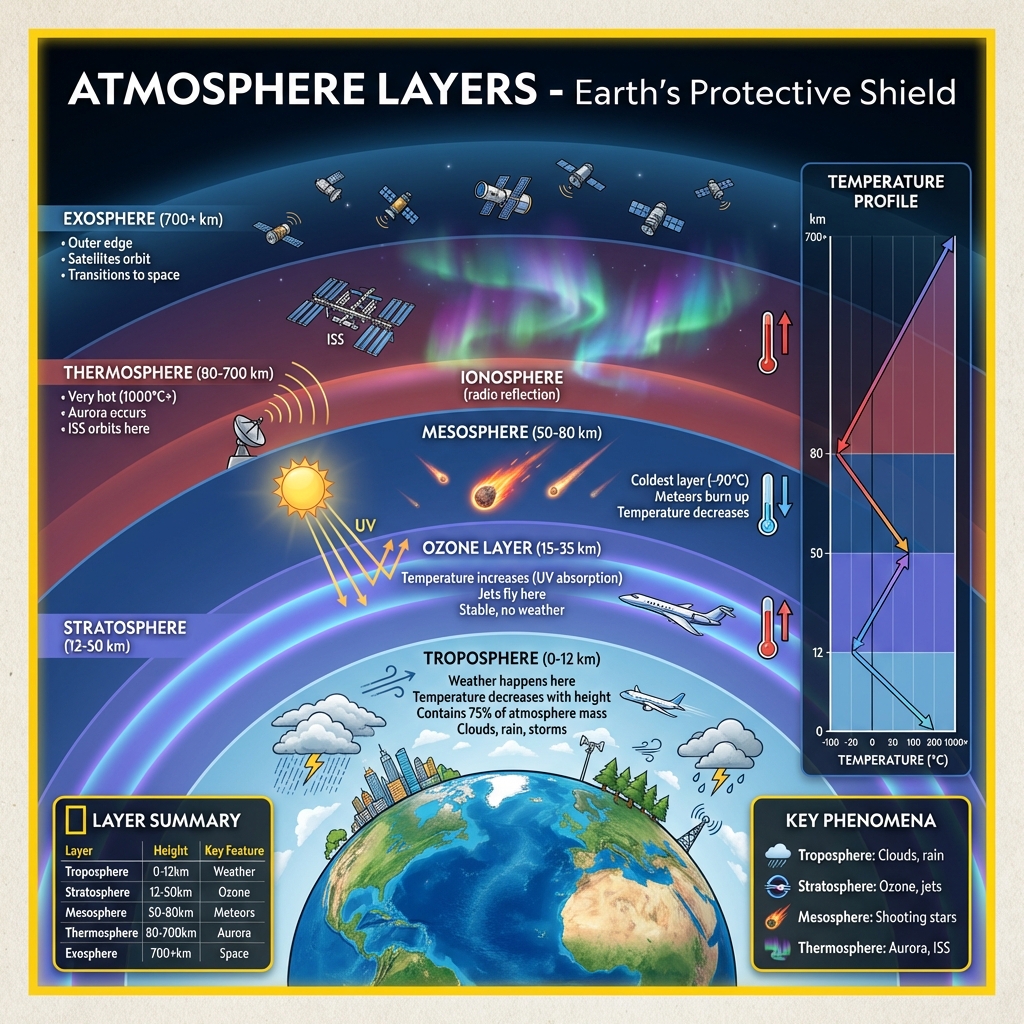
Map the vertical thermal layers of the atmosphere from Earth's surface outwards.Vertical Stratification:
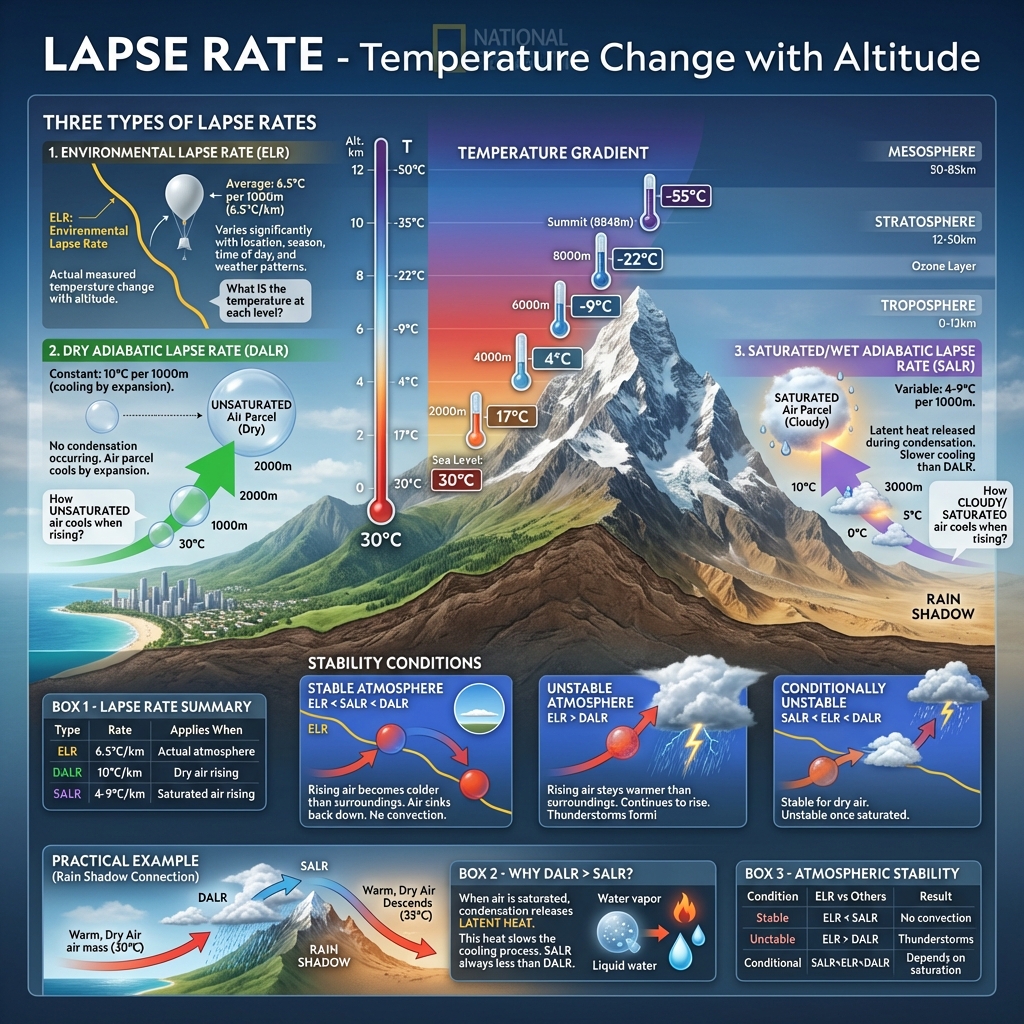
  • Troposphere (0–18 km): Bounded by the Tropopause. Houses all meteorological events. Temperatures decrease with height at the Normal Lapse Rate of $6.5^{\circ}C\text{ per km}$. Contains 90% of atmospheric mass.
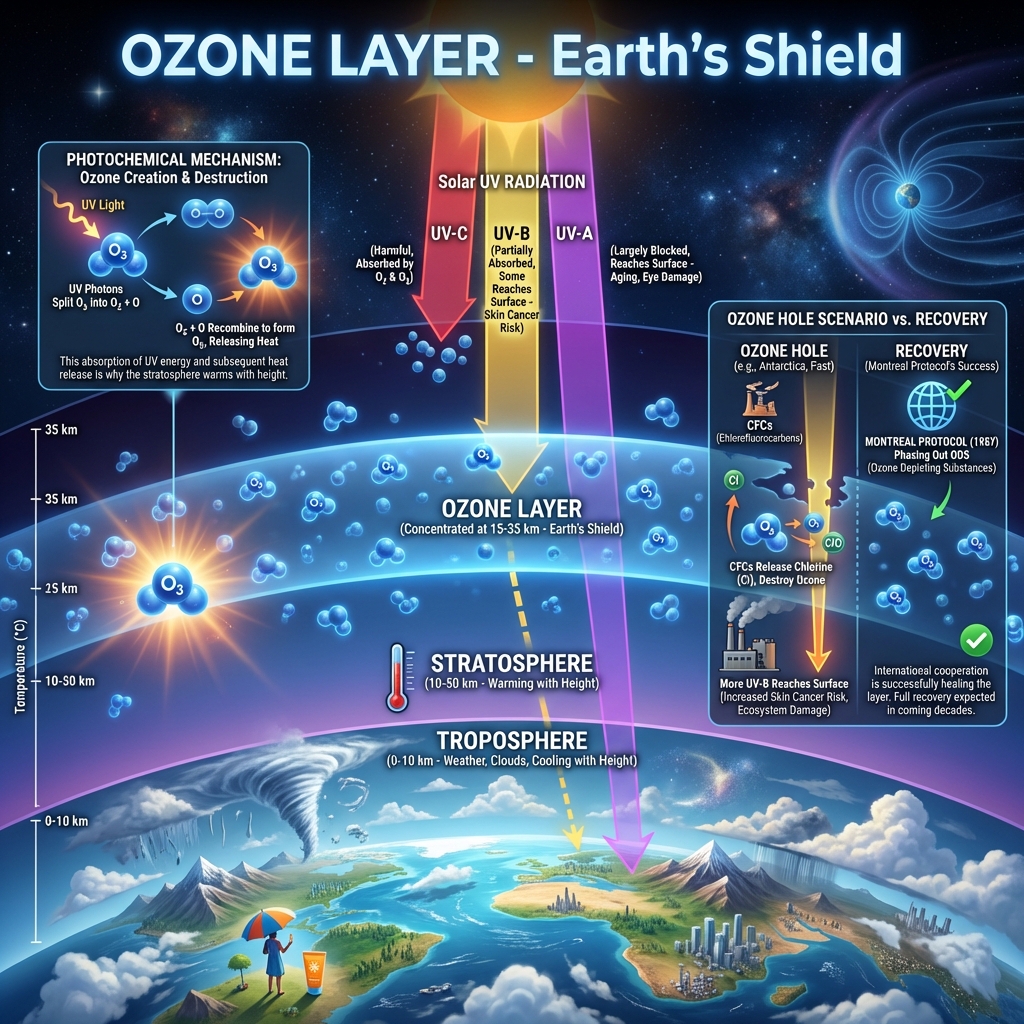
  • Stratosphere (18–50 km): Contains the Ozone Layer (peaking at 20-30 km), which absorbs harmful solar UV-B and UV-C radiation. Temperatures rise with height due to UV absorption. Highly stable air; ideal for flying commercial jets.
  • Mesosphere (50–80 km): Temperatures drop to their lowest in the atmosphere (reaching $-100^{\circ}C$). Meteors disintegrate and burn up here due to frictional resistance.
  • Ionosphere (80–400 km): Layer containing electrically charged ions. Reflects radio waves back to Earth for communications. Features the auroras (Aurora Borealis in the North Pole, Aurora Australis in the South Pole).
  • Exosphere (400+ km): Extremely rarefied outermost layer that gradually merges into outer space.

Radiation Budget, Albedo & Ozone Layer

Radiation Budget, Albedo & Ozone Layer
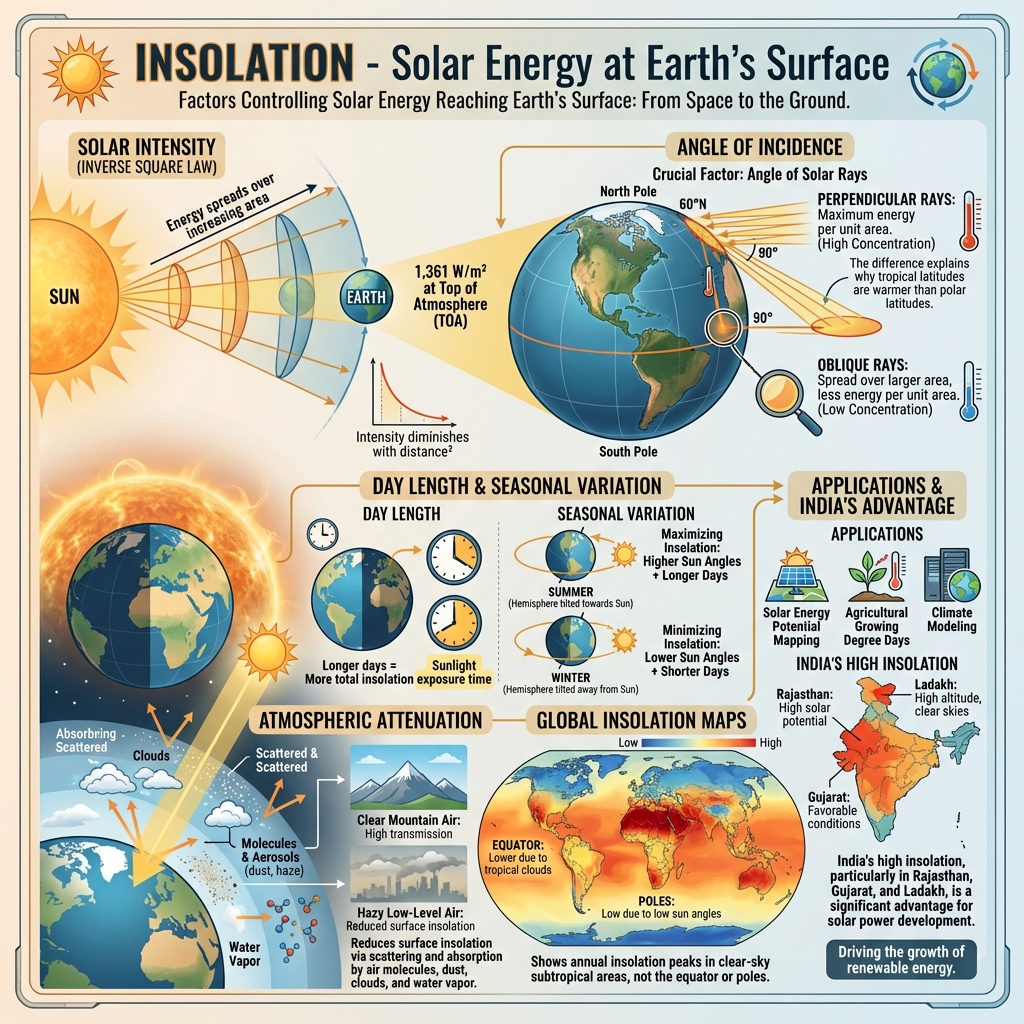
Explain the difference between Insolation and Terrestrial Radiation.Thermal Radiation Balance:
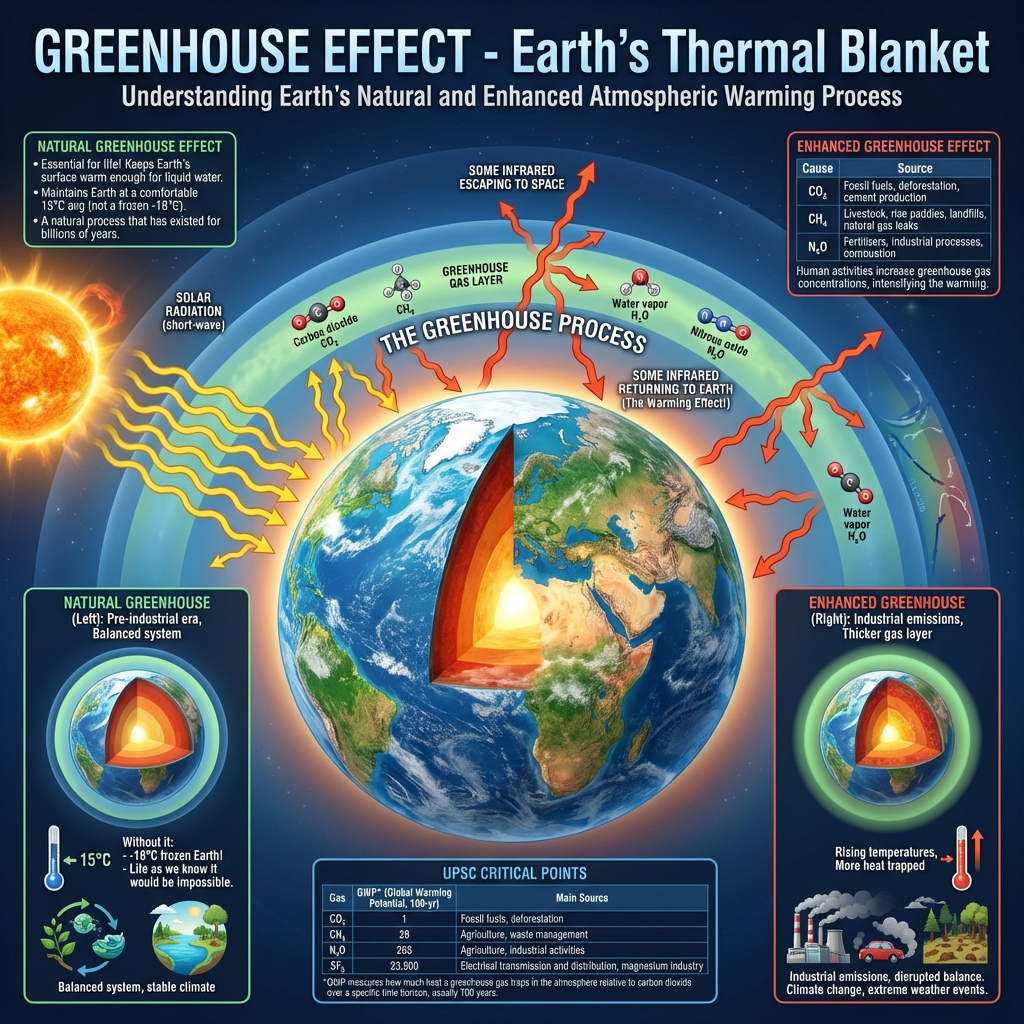
  • Insolation: Incoming solar radiation reaching Earth, consisting of short-wave electromagnetic waves.
  • Terrestrial Radiation: Outgoing radiation emitted by Earth's heated surface, radiating back as long-wave infrared energy (readily absorbed by greenhouse gases like $CO_2$ and water vapour).
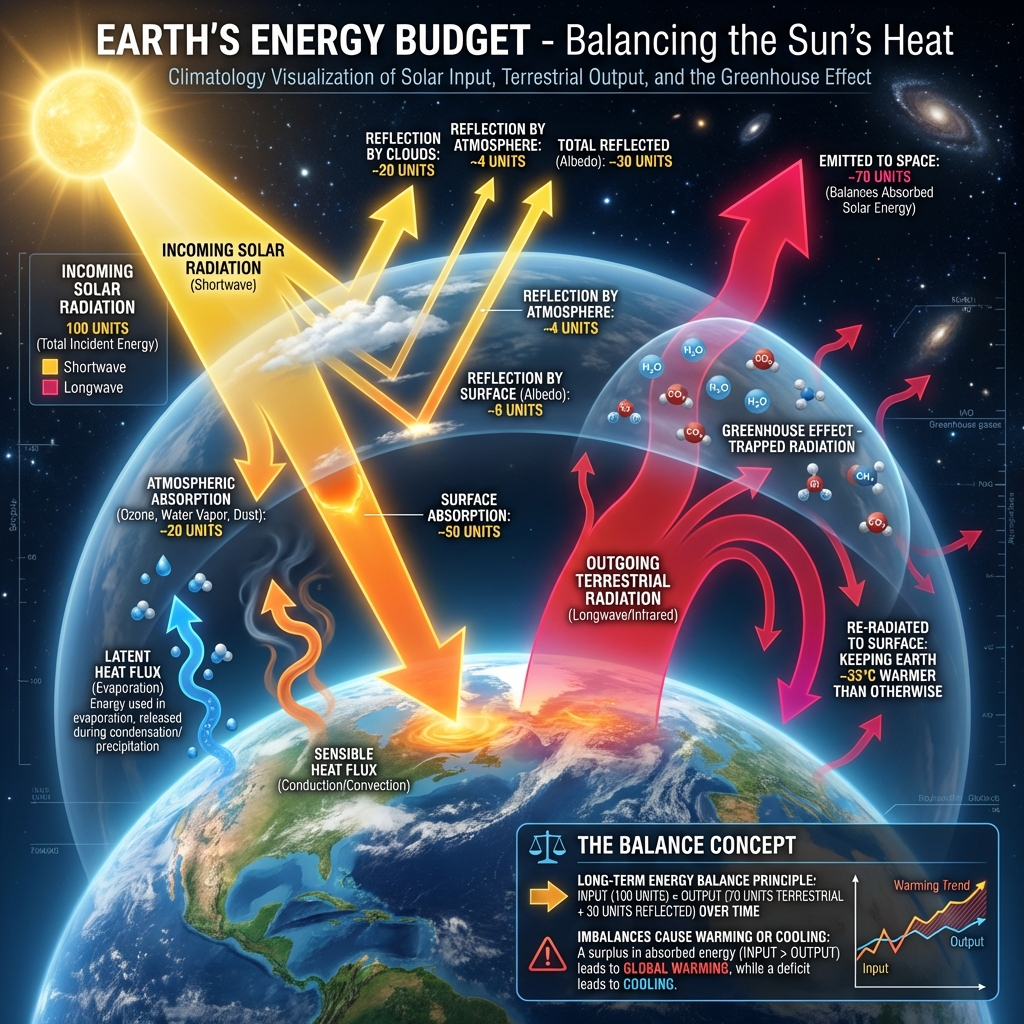
Define Albedo and explain the Earth's global heat budget equilibrium.Global Albedo & Heat Budget:
  • Albedo: The reflectivity of a surface, measured as the fraction of solar energy reflected directly back to space without absorption. Bounded examples:
    • Fresh Snow: 80% to 90% (highest).
    • Global Average: ~30% to 35% reflected directly.
    • Forests: 12% to 18% (highly absorbing).
  • Heat Budget: The thermodynamic equilibrium maintained on Earth where incoming solar energy is exactly balanced by outgoing terrestrial radiation, keeping global temperatures stable.
Identify the causes and policy response to Ozone Layer Depletion.Ozone Layer Dynamics (O₃):
  • Role: Filters out carcinogenic ultraviolet radiation.
  • Depletion Factors: Catalyzed by Chlorine and Bromine radicals derived from Chlorofluorocarbons (CFCs), Halons, and Nitrous Oxide ($N_2O$).
  • Policy Response: The Montreal Protocol (1987), which mandated the phase-out of ozone-depleting substances (ODS) and remains the most successful global environmental treaty.

Global Circulation & Weather Systems


Planetary Wind Systems & Pressure Belts

Planetary Wind Systems & Pressure Belts
Map the major global pressure belts and wind cells.Planetary Circulation:
  • Pressure Belts:
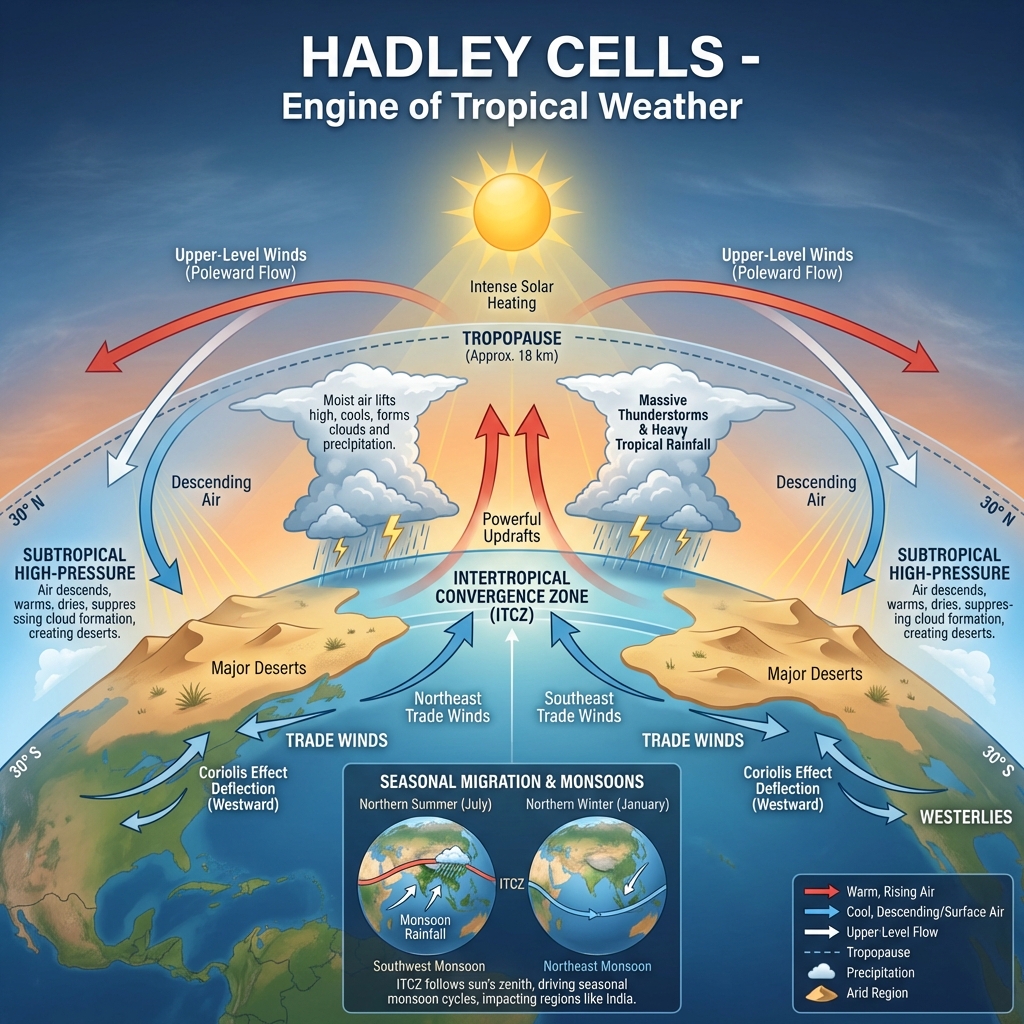
    • Equatorial Low (Doldrums): 0° to 10° N/S. Rising warm air; calm winds; forms the Inter-Tropical Convergence Zone (ITCZ).
    • Sub-tropical Highs (Horse Latitudes): 30° to 35° N/S. Subsided dry air, characterized by calm conditions and deserts.
    • Sub-polar Lows: 60° to 65° N/S. Convergence zone for warm temperate and cold polar air masses.
    • Polar Highs: Intense thermal sinking of cold air at the poles.
  • Atmospheric Cells: Hadley Cell (Equatorial to Sub-tropical), Ferrel Cell (Sub-tropical to Sub-polar), and Polar Cell (Sub-polar to Polar).
  • Planetary Winds:
    • Trade Winds: Blow from sub-tropical highs to the equatorial low; highly consistent.
    • Westerlies: Blow from sub-tropical highs to sub-polar lows. Strongest in the southern hemisphere due to minimal land obstruction (known as the Roaring Forties, Furious Fifties, and Shrieking Sixties).
Contrast the major regional warm and cold local winds.Local Winds Database:
  • Warm Winds:
    • Loo: Hot, dry wind blowing across Northern India during summers.
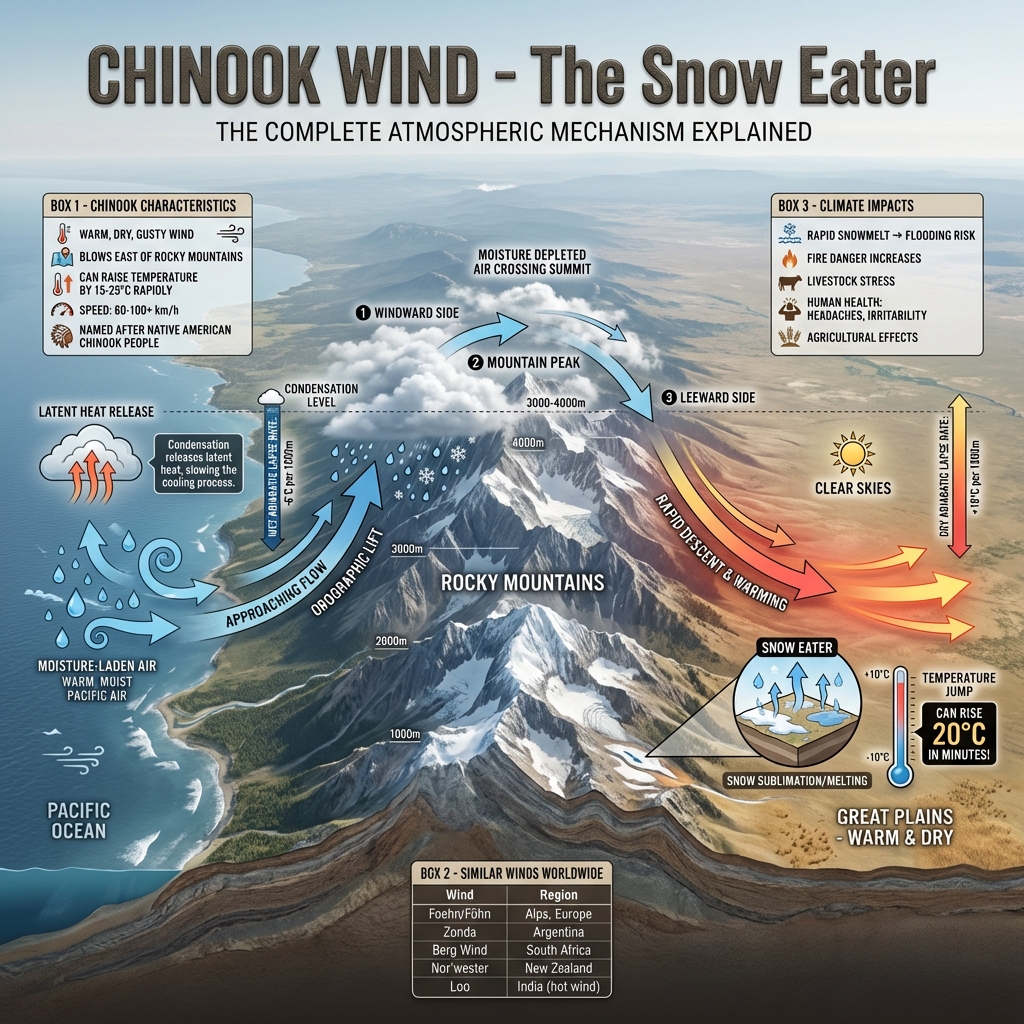
    • Chinook: Dry katabatic wind in the Rocky Mountains ("Snow-eater" that raises winter temperatures).
    • Harmattan: Dry, dusty trade wind blowing over West Africa ("The Doctor" due to its drying, healthy relief).
  • Cold Winds:
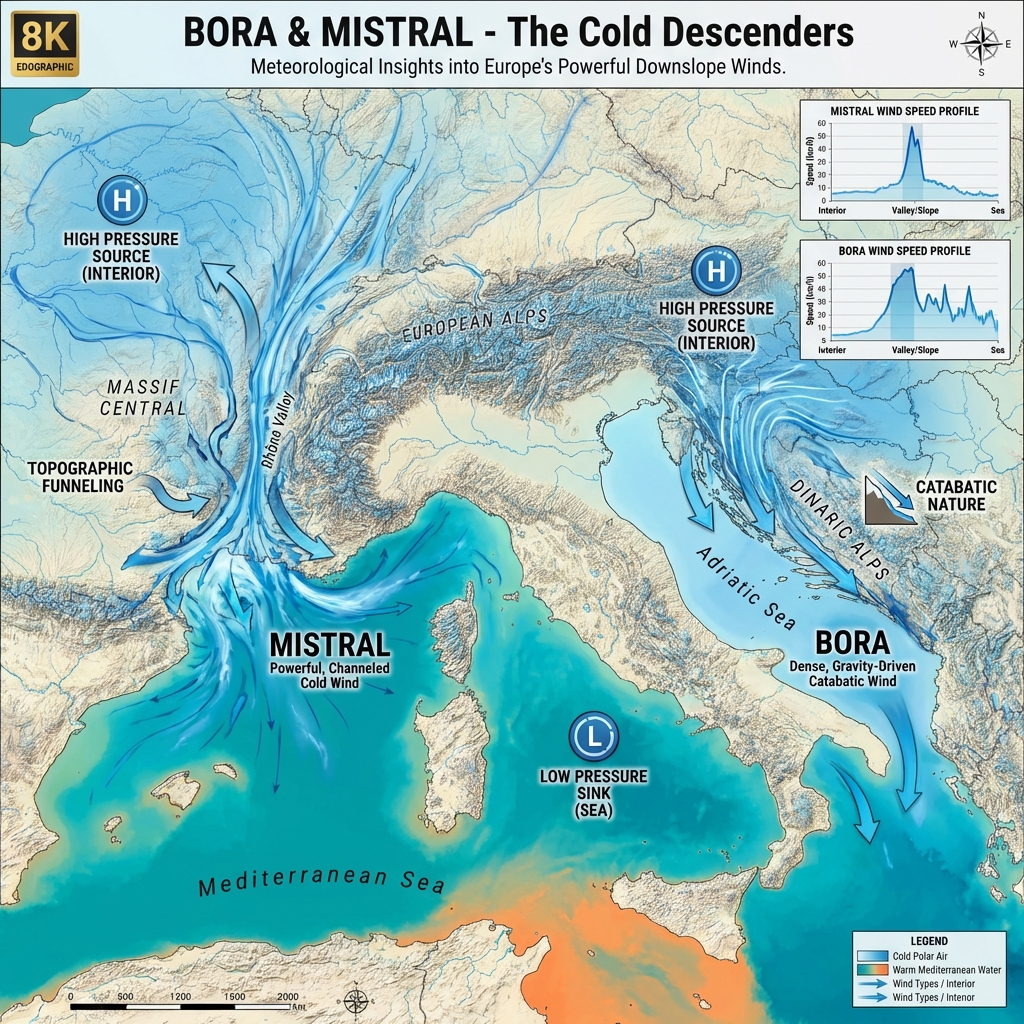
    • Mistral: Cold, dry wind blowing from the Alps down to the Mediterranean (France).
    • Bora: Sinking cold wind affecting the Adriatic coast.

Cyclones & Jet Streams

Cyclones & Jet Streams
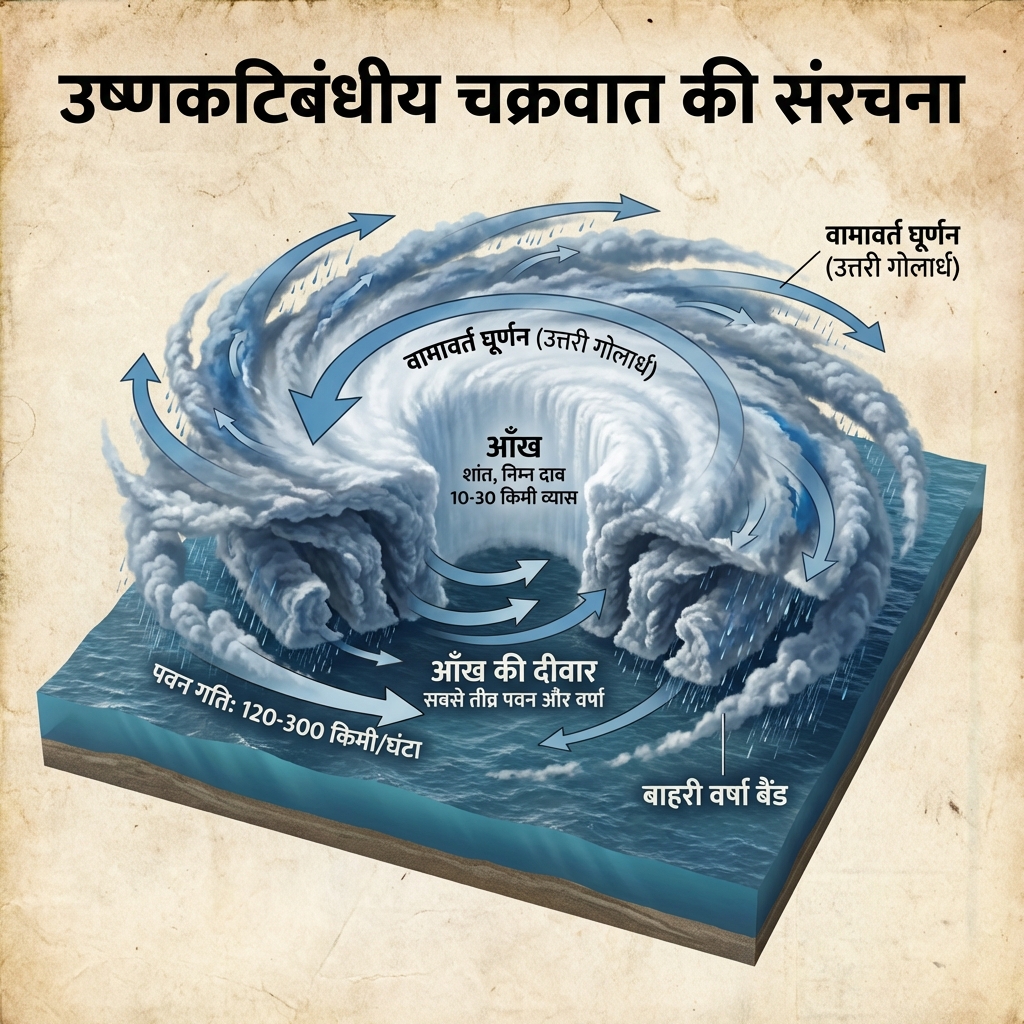
Compare and contrast Tropical and Temperate (Extra-tropical) Cyclones.Cyclonic Systems:
  • Tropical Cyclones:
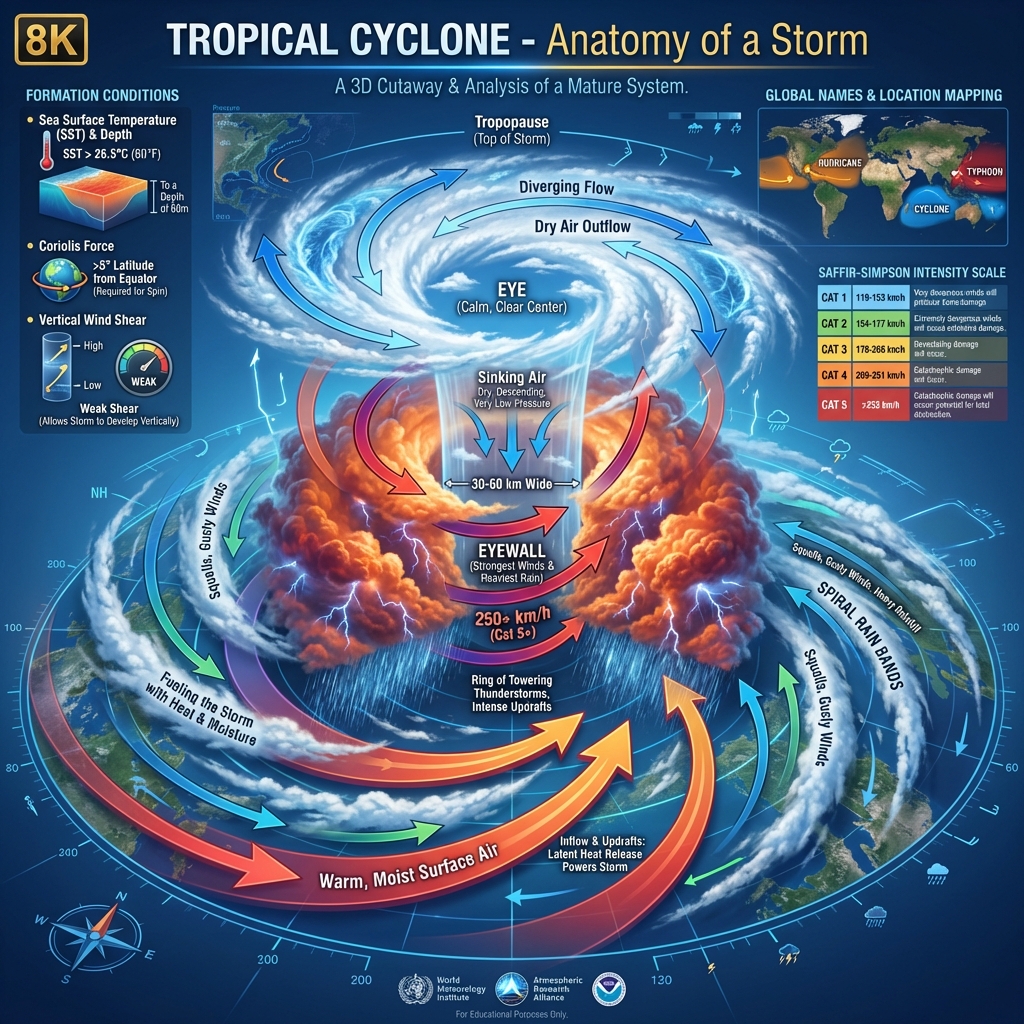
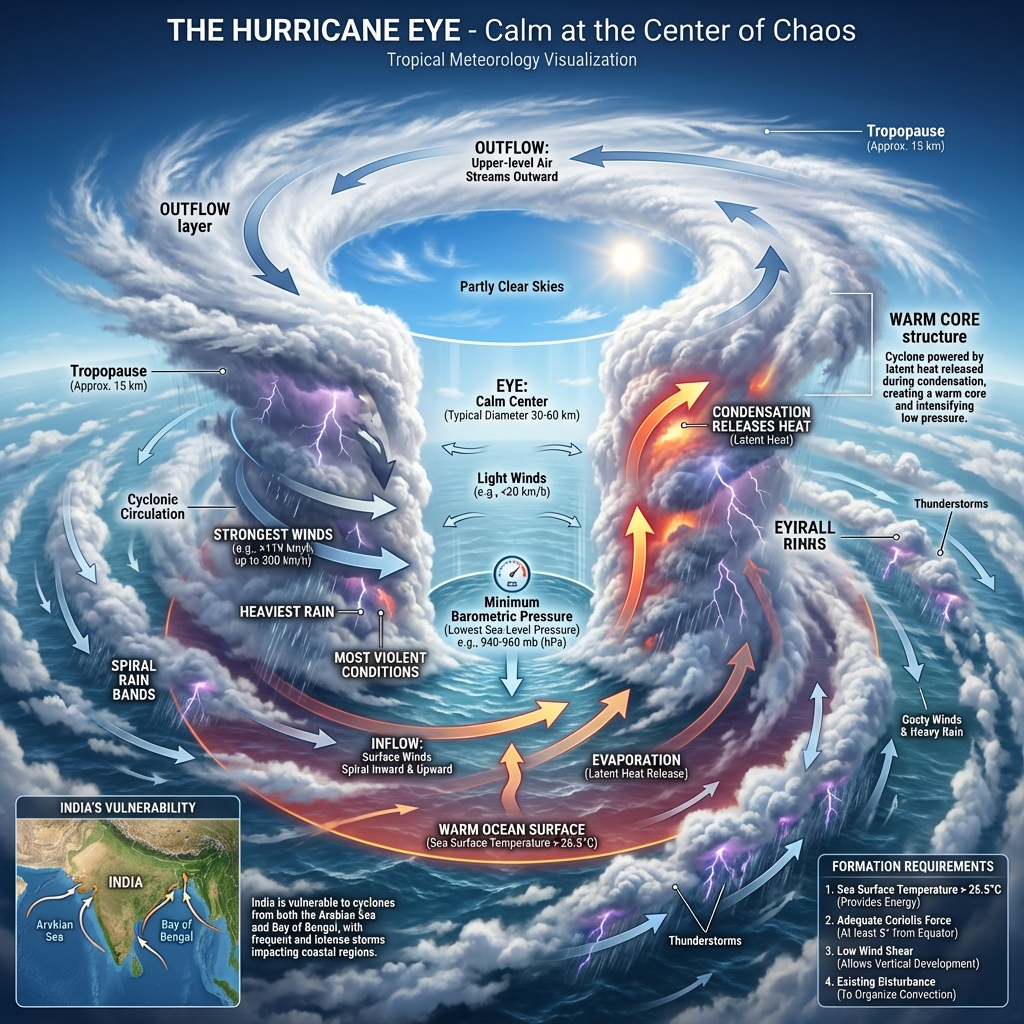
    • Conditions: Warm sea temperatures ($>27^{\circ}C$), presence of the **Coriolis Force** (cannot form at the equator, 0° to 5°), and high moisture supply.
    • Structure: Driven by latent heat of condensation. Features a calm, cloudless central **Eye** surrounded by a violent **Eye Wall** (highest winds/rainfall).
  • Temperate (Frontal) Cyclones:
    • Conditions: Formed along polar fronts where contrasting cold polar and warm subtropical air masses meet.
    • Structure: Do not have a clear eye. Cover a much wider area and have gradual weather changes compared to tropical cyclones.
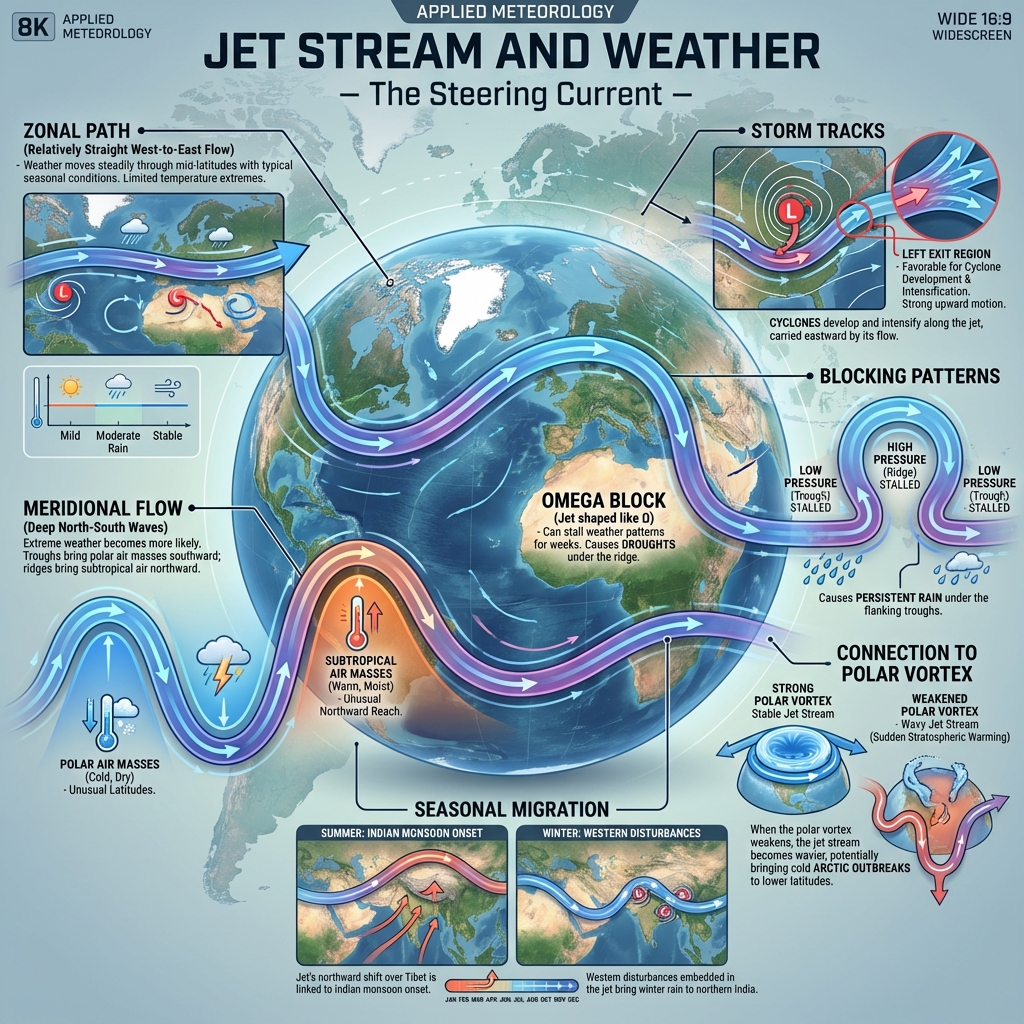
Define Jet Streams and explain their influence on the Indian Monsoon.Jet Streams:
  • Definition: Narrow, meandering bands of high-speed westerly winds flowing in the upper troposphere (9-12 km altitude).
  • Indian Monsoon Nexus: The onset of the South-West Monsoon is linked to the northward displacement of the Subtropical Westerly Jet Stream from the south of the Himalayas to the Tibetan Plateau, allowing the tropical easterly jet stream to establish over Southern India.

High-Yield UPSC Revision Pointers

  • Normal Lapse Rate: Average temperature decrease of $1^{\circ}C$ for every 165 meters of altitude gained in the troposphere.
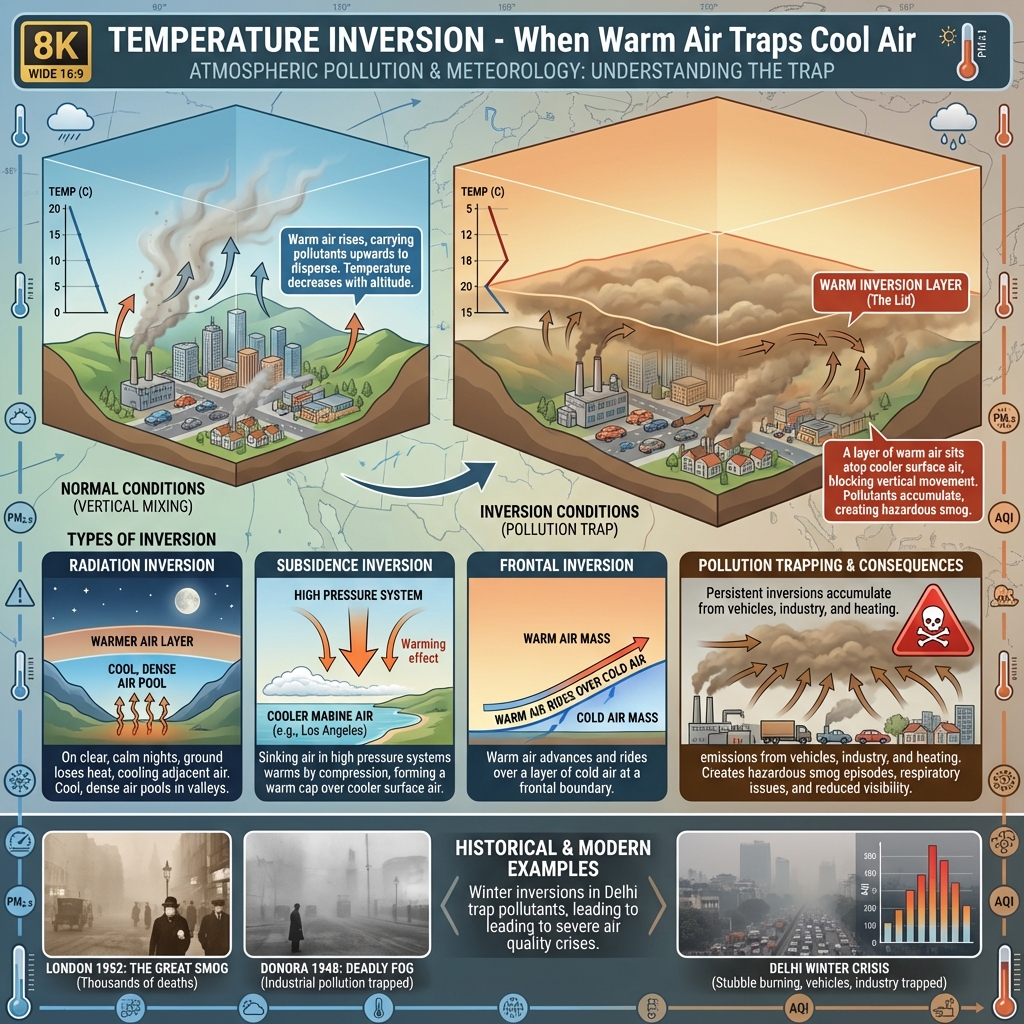
  • Temperature Inversion: An anomaly where temperature increases with altitude. It traps cold air, pollutants, and smog close to the ground, especially in valley basins during winters.
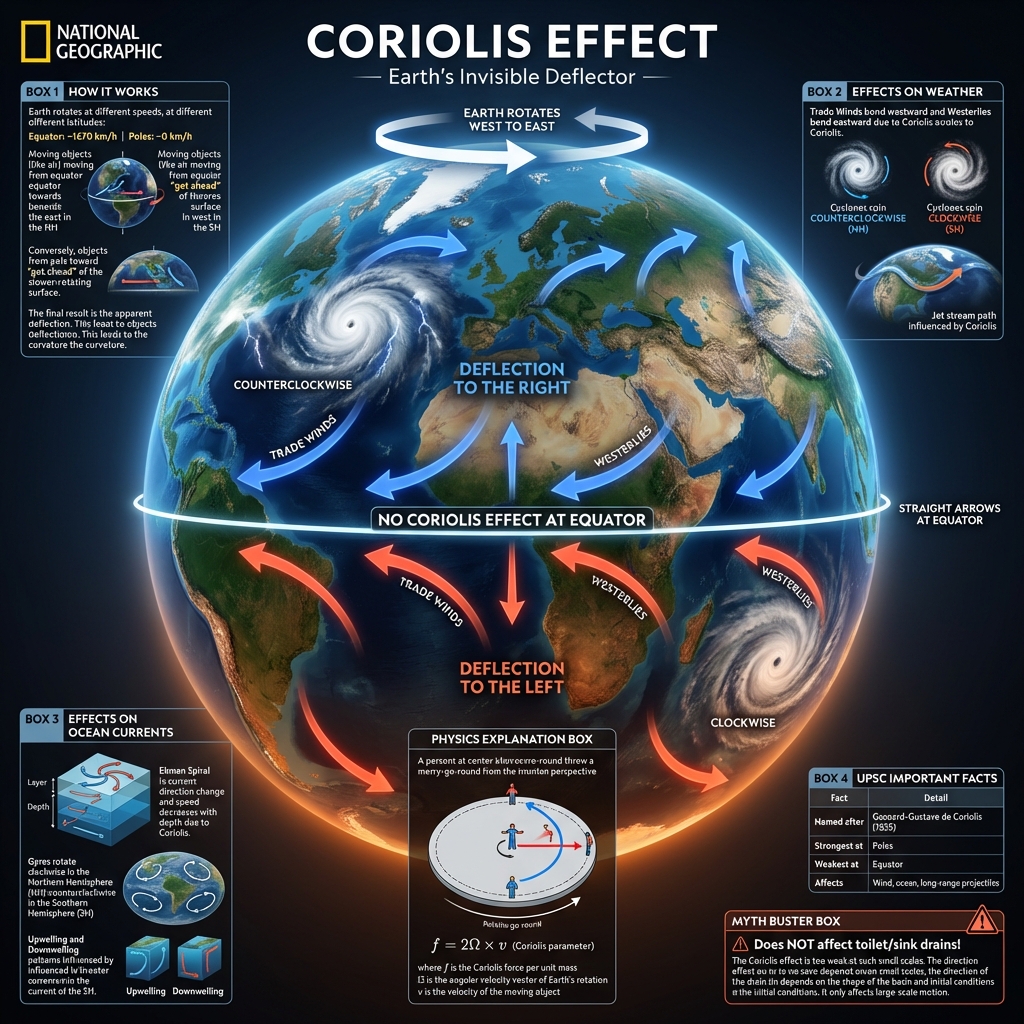
  • Coriolis Effect: Apparent deflective force due to Earth's rotation. Deflects moving objects to the right in the Northern Hemisphere and to the left in the Southern Hemisphere. It is zero at the equator and peaks at the poles.
  • Dobson Unit (DU): Standard unit of measurement for column ozone in the atmosphere (1 DU corresponds to a layer of pure ozone 0.01 mm thick at standard temperature and pressure).

Visual & Illustrative Assets


🖼️ Supplemental Asset Directory
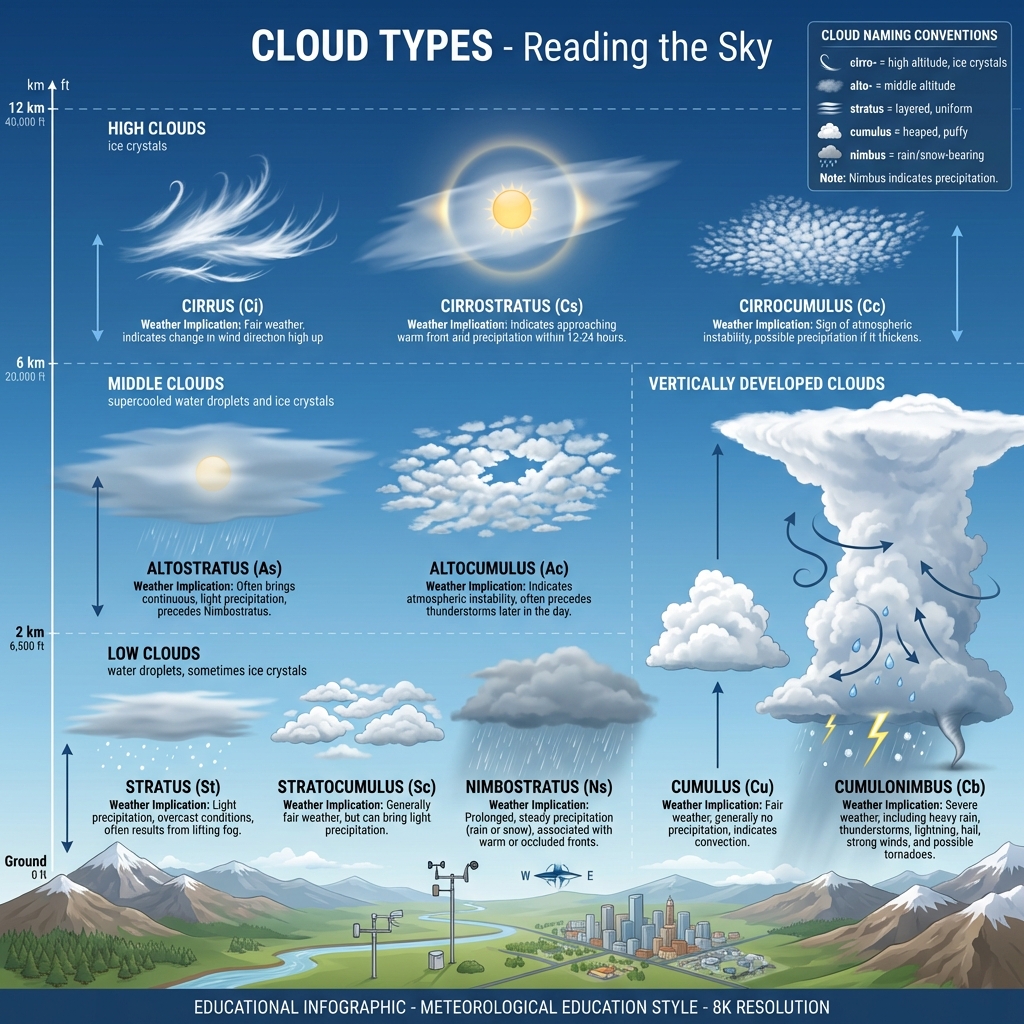
  • Cloud Classification and Types: Cloud Classification and Types
  • Atmospheric Layers Structure: Atmospheric Layers Structure
  • The Greenhouse Effect Explained: The Greenhouse Effect Explained
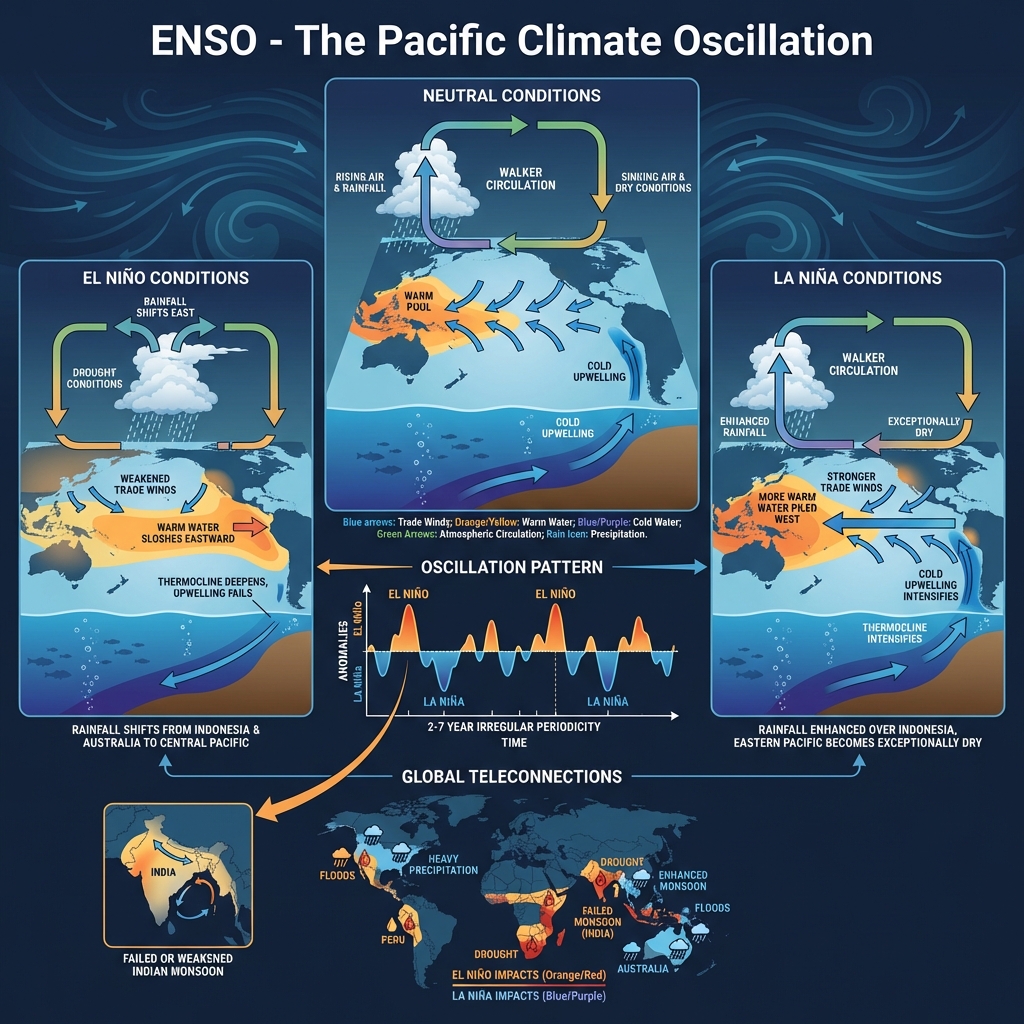
  • EL Niño and La Niña (The ENSO Cycle): EL Niño and La Niña: The ENSO Cycle
  • Insolation and Solar Radiation Budget: Insolation and Solar Radiation Budget
  • Variations in Insolation and Angle of Incidence: Variations in Insolation and Angle of Incidence
  • Earth's Global Heat Budget: Earth's Global Heat Budget: A Detailed Breakdown
  • Ozone Layer and UV Protection: Ozone Layer and UV Protection
  • Global Pressure Belts and Wind Systems: Global Pressure Belts and Wind Systems
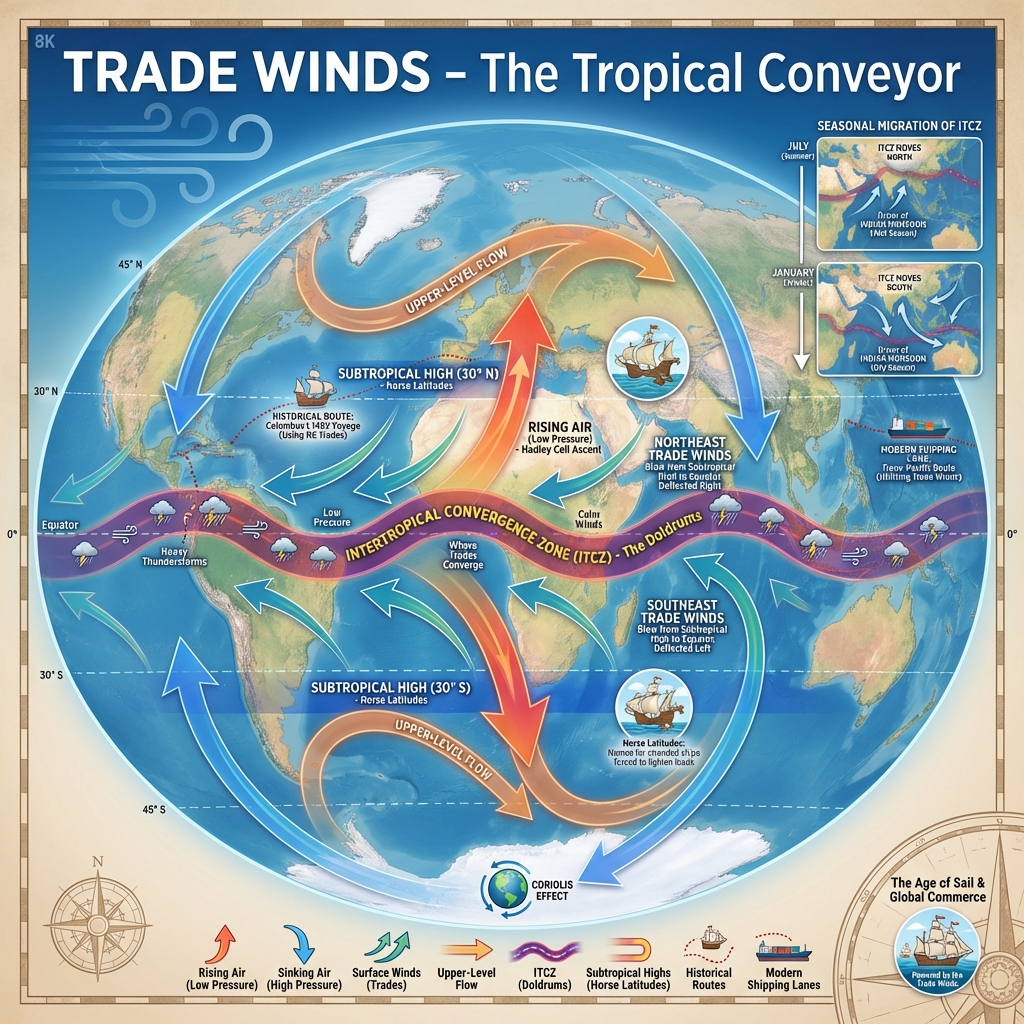
  • Hadley Cell Circulation: Hadley Cell Circulation
  • Chinook Wind Mechanism: Chinook Wind Mechanism
  • Mistral and Bora Winds: Mistral and Bora Winds
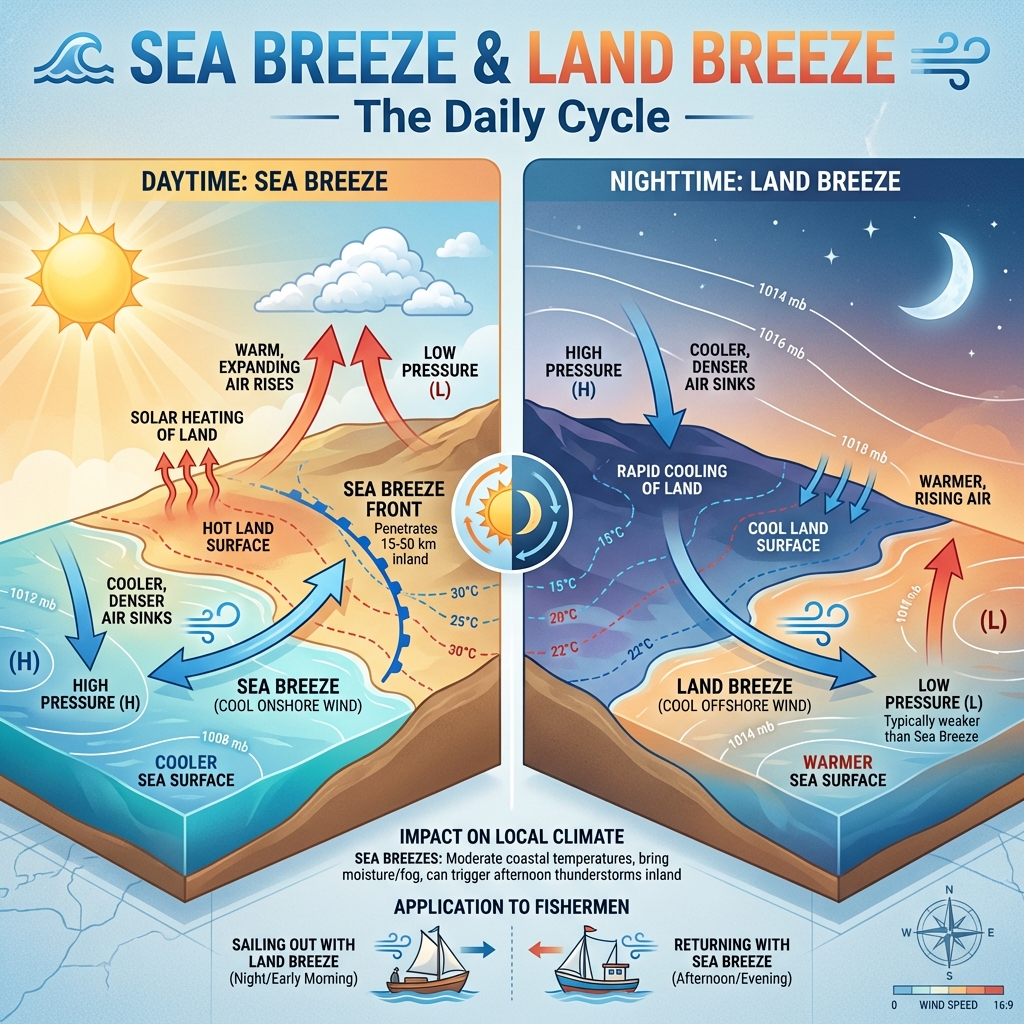
  • Sea Breeze and Land Breeze Cycle: Sea Breeze and Land Breeze Cycle
  • World Map of Major Local Winds: World Map of Major Local Winds: Warm and Cold
  • Tropical Cyclone Structure: Tropical Cyclone Structure
  • Hurricane Eye Structure: Hurricane Eye Structure
  • Tropical Cyclone Anatomy: Tropical Cyclone Anatomy and Eye Wall Dynamics
  • Jet Stream Dynamics: Jet Stream Dynamics
  • Normal Lapse Rate and Atmospheric Stability: Normal Lapse Rate and Atmospheric Stability
  • Temperature Inversion and Smog Trapping: Temperature Inversion and Smog Trapping
  • The Coriolis Effect (Global Deflection): The Coriolis Effect: Global Deflection
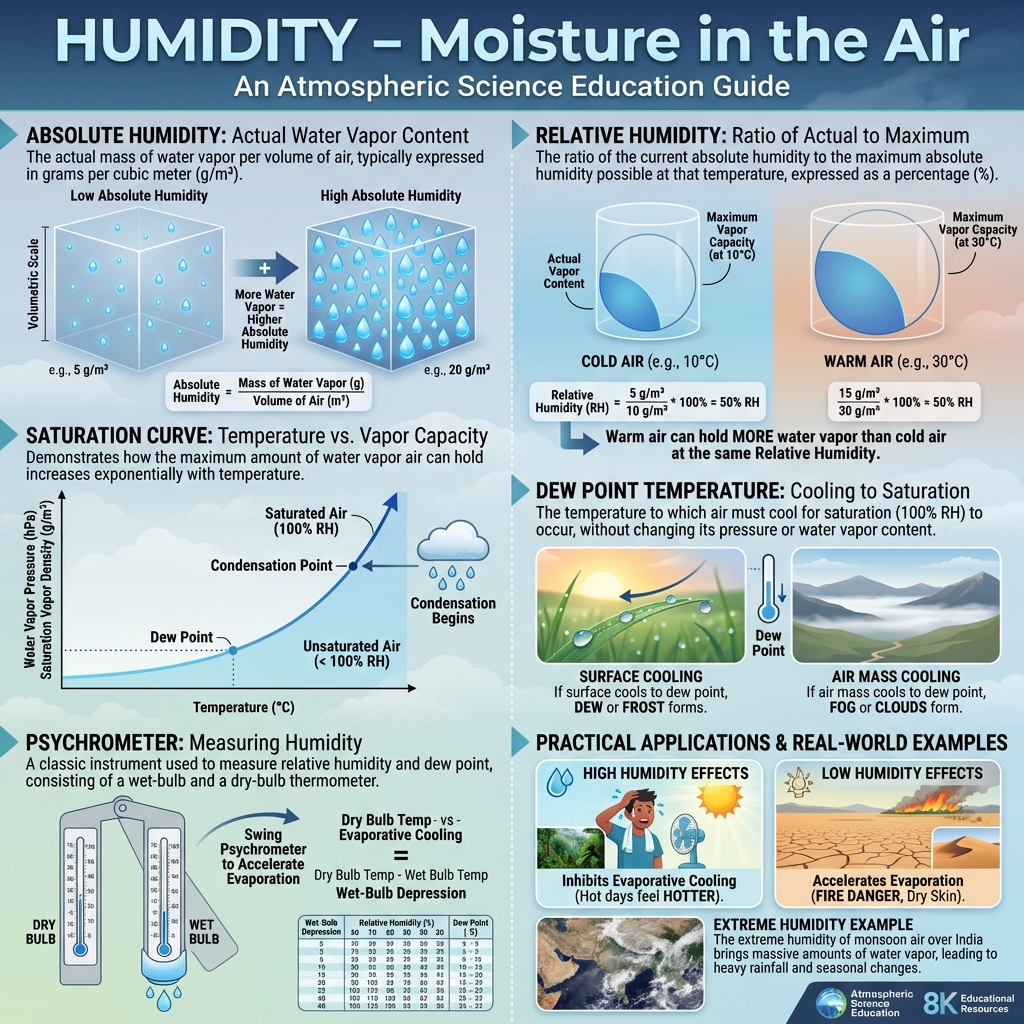
  • Humidity, Dew Point and Cloud Formation: Humidity, Dew Point and Cloud Formation
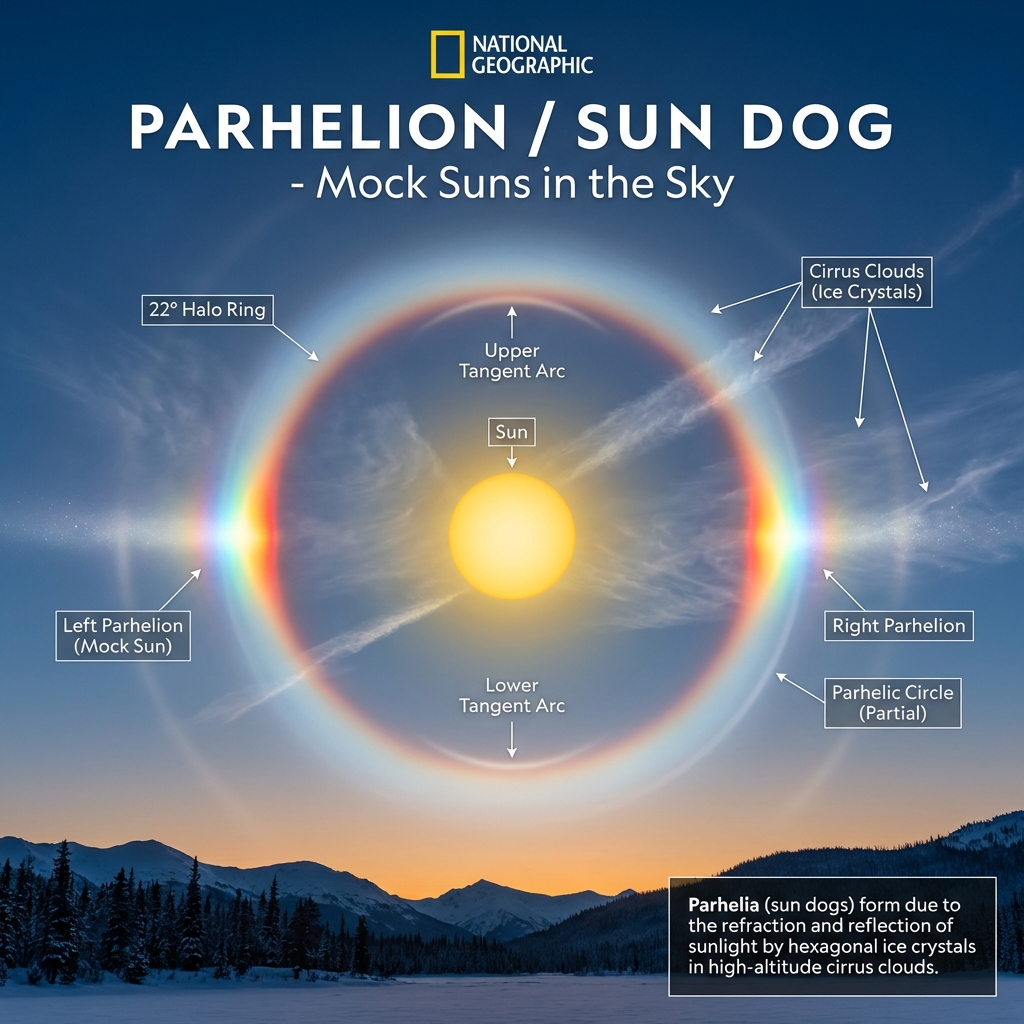
  • Parhelion (Sundog) Optical Phenomenon: Parhelion (Sundog) Optical Phenomenon
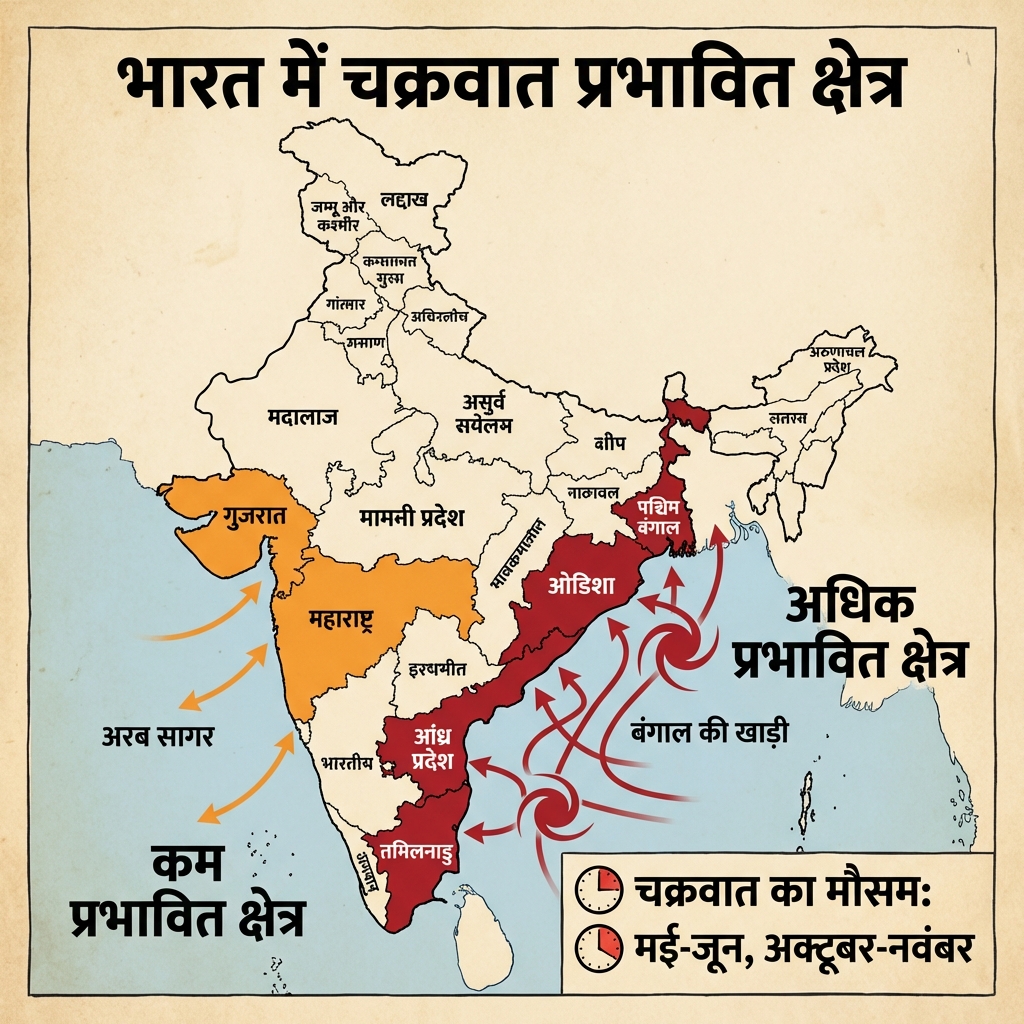
  • Cyclone (Chakravat) Structure: Cyclone (Chakravat) - Alternative Diagram
  • Cyclone Hazard Zones (Chakravat Kshetra): Cyclone Hazard Zones (Chakravat Kshetra)
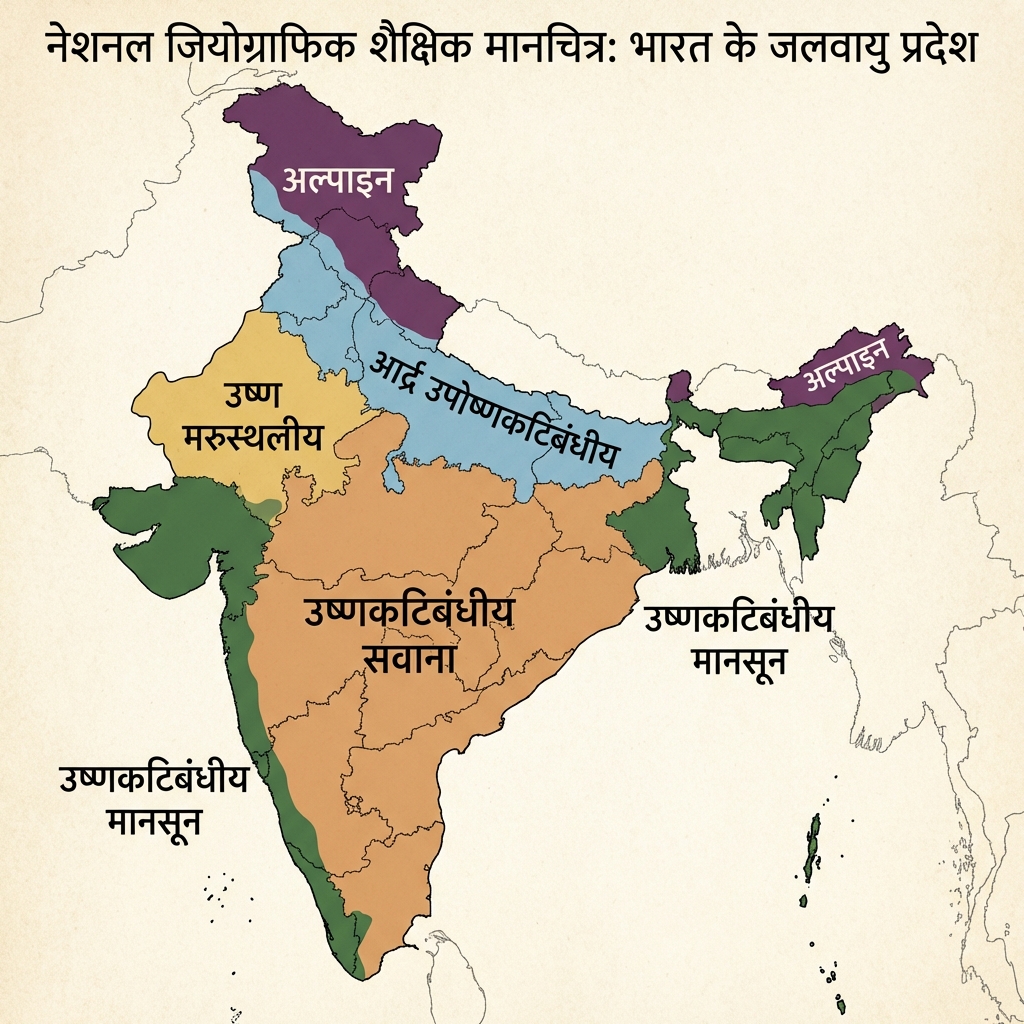
  • Climatic Regions (Jalvayu Pradesh) - Global: Climatic Regions (Jalvayu Pradesh) - Global
Mains Practice Questions


  • "Explain the mechanism of the Heat Budget and its role in maintaining Earth's thermal stability."
  • "Discuss the impact of Temperature Inversion on air quality in urban centers."
  • "Analyze the relationship between Jet Streams and the onset of the Indian Monsoon."